Follow Us on Google
By Damiete Braide
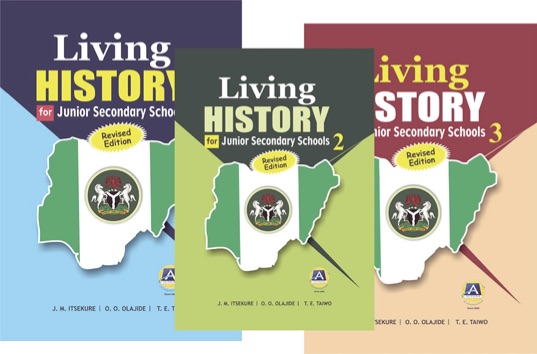
Accessible Publishers Limited and the authors of the Living History for Junior Secondary Schools (JSS 1–3) series have strongly refuted claims circulating in a viral social media video that Igbo history was excluded from the textbooks, describing the allegation as false, misleading and malicious.
The controversy arose after a Facebook video post by social media user, Vivian Ifeoma, alleged that the Igbo nation was omitted from the widely used history books designed for junior secondary school learners in Nigeria. The video quickly gained traction online, drawing reactions from educators, parents and members of the public who expressed concern about cultural representation in educational materials.
However, both the publisher and the authors have dismissed the claim as unfounded, insisting that Igbo history features prominently in the series in accordance with national curriculum standards approved by the Nigerian Educational Research and Development Council (NERDC).
In an official statement issued shortly after the videos began circulating, Accessible Publishers Limited clarified that the allegation was based on either a failure to read the books or deliberate misrepresentation of their contents.
“Our attention has been drawn to a social media video referencing a section of Living History for Junior Secondary Schools (JSS 1),” the statement read. “After an internal review by our seasoned authors and professionals, we observe that page 27 of the book is dedicated to Igbo-Ukwu: Culture and Artefacts, where the history, artistry and cultural contributions of the Igbo people are explored as part of Nigeria’s shared heritage. This section reflects our long-standing commitment to cultural representation within curriculum-approved educational content.”
The publisher further emphasised that all its textbooks are produced strictly in line with national educational standards and undergo rigorous academic review before publication.
“Our firm, Accessible Publishers Limited, wishes to clarify that all its textbooks are developed in strict compliance with the curriculum guidelines issued by the Nigerian Educational Research and Development Council (NERDC), and are authored and reviewed by seasoned subject-matter experts,” the statement continued.
“We therefore invite educators, parents and the wider community to read the book, explore the content and form their views based on the complete material. Accessible Publishers Limited remains committed to producing educational resources that inform, inspire and respect Nigeria’s rich diversity.”
A detailed examination of the three-part Living History series supports the publisher’s position. In Book One, Chapter Two titled “Land and People of Nigeria,” the authors provide an overview of the country’s ethnic composition and geographic distribution. On page 15, Nigeria is described as home to over 550 language groups that historically formed kingdoms and political entities, including the Yoruba, Edo, Igbo, Hausa, Ibibio, Efik, Fulani, Kanuri, Tiv, Angas, Ijaw, Isoko and Urhobo peoples.
The following page highlights the demographic significance of the three largest ethnic groups, noting that the Hausa/Fulani, Yoruba and Igbo together account for over 60 per cent of Nigeria’s population, with the Igbo alone estimated at about 18 per cent.
The same book also contains a dedicated section on Igbo civilisation. Chapter Three, titled “Pre-History: Early Centres of Civilisation,” devotes pages 27 to 30 to Igbo-Ukwu culture and artefacts, including archaeological discoveries that demonstrate the antiquity and sophistication of Igbo society. The text references the excavation work of British archaeologist Thurstan Shaw, whose findings established Igbo-Ukwu as one of the earliest known centres of civilisation in what is now Nigeria.
In Book Two of the series, the opening chapter focuses on “The Non-Centralised States in Pre-Colonial Nigeria,” with the Igbo presented as a major example of non-centralised political organisation. The chapter explores Igbo origins, settlement patterns, governance structures and socio-economic systems, reinforcing their importance in African historical development.
Given this coverage, the authors argue that the claim of exclusion is not only inaccurate but also unfairly damaging to their professional reputation and to the publisher’s standing in the educational sector.
One of the co-authors, Mrs Taiwo Eucharia Taiwo, a professional historian and educator with degrees from the University of Lagos and the University of Ibadan, said she was shocked when she first encountered the viral video.
“The first thing that came to my mind when I saw the video was disbelief,” she said in an interview. “I asked myself whether it was really about our books. The first video post wasn’t very clear, but later I saw the one where the woman showed the covers. My reaction was shock, because there is no way Igbo would not have been mentioned in the books.”
Taiwo explained that the writing of historical textbooks follows established academic principles that make omission of a major ethnic group impossible.
“In writing about the history of any people, you consider their geographical location, climate, neighbours and identity,” she said. “You cannot understand a person without knowing their location. In addressing the land and peoples of Nigeria, we mentioned the Igbo alongside other ethnic groups. That is foundational.”
She added that the series deliberately includes multiple references to Igbo history appropriate for the cognitive level of junior secondary learners.
“There is a place where we discussed population distribution based on historical census figures and highlighted the Igbo alongside Hausa/Fulani and Yoruba,” Taiwo said. “We then moved to centres of civilisation in Nigeria. Archaeological evidence and carbon dating show chronological development from Nok to Ife and Benin, and then Igbo-Ukwu. You cannot mention Igbo-Ukwu without Igbo. All these are clearly in the books.”
According to her, the textbooks simplify complex historical concepts for younger students without compromising accuracy.
“One thing about these books is that they are simplified because of the age of the learners, from JSS 1 to 3,” she explained. “But there is no fallacy in the three-book series. The books still rest on the framework of historical scholarship.”
Taiwo also addressed the suggestion in the viral video that Igbo civilisation was treated only as a minor footnote.
“That claim is simply not true,” she said. “Igbo-Ukwu is presented as a major centre of civilisation. In Book Two, the Igbo are discussed as a significant non-centralised state in Africa, with their origin, location, political structure and economy explained. That is not marginalisation.”
She urged members of the public who had been influenced by the viral video to verify the facts by consulting the textbooks directly.
“To the public that has been misled, I will say: please, read the books,” she said. “Not because we want to justify ourselves, but because we want the truth to be out there. Read Book One, Book Two and Book Three of Living History and compare them with the curriculum. You will see that the content aligns fully with what is required.”
Taiwo suggested that the creators of the viral posts may not have read the books before making their claims.
“When I watched the videos, what came to my mind was that either they did not read the books or they are not historians,” she said. “It is unfortunate that misinformation can spread so quickly online.”
Educational experts note that misunderstanding of textbook structure may have contributed to the controversy. The national curriculum for junior secondary history divides Nigerian societies into centralised and non-centralised states. Because the Igbo historically operated decentralised political systems, detailed discussion of their governance appears in sections dealing with non-centralised societies rather than in chapters on centralised kingdoms such as Benin or Oyo.
Taiwo explained this distinction, emphasising that the structure of the curriculum itself determines chapter placement.
“The curriculum for JSS 1 ends with centralised states,” she said. “Igbo is not a centralised state. In Book Two, which follows the curriculum, we begin with non-centralised states, and there the Igbo are discussed extensively as a major example across Africa.”
Beyond academic clarification, the dispute has also drawn legal commentary. Entertainment lawyer Rockson Igelige, who recently secured a N210 million judgment against a telecommunications company on behalf of musician Veno Omarioghae, described the viral allegations as potentially defamatory.
“Spreading unfounded statements, online or offline, with the intent to tarnish or lower the esteem of a person, product or company in the eyes of right-thinking members of society is defamatory,” he said. “In Nigeria, such actions are both civilly and criminally actionable.”
He noted that publishers and authors invest significant resources in research, writing and review, and that reputational damage from misinformation can have serious consequences.
“Educational publishing relies heavily on credibility,” Igelige added. “False claims that a textbook excludes a major ethnic group can undermine trust and affect adoption by schools and education authorities.”
The publisher also expressed concern that the controversy reflects broader challenges in Nigeria’s reading culture, including superficial engagement with texts and poor comprehension among some readers.
According to Accessible Publishers Limited, the allegation highlights the need for critical reading and verification before sharing claims online.
“Unfortunately, in an age of viral content, many people react to snippets or screenshots without consulting the full material,” a company representative said. “We encourage educators and parents to examine textbooks directly rather than rely on social media interpretations.”
Despite the dispute, the publisher reaffirmed its commitment to inclusive representation of Nigeria’s diverse cultures and histories.
“Our mission has always been to produce educational resources that respect and reflect Nigeria’s multicultural heritage,” the company said. “We take that responsibility seriously and will continue to ensure that all major ethnic groups and historical traditions are accurately represented in our publications.”
Scholars contacted for independent comment agreed that Igbo-Ukwu remains one of the most significant archaeological sites in West African history, known for sophisticated bronze artefacts and evidence of early metallurgy dating back over a millennium. Its inclusion in junior secondary textbooks is considered essential for understanding pre-colonial Nigerian civilisation.
Education analysts also noted that controversies over representation often arise from selective reading or misunderstanding of curriculum sequencing rather than actual omission.