Follow Us on Google
•Lives of my pharmacist dad, midwife mum triggered my love for medicine
By Yemi Bankole and Rukayat Badmus
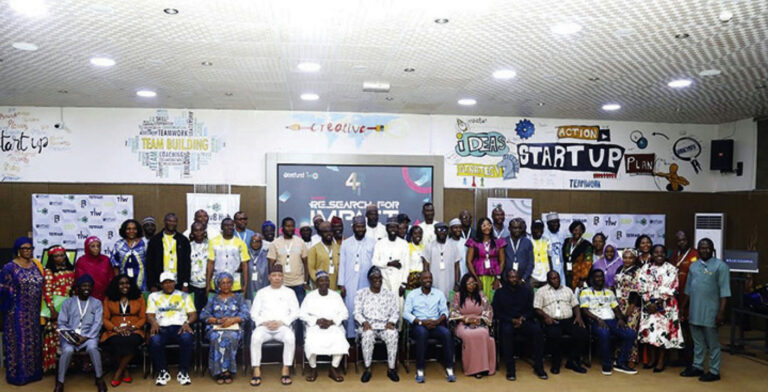
The worlds of medicine and scholarship emptied inside Ibadan on Friday, February 20 to felicitate one of their icons, Prof Olajide Olaolu Adedapo Ajayi, as he turned 90 years.
Prof Ajayi is a former Chief Medical Director (CMD) of the nation’s premier tertiary health institution, the University College Hospital (UCH), Ibadan and the first Black African to head the International Federation of Surgical Colleges (IFSC), the global body that regulates the training and practice of surgeons all over the world.
Ajayi retired from UCH on the cusp of the 21st Century after a distinguished career as a major player in national and global health affairs. He earned fame as a world class surgical oncologist for his ground-breaking study, together with his mentor, Prof Victor Anoma Ngu, in Bukittt’s Lymphoma, among other notable seminal works which enabled an understanding of and better treatment procedures of the diseases in his areas of expertise. He is also respected as an astute health administrator, teacher and mentor of other distinguished medical scholars and practitioners, many of whom are at the commanding heights of the profession. Of notable hue in his honorific feather-decorated hat is the Commander of the Order of Niger (CON) he bagged in 1998 for his meritorious service and contributions to the development of health care delivery in Nigeria.
Having been born and nurtured by Emmanuel Aiyedun Ajayi a pharmacist-father and a midwife-mother, on February 20, 1936, Olajide Ajayi seemed to have no other choice of professional calling other than to become a physician.
The tragic loss of his parents, and three siblings, in unnerving succession, and incapacitation of the fourth due to a meningitis epidemic when he was just a teenager in the 1940s, in the northern part of Nigeria only amplified the irony of his destiny pull to a life of compassion, selflessness, empathy, discipline and care-giving.
In this interview, the renowned surgeon and cancer expert offers lessons from his career and life’s trajectory. He describes misfortune and hardship as a natural part of life and the process of becoming, stressing that with determination, resilience and faith in God, one would overcome.
What is your definition of life at 90?
I can only speculate about the meaning of life, but from everything I’ve read, seen, and lived, I believe strongly that everything has a purpose. The very fact that I’m alive means there is a divine purpose to my existence. I may not always understand that purpose, but over time, through learning, training, and experience, I’ve come to believe that God assigns each of us a role in humanity. My responsibility is to live by certain principles; morality, faith, discipline, and trust that I am being used for something meaningful. So in whatever circumstance I find myself, I return to my core belief: God placed me there for a reason. If you don’t know why you’re here, you don’t know what to pray for. So my prayer is always simple: “God, reveal my purpose.” And once I’m convinced of what I must do, I follow it convinced that Olorun lo ran mi — it is God that sent me.
How did you make out that the medical profession was connected to that purpose?
I did not. I studied medicine because of the family values transferred to me by my father who was a pharmacist and my mother who was a midwife. So it was always fate and compassion. I grew up in Jos and, later, Bauchi. Those days, in Jos, our house was called Gidan Dekita (doctor’s house). My mother would get a call early in the morning or late in the night to attend to pregnant women in labour. As her first son, she would take me along because she had no other companion. When we got there, I would just look for a comfortable place to sleep. When the delivery was complete, she would wake me up and we would go home. I never saw my father get paid money, neither did I ever see my mother negotiating the price of a delivery. At Christmas and other festivals or ceremonies, people brought presents for my parents and I saw them as tokens of appreciation. Sadly, I lost both of them at 14. So, the most important thing they left me with were those values of love and compassion.
How do you reconcile this with your policy requiring people to pay for medical services and consumables as Chief Executive of UCH in the 90s?
That was a management issue. It was not a moral issue. When I took over as head of UCH, there was something called “not available syndrome”. You want syringe? Not available. You want saline? Not available. And patients, mostly the poor ones, were dying. One of the key mandates of the hospital is to train future doctors. But you can’t train doctors effectively in circumstances when some patients will be brought in unconscious and you’d say drip is not available. It was on the basis of that that I ran a cost recovery programme officially recognised worldwide as the Bamako Initiative. The principle was that certain essential drugs must be available in the hospital. But if the government cannot provide it, you go to manufacturers or primary sales people to buy the drugs at the cheapest price. possibly on compassionate grounds. If an aspirin costs N20 at a pharmacy, the pharmacies must have gotten the drug from the manufacturers at N10. So, I persuaded the primary distributors (May and Baker) and so on, to sell to me at the cost price. So, instead of saying, “not available” and leaving patients to die, we offer to get the drugs for them 10 Naira. This made the drugs and consumables available for the departments and personnel who used them and eliminated the agonising experience of patients going through third parties. So the intensive care units had options, the maternity units had, the infusions and drugs suddenly became available at the pharmacy at the cost price. Even if you can’t pay, we don’t send you back. And in an emergency situation, treatment is free, we don’t say, bring N20 before we register you. You now ask, who pays for the drug for the treatment? It comes from the 10 per cent of whatever we added to the cost of the drugs procured for the hospital. So, we did not make profit. We simply ensured that drugs and consumables were always available, especially during emergency situations. I think those opposed to it later saw the purpose. That way, we were able to restore full services and teach the correct things to do in given circumstances. Basic duties and manpower development was resuscitated. And people, who saw the benefits and the impact, started to donate drugs to us.
How are you able to retain your faith in God, despite the hardship and deprivations you faced early in life?
Those hardships strengthened my faith in God. In the 1930s and ’40s, meningitis outbreaks were common in the north. Entire families were wiped out. I lost three siblings in one outbreak; one survived but became paraplegic. We all slept on the same mat, yet I was the only one who didn’t fall ill. When you survive that kind of epidemic, it strengthens your philosophical viewpoints as you grow up. My grandmother was ‘’Iya Aladura” of the local church. And my mother was known as ‘’Omo Iya Aladura”. So, I had a very strong religious background where we don’t query God. Then my mother died when I was 13. So, I understood early that there are painful sides of life and that everything, good and painful, happens for a purpose. Your only hope is to go down on your knees and seek guidance from God, the only One who knows and controls everything.
How did you deal with difficult people or those of different viewpoints?
It is perfectly normal to have people who don’t agree or will never agree with you. I also don’t agree with everything others say or do. If you can think of everything in God’s wonderful creation as having a fundamental purpose, it’s easier to endure. And then you realise that in spite of the clouds in the sky, there’s always a silver lining on the horizon. I was once on my own and a stranger walked up to me and said: “Hello, you look a bit miserable this morning. Is there anything I can do for you?” And then he put his hand in his pocket and gave me a coin. He found me at that spot because I was pretending to be window-shopping, whereas I was actually trekking home because I was ashamed that my friends might see me and say I don’t have transport fare. I used to go to W.H. Smith’s bookstore in England and pretend as if I wanted to buy a book. I would actually read them while appearing to be flipping through before making a selection. It made me very popular in medical school because I was the last to leave the library. I didn’t go to parties much. For the few I attended, I would go to the toilet and be reading my notes. I learned many things offhand.
Tell us of a major operation that either brought you joy or sadness in your career as a surgeon.
There were many occasions. Most of the time, it’s not that you don’t know what to do. You are a human being. If you have the humility to say ‘Maybe it’s my fault’, ‘Maybe if I had done this’, You read more about other people’s experiences, you discuss your weaknesses openly, you learn, you grow. Sometimes, I asked my senior colleagues: “If we had done this or that, would the patient have survived?” And one would reply: ‘No. I know what you are thinking. She suffered XYZ; if we had succeeded, it would have been for a very limited period.” I learn from such conversations, to think differently. So, experience is the collation of your past mistakes. My youngest child, Kunle, is a surgeon based in the US. One day, he called me and said they had been operating on a patient for six hours. She kept bleeding and they couldn’t stop the bleeding. He said they had given her all sorts of drugs. So I told him: “Take a towel and pack the bleeding point and stitch the towel inside the patient, and then ask the anaesthetist to wake the patient. Take the patient to the ward and tell the anaesthetist that first thing the following morning, you want to take the pack out.” They did exactly as I said and the bleeding stopped. Six hours later, the patient was asking for food. By the end of the day, half of the major surgeons in California started talking about one black surgeon who did the unthinkable. He said some of his colleagues were cynical when he mooted the idea, describing it as “the jungle technique.”
What has living without your late wife mean to you?
Everything we had, we built together. She died in 2005, 44 years into our marriage. I miss her but I have tried to keep her memory alive. Her room is intact. The pictures, art pieces and much of all the things are still as she had arranged them. I have told the children that nothing will leave that room until I’m gone. The only one person who has slept in that room in the past 20 years was Justice (Kunle) Somolu who was in town and didn’t want to go to a hotel. I have friends and family members that I visit. And I’m active in church. I chaired the Cathedral Building Committee in Ijebu. I built a church at Ilowa Ijesha in honour of my mother; Adebola Ajayi Memorial Anglican Church. When I had my room upstairs, the whole of the down floor was my office until about three or four years ago. I was very active. I was invited to lectures; I chaired several committees. I almost became a professional writer of forewords in books. I wrote and read books, and edited articles. I’ve been of excellent health. I used to take an hour walk every morning until one day when I ran into a ditch, and a sudden pain hit my back. Otherwise, I used to travel a lot. No special diets. I just take some medications to control blood pressure. And I still take wine.