Follow Us on Google

By Chinyere Anyanwu
President Bola Tinubu has challenged polytechnics and other technical institutions to produce graduates capable of developing practical solutions to Nigeria’s economic and technological challenges rather than merely seeking employment or depending on imported technologies.
Tinubu, who spoke yesterday at the 38th convocation ceremony of Yaba College of Technology (Yabatech), Lagos, said Nigeria needed skilled graduates who could drive industrialisation, create jobs and develop homegrown solutions in agriculture, energy, healthcare and other critical sectors.
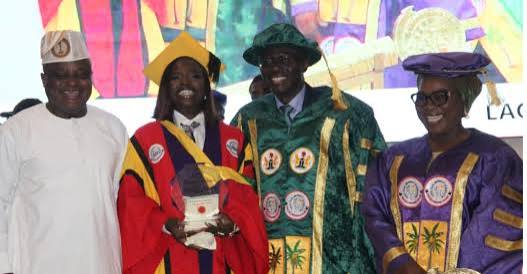
The institution graduated 10,886 students across eight faculties, with David Momoh of the Faculty of Engineering emerging as the best overall graduating student with a Grade Point Average of 3.96.
Represented by the Director of General Services in the Federal Ministry of Education, Nkiru Nneji, the President commended Yabatech’s contributions to technical and vocational education, describing the institution as strategically important to Nigeria’s technological development.
“As Nigeria continues to pursue economic diversification, industrialisation, technological advancement and sustainable development, the role of polytechnics in producing practical, industry-ready graduates cannot be overemphasised,” he said.
Tinubu urged the institution to strengthen training in artificial intelligence, renewable energy, digital technology, advanced manufacturing and entrepreneurship to equip graduates for emerging economic opportunities.
“I encourage the College to sustain its tradition of excellence while embracing new opportunities in digital technology, artificial intelligence, renewable energy, advanced manufacturing, entrepreneurship and other emerging fields,” he said.
Addressing the graduands, the President challenged them to develop indigenous technologies rather than depend on foreign innovations.
“Nigeria does not need more importers of apps and gadgets. We need Yabatech graduates who will build Nigerian solutions for Nigerian problems – solar mini-grids for our communities, agritech for our farmers, health-tech for our clinics, edutech for our schools, fintech for our traders.
“With the skills you have acquired here and the support available through NELFUND, TVET, Student Venture Capital Grants and other Federal Government interventions, you should become job creators, rather than becoming job seekers,” he said.
He also cautioned the graduates against deploying their knowledge for cybercrime, fraud and misinformation, urging them to embrace integrity, patriotism and hard work.
Other News
Earlier, Yabatech Rector, Ibraheem Abdul, said the institution’s planned transformation into the Federal University of Technology and Vocational Studies would strengthen its capacity to deliver technology-driven education, innovation and entrepreneurship.
He described the transition as a significant development in Nigeria’s higher education system, reflecting the growing importance of technical competence and vocational proficiency to national development.
“Our ambition must be to produce graduates who are knowledgeable, technically competent, innovative, entrepreneurial and ethically responsible. We must also develop an institutional culture that values excellence, creativity, discipline, integrity and service,” Abdul said.
He added that the proposed university must distinguish itself through graduates capable of translating knowledge into productive outcomes.
“Our guiding philosophy should be clear: a university where knowledge meets skills, innovation meets industry, and education creates value,” he stated.
Chairman of the Governing Council, Funso Afolabi, also called for a shift from conventional classroom instruction towards practical competencies, critical thinking and entrepreneurial development.
According to him, the relevance of technical and vocational education should be measured by its contribution to solving problems, stimulating innovation and creating economic opportunities.
“Technical and vocational education remains central to Nigeria’s economic transformation. Our national development aspirations require a skilled workforce capable of translating knowledge into products, research into solutions and innovation into economic value,” he said.
Afolabi urged the graduands to regard their certificates as a foundation for innovation and enterprise rather than the end of their intellectual development.
“Nigeria needs graduates who will not merely seek employment but create opportunities, who will not simply identify problems but develop solutions; and who will translate knowledge into measurable economic and social value,” he said.
Momoh delivered the valedictory address on behalf of the 2024/2025 graduating class.