Follow Us on Google
By Charles Osezua
It was a balmy Wednesday afternoon in May 1989, when news came over the radio that the Armed Forces Ruling Council (AFRC), Nigeria’s highest decision-making body, had approved the Gas Pricing Policy my team and I had worked on for nearly three years.
With hugs, high fives and jubilation in the room, we congratulated each other and basked in the euphoria for the rest of the day. To many, the news would have been no more than another news bulletin highlighting some government action, but to us and many industry players and watchers, the announcement signalled something monumental and in many ways, the key to unlocking the development of Nigeria’s abundant natural gas resources had been given legal imprimatur.
I was excited and felt very proud to be a Nigerian and I could envision, immediately, the economic development and transformation of my country facilitated by gas which would fuel power and petrochemical plants, as well as fertiliser companies with other multiplier effects. It was an opportunity for Nigeria to industrialise, stamp her authority as the leading economy in Africa, and perhaps dictate the pace of, or become the go-to-nation for Gas Policy and Pricing dynamics.
The making of the Gas Pricing Policy was a massive undertaking spanning over 18 months spent gathering data and meeting requirements by professionals from the Nigerian National Petroleum Corporation (NNPC) and Shell Petroleum Development Company (SPDC), with support from their home offices in London and The Hague. We had spent several months in London at Shell Centre, relentlessly working and carefully reviewing the output from a computer model called The Pathfinder.
Given the diversity of interests and attempts to fairly satisfy varying parties in the country, the model had to go through a lot of re-works, which eventually gave birth to an agreed blueprint with timelines across the gas value chain for the various actions and activities from gas production through transportation all the way to utilisation.
Days and weeks were spent inside the chilly offices and corridors of the corporate planning department of the defunct National Electric Power Authority (NEPA), and the Ministry of Industries, Power and Steel, to meticulously gather data on existing and planned power projects, fertiliser plants, steel plants, and rolling mills, in order to provide base load estimates for the proposed National Gas Supply Master Plan.
This was followed by months of technical and commercial presentations to oil and gas industry stakeholders, top NNPC management, key decision makers of international oil companies, owners and producers of gas, NEPA, industrialists, and relevant government ministries, to ensure their buy-in.
Finally, Nigeria had the approval of the Armed Forces Ruling Council for a Gas Pricing Policy that would drive the development of gas infrastructure for the first time in the 40 years since the production of oil and gas began in the country. At that point, the general feeling was that the country had ultimately set its sights on transforming the lives of its people by directly and indirectly creating employment for thousands and even millions, using gas as energy for economic growth and sustainable development.
Given the assumptions that went into the economic model for the gas pricing policy, we envisaged mass investments across the gas value chain propelled by growth in power generation, petrochemical industries, as well as re-energised and expanded industrial estates.
Our joy was, however, short-lived as our celebration was abruptly shattered.
Two weeks after the passage of the Gas Pricing Policy into law, there was an unprecedented development. The new law to be documented in the Federal Government Gazette was suspended! This was unexpected and had never happened before.
I was shocked and had to ask, “Is this real? Have we surrendered to mediocrity? Have we suspended our future as a nation that was set to dictate the pace for other emerging economies in Africa?” We were all perplexed and our faces were grim, as if the world had crashed around us. Indeed, we were grossly disappointed, and couldn’t fathom what had happened. “What happened?” was the question.
We soon had an answer. An Air Force chief with responsibility for Power, Steel and Industry who was absent from the council meeting when the approval was granted, raised objections. He was said to have declared that “my ministry cannot pay the approved tariff”.
Shockingly, the Commander in-Chief had vacillated and the council decided to review the policy. Hitherto, as I was informed, nobody could reverse the decision of the Commander in-Chief in a military government, let alone a decision backed by the Armed Forces Ruling Council chaired by the Commander in-Chief. It was unbelievable!
Over three decades later, I watch in disbelief as we struggle. Recently, after several attempts at fixing the crippled gas pricing policy, Nigeria celebrated the contract signing for the construction of the Ajaokuta, Kaduna, and Kano (AKK) gas pipeline under a contractor financed, build and transfer arrangement, whose commercial construct may still require a sovereign guarantee.
The gas development and pricing policy had defined the AKK pipeline as one of the major gas infrastructural “backbone” projects scheduled to have been completed by 1992 to deliver natural gas to the industrial centres of Kaduna and Kano, and ensure the functioning of new power plants, fertiliser and petrochemical plants.
We missed the deadline by almost three decades.
Several events have taken place since the late 1980s when the desire to promote gas development in Nigeria was gravely undermined. This book is therefore, in many ways, part of my chronicles of our early efforts at developing gas policies in Nigeria, the impact of politics on the realisation of the promised economic value across the value chain, the losses suffered by the country on account of the politicisation of the decision-making process and lessons to guide the future.
As we proceed, let us consider a quick question; why has Nigeria found it difficult to commercialise gas the way it has with oil which has earned the country revenue in excess of $400 billion in exports in 60 years especially with Nigeria as the fifth largest producer in the world?
This question is important and critical to understanding the missing link in Nigeria’s gas story.
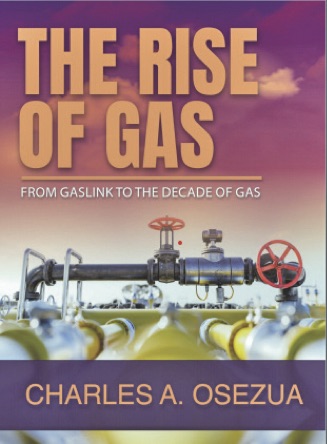
The book, The Rise of Gas (From Gaslink to the Decade of Gas) by Charles Osezua (MON), Radi8 Publishers, 2023 will be launched on April 9, 2023 at the Nigerian Institute of International Affairs (NIIA), Victoria Island, Lagos.