Follow Us on Google
• Excruciating life of babies born with cleft palate
From Gyang Bere, Jos
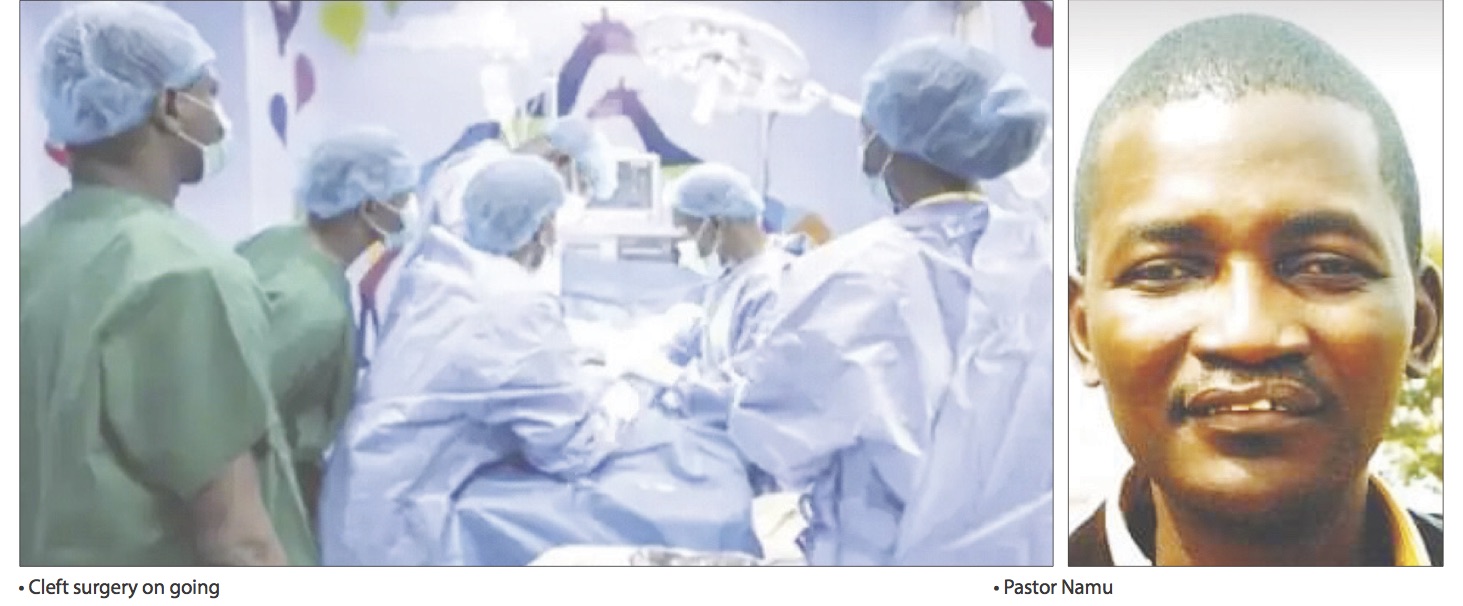
Despite the social discrimination, babies born with cleft palates can still grow to full life. This has been proven by many of such babies, who grew to become stars among their peers, overcoming the obstacles of their birth. That is the case of 39-year-old Mutuwa Namu, who is today a highly respected clergy in Plateau State.
He was born with cleft palate and lip. As a result, he was discriminated against by his age mates and by the members of his community. Some even suggested he should be thrown to a river to appease water spirits.
For Namu, growing up with a cleft lip and palate was traumatising, humiliating and life threatening. The abnormal condition affected his social life and relationship as he could not eat, speak nor hear properly like other children.
Sadly also, his birth came with strange circumstances and feelings. He was the only child delivered alive by his mother after several years of childlessness. The mother’s babies had died mysteriously at childbirth. This situation caused his parents to name him “Mutuwa” meaning “death.”
His situation was compounded by the death of his father just two weeks after his birth. Many believed that the trauma of Mutuwa’s physical disability played a part in the untimely death of his father. And that made the people to love him less.
His mother was left alone, moving from one point to another seeking solution to the condition. She spent money for his upkeep in hospitals and on native treatment. Her child’s condition only got worse and irritating.
She was devastated. She developed an illness that turned her blind and deaf. A few years after, she gave up the ghost, leaving behind the cleft boy to fend for himself.
Some relatives picked him up. But they could barely do anything.
Nobody was willing to associate with him. He grew up with the condition until 1996 when he came across a nurse at the Jos University
Teaching Hospital (JUTH), who picked interest in him.
She picked him to stay with her while he went through medical examination for months. He underwent surgery at Christian Broadcast Network (CBN), JUTH in 2006 to correct the defect.
Namu narrated his chilling experience: “I was ashamed of myself. I could not stay where people are. I asked God at some point why He created me this way.
“I could not close my mouth. Saliva was coming out of my mouth uncontrollably. Before the surgery, I move along with a piece of cloth to cover the mouth. Yet, it was smelling and looking very disgusting.
“This was how my condition was. I could not mingle with my peers or even laugh. It was a hard struggle. But to God be the glory, there was a glimmer of light at the end of the tunnel. I can laugh now.”
Namu picked up his life and was determined to make it. He went to school as an adult. After his secondary education, he proceeded to a theological seminary school.
Today is a pastor with ECWA Church: “I had a dream that I died and was with God. I was complaining to Him, asking Him why he made me that way. I promised Him if He restored my mouth, I would come back to earth and speak the gospel of salvation.
“Now I am a pastor, married and blessed with three children. This is to confirm that God has intervened in my case.”
Vice-President and Regional Director, Smile Train, Africa, Nkeiruka Obi, encouraged cleft affected children and their families to always visit the nearest partner hospital for treatment:
“Cleft is a common birth disability in which the patient experiences difficulty in breathing, eating and speaking. Children with clefts are more likely to have missing or mis-positioned teeth and will often require on going orthodontic treatment.
“They may be particularly susceptible to tooth decay or cavities and are often marginalised, excluded and bullied, which can further restrict their access to basic dental and surgical care.
“Without care, these children may end up in great pain and lose teeth at an early age. This can impair their ability to chew, speak and even sleep, significantly harming their health and quality of life.
“It is essential that children with cleft receive timely oral healthcare to not only significantly decrease the development of tooth decay and cavities, but also improve quality of life in the long term.
“Timely oral health care uplifts cleft-affected children’s mental and emotional health and enables them to thrive. As we commemorate World Oral Health Day, we endeavour to provide quality cleft care so that patients with clefts can also be proud of their mouth.”