Follow Us on Google
From Idu Jude, Abuja
The Minister of Humanitarian Affairs and Poverty Reduction, Dr Bernard M. Doro, has pledged that his leadership is dedicated to eradicating poverty in Nigeria rather than simply managing it.
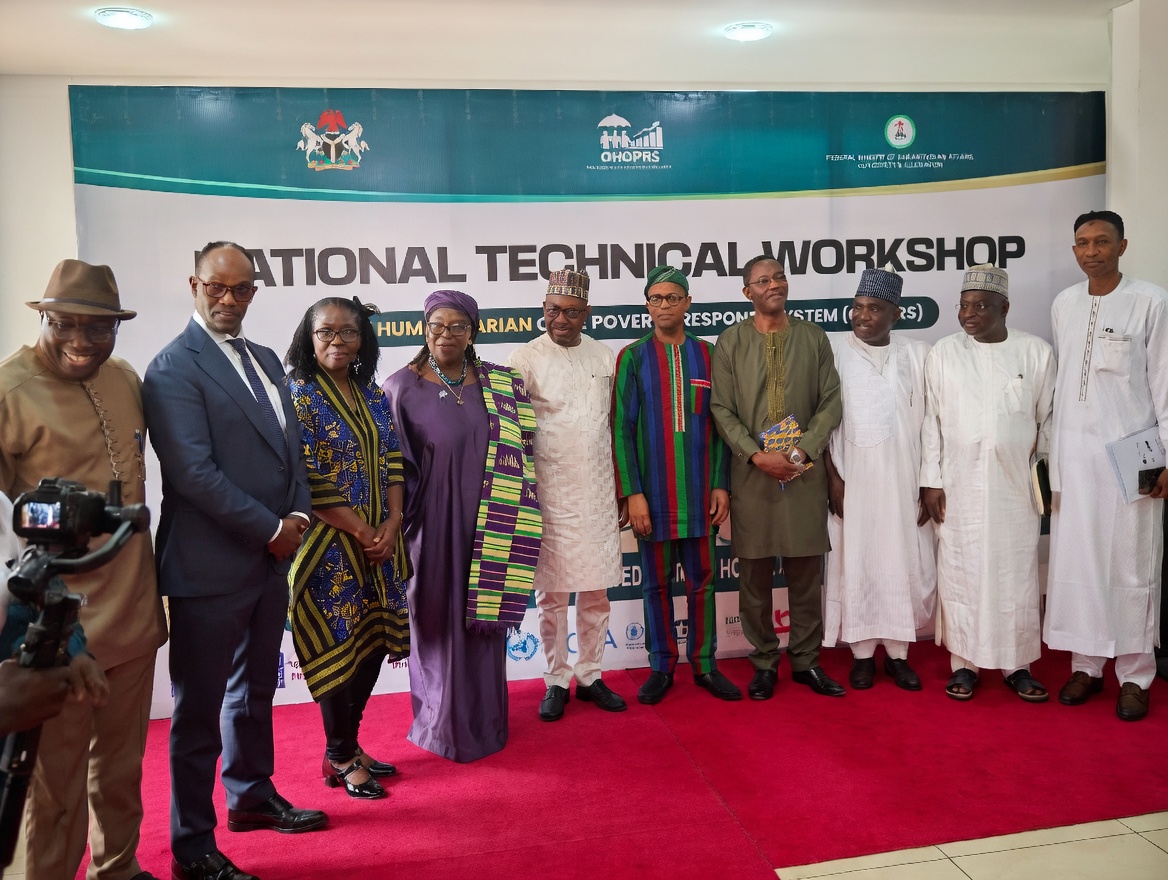
The minister stated this on Friday in Abuja while attending a national technical workshop themed Financing Social Protection in Nigeria.
According to the minister, the workshop marked a defining moment in Nigeria’s journey towards reforming humanitarian interventions and reducing poverty at scale.
Over the past four days, he said, the Federal Government of Nigeria, through the Federal Ministry of Humanitarian Affairs and Poverty Reduction, in collaboration with International Alert, convened the national technical workshop to address a fundamental challenge: the fragmentation of humanitarian response and poverty reduction efforts in the country.
“This is the story that changed everything. Recently, a field team in the North-East met a mother of four who had spent three years caught in a cycle of ‘intermittent help’. She received enough food to survive the week, but never enough tools to change her life. Her words should haunt us all: ‘We are always helped, but we are never moving forward.’
“When this story was shared with me, it reinforced a difficult but necessary truth. It is not that support is not reaching people. It is that our systems are not designed to move people from survival to self-reliance. And that is why the reform we are announcing today is not optional. It is a bold shift that is necessary.”
The minister further highlighted that “there is a cost for inaction. We cannot afford to do nothing. If a patient arrives at a hospital and ten different doctors each treat one symptom with no shared notes, no shared diagnosis, that patient may survive the day but will never truly recover. Nigeria’s poor have had many doctors. What they have not had is a consultant who sees the whole solution.”
He said that, following extensive high-level technical deliberations, the Federal Ministry of Humanitarian Affairs and Poverty Reduction has now adopted the ‘One Humanitarian One Poverty Response System’ (OHOPRS) as a unified national framework for coordinating humanitarian action, social protection, and poverty reduction.
“It is a process. OHOPRS is not another programme. It is intended as a national operating system.”
Continuing, he said that for too long the Nigerian systems have been fragmented across institutions, duplicated across programmes, and disconnected across data and financing systems.
Other News
“The result has been repeated interventions with no clear transition pathway, waste of resources due to duplication and lack of synergy, and persistent vulnerability across communities under the present administration.
Nigeria is now moving from effort to impact and from support to transformation.”
What will change
Through OHOPRS, he said, five fundamental shifts are being introduced:
From multiple coordination systems to one unified national system
From multiple registries to a single, integrated national registry architecture
From project-based funding to a pooled and accountable financing framework
From intervention delivery to measurable poverty exit outcomes
From periodic reporting to real-time monitoring
He clarified that OHOPRS is built on a “ladder of progress” that tracks every citizen’s journey, using the National Social Register.
It will monitor every intervention through a unified beneficiary register, use the Poverty Exit Pathway (PEP) to guide people towards self-reliance, and ensure they remain out of poverty through the Growth Register.
The minister said the reform requires collective commitment and alignment of all ministries, departments, and agencies, as well as state governments and local government authorities, development partners, the private sector, civil society, and non-governmental organisations.
On behalf of the federal government, the minister said poverty reduction is not an act of charity but a pillar of national security.
“We are no longer content with “managing” poverty. Our goal is to end it. We are moving from helping Nigerians survive to enabling them to thrive.”