Follow Us on Google
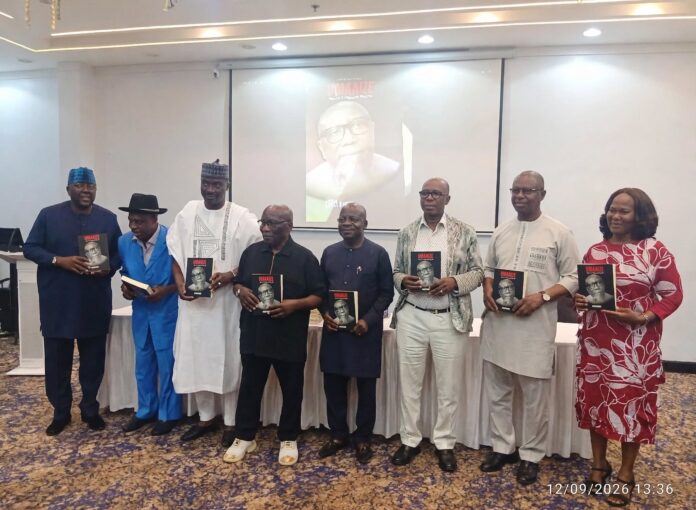
Veteran journalist and public intellectual, Dr. Chidi Amuta, launched his memoir, Homage: Return to Familiar Places, in Lagos at the weekend, drawing leading figures from politics, academia and the media to celebrate his decades of scholarship, journalism and engagement with Nigeria’s national affairs.
Among those at the event were Abia State Governor, Alex Otti, and former Rivers State governor, Chibuike Rotimi Amaechi, both former students of Amuta at the University of Port Harcourt.
The event was chaired by veteran media executive and academic, Dr. Yemi Ogunbiyi, while former military president, General Ibrahim Babangida, was Special Guest of Honour and was represented by Abbey Ibrahim.
Ogunbiyi described Amuta as a uniquely gifted intellectual whose influence and distinctive writing would remain relevant despite the emergence of artificial intelligence.
Recalling their association of about five decades, beginning at the University of Ife, now Obafemi Awolowo University, Ogunbiyi said Amuta emerged from an era of intense intellectual ferment which helped shape him as a scholar and writer.
He singled out Amuta’s The Theory of African Literature for praise, describing it as a classic that “has not been beaten anywhere yet.”
Ogunbiyi said Amuta subsequently built a career spanning academia, journalism and public affairs, with his exceptional writing skills particularly evident during his years in the media.
He recalled that while at the Daily Times, Amuta could produce incisive editorials within minutes, demonstrating an unusual ability to interrogate complex national issues with speed and intellectual depth.
In a goodwill message read on his behalf, Babangida described Amuta as a national asset whose writings were marked by courage, balance and an ability to interrogate Nigeria’s problems beyond ethnic, regional, religious and partisan considerations.
According to the former military president, Homage traces Amuta’s journey from a modest rural childhood through academia, journalism and public affairs, offering readers “an insight into the modest life of a fine writer and a notable intellectual.”
He described the memoir as “literary and refreshing in style” and rich in insights into Amuta’s life and Nigeria’s complex national history.
Amaechi credited Amuta with helping to shape his intellectual outlook, ideology and conduct in public life.
The former Rivers governor, who said Amuta supervised his long essay at the University of Port Harcourt, described him as one of the “best materials” at the institution and praised his contribution to African literary scholarship.
Amaechi also recalled that several of Amuta’s former students went on to prominent careers in public life, citing himself, Otti and former Bayelsa State governor, Timipre Sylva, among others.
“I’m sure that as you write, and as we buy this book, you will be very proud that you trained us. You’ll be very proud that we took after you in terms of ideology,” Amaechi told his former lecturer.
He also described The Theory of African Literature as a groundbreaking contribution to African literary theory.
Otti similarly paid tribute to his former lecturer, describing Homage as an engaging account which demonstrated Amuta’s enduring literary ability.
The Abia governor said he began reading the memoir while travelling and was struck by the fluidity of the narrative.
“Let me thank Dr. Chidi Amuta for this book. And it made a fantastic reading. In fact, if you take the book, you’ll probably not be able to put it down,” Otti said.
He commended Amuta for producing the memoir at 73, saying the achievement should challenge those who cite age or demanding schedules as obstacles to intellectual work.
Veteran journalist, Ray Ekpu, also praised Amuta’s contributions to journalism and publishing, saying he had helped advance journalism as a serious intellectual profession.
Recalling their relationship dating back to the intellectual debates of the 1980s, Ekpu said: “Dr. Chidi Amuta, you’ve added to that trajectory, and I am very, very thankful.”
Reviewing the book, former presidential spokesman and Chairman of the Editorial Board of THISDAY Newspapers, Olusegun Adeniyi, described the memoir as a profound account of both Amuta’s personal journey and Nigeria’s history.
Adeniyi said the book moves from Amuta’s childhood and experience of the Nigerian Civil War through his academic career, journalism, public service, family life and reflections on the Nigerian condition.
According to him, one of the memoir’s major strengths is its ability to connect personal memory with Nigeria’s post-colonial experience without descending into self-celebration.
He described it as a blend of biography, intellectual history and reflection on Nigeria’s unfinished national project.
Amuta, in his remarks, described the memoir as “a product of friendship, fellowship and comradeship.”
Other guests included members of Amuta’s family and former Director-General of the Nigerian Maritime Administration and Safety Agency (NIMASA), Dr. Dakuku Peterside.