Follow Us on Google
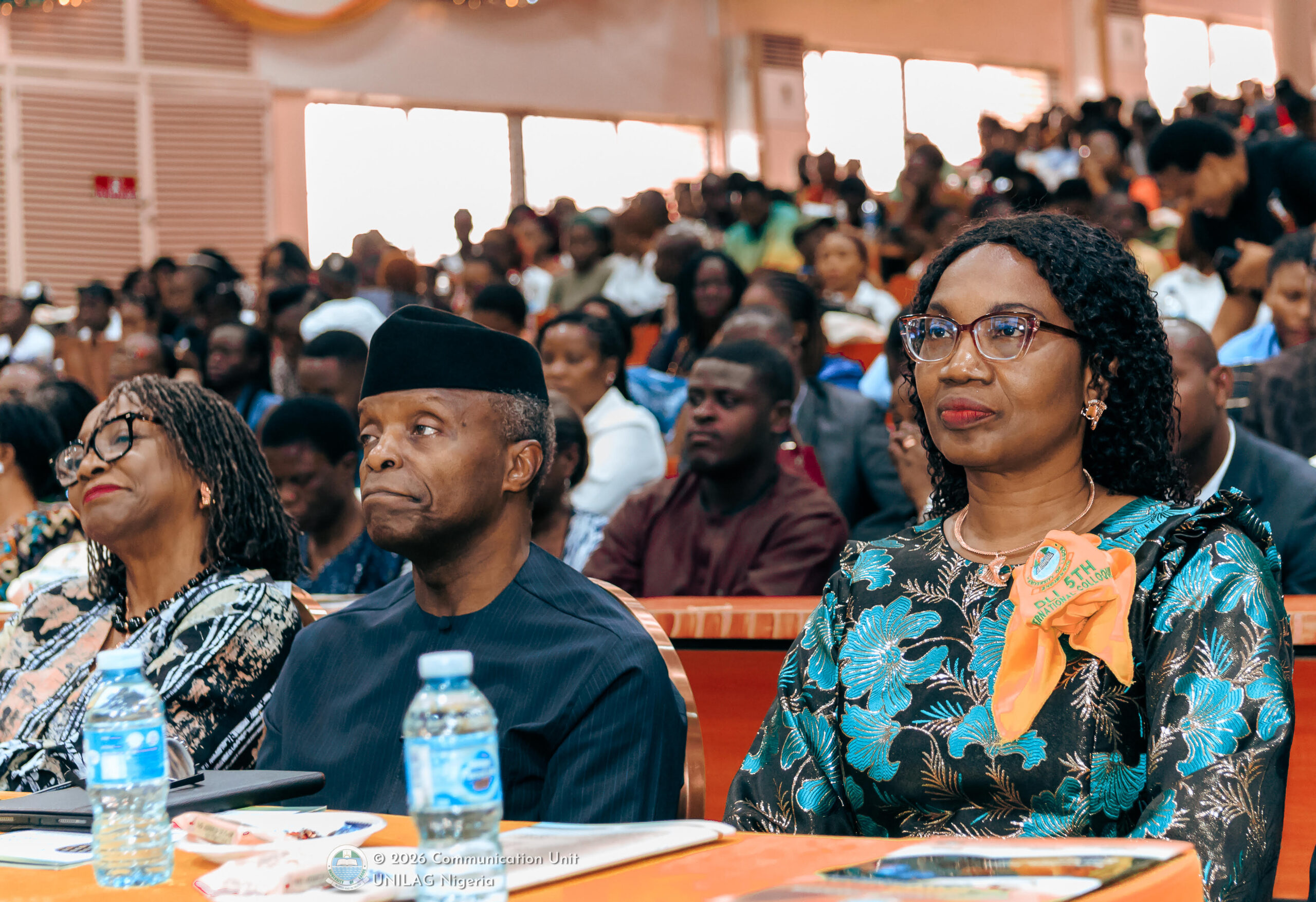
Former Vice President, Prof. Yemi Osinbajo, and Vice Chancellor of the University of Lagos (UNILAG), Prof. Folasade Ogunsola, have called for greater deployment of Open and Distance Learning (ODL) to address the widening gap between the number of Nigerians seeking university education and available admission spaces.
Osinbajo said the conventional university system alone could no longer meet the growing demand for higher education, arguing that ODL, supported by Artificial Intelligence (AI) and other emerging technologies, offered a viable route to expanding access without compromising quality.
They spoke on Tuesday at the 5th International Colloquium of UNILAG’s Distance Learning Institute (DLI), themed, “Reimagining Open Distance Learning Ecosystem: Technology, Policy and Institutional Priorities.”
Other speakers included Prof. Stephen Brown, Fellow of the University of London Centre for Online and Distance Education, and Director of UNILAG’s Distance Learning Institute, Prof. Risikat Dauda.
Chairing the occasion, Osinbajo said the pressure on Nigeria’s university system was evident in the huge disparity between the number of candidates seeking admission and those eventually offered places.
According to him, about 2.2 million candidates applied for admission through the Joint Admissions and Matriculation Board (JAMB) in 2026, but only about 35 per cent secured admission.
“Large numbers of candidates chose universities as their first choice as against polytechnics and colleges of education. If demand for university education continues to rise, we will have 2.7 million candidates applying for admission and three million in subsequent years,” he said.
The former vice president said the situation made it imperative for universities to rethink the traditional model of delivering higher education and embrace technology-driven alternatives capable of accommodating substantially more students.
“It is now clear that the vehicle to provide massive and quality university education is through ODL. And with AI, it will open more spaces for our teeming youths seeking university admission.
“If we get it right, ODL will not only be regarded as an alternative but a viable vehicle to provide quality university education,” Osinbajo said.
He said AI, with its capacity to provide access to vast educational resources, could significantly transform tertiary education and urged universities operating ODL programmes to take advantage of the technology.
Other News
Osinbajo described the theme of the colloquium as timely, saying discussions around technology, policy and institutional priorities were critical to building a stronger ODL ecosystem.
He commended the UNILAG management for sustaining the DLI as a platform for providing university education to people who are working or unable to access conventional university programmes.
Ogunsola, in her remarks, said the conversation on ODL had become particularly urgent as Nigeria grappled with the challenge of providing university education for its large youth population.
She noted that while universities had for centuries been defined largely by physical campuses to which students travelled to receive instruction, technology had fundamentally altered that model.
“Today, technology has made it possible to learn from anywhere. ODL provides an important pathway for expanding access to higher education for workers, people with disabilities and those who need a more flexible mode of learning,” she said.
The vice chancellor said the National Universities Commission (NUC) had recognised ODL as an important instrument for expanding access to quality higher education and had established regulatory frameworks for its operation.
“UNILAG has a long tradition of using alternative models of educational delivery to widen access, and the DLI has become the university’s principal organ for coordinating ODL programmes,” Ogunsola added.
Dauda said ODL had moved beyond being a peripheral alternative to conventional classroom education and had become increasingly important to national development.
“ODL is no longer a peripheral alternative to the traditional classroom. It has become the backbone of how nations expand access, close skills gaps and prepare their citizens for a labour market being written in real time by artificial intelligence and digital transformation,” she said.
The DLI director commended Ogunsola and the university management for their support for the institute’s growth and for providing the platform for the international colloquium.