Follow Us on Google
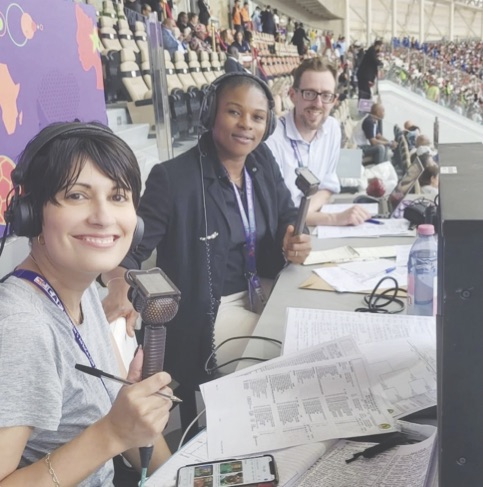
When discussions turn to insightful analysis of women’s football, few voices carry the authority of Desire Oparanozie, a forward whose international career spanned four editions of the FIFA Women’s World Cup.
The retired Nigerian striker, celebrated for her powerful finishing and commanding presence in attack, remains one of Africa’s most decorated players, boasting four titles at the Women’s Africa Cup of Nations with the Super Falcons.
Now 32 and retired from active football, Oparanozie is channeling her experience into analysis, mentorship and development initiatives — but her passion for the growth of the women’s game remains unmistakable.
Infantino era sparks growth in Women’s Football
Reflecting on the first decade of Gianni Infantino as president of FIFA, Oparanozie described the period as transformative for women’s football, citing structural reforms and expanded global opportunities.
“The FIFA President is no doubt on the right path to grow and improve women’s football,” she said in an exclusive interview. “Since coming on board, the evolution of women’s football from 2016 to today has been marked by rapid growth and professionalisation.”
A key milestone, she noted, is the steady expansion of the Women’s World Cup — from 24 teams in 2019 to 32 in 2023, with plans for 48 nations in the future. According to Oparanozie, the increase has broadened competitive exposure and accelerated development across continents, particularly in Africa.
The former Wolfsburg and Guingamp striker highlighted Africa’s progress at the 2023 finals, where four teams featured and three reached the knockout stage, evidence that the competitive gap with traditional powerhouses is narrowing.
Landmark player payments and club competitions
Oparanozie also applauded FIFA’s decision to introduce direct player payments at the 2023 Women’s World Cup in Australia and New Zealand — a reform she described as groundbreaking.
The payment structure guaranteed a minimum of $30,000 to each participant and up to $270,000 for players in the winning squad, marking the first time athletes received compensation directly rather than through national federations.
“For African players, especially Nigerians, the 2023 tournament was a reward for years of hard work,” she said, noting that the policy represented a significant step toward gender equity in sport.
She further welcomed the launch of the FIFA Women’s Champions Cup — the women’s equivalent of the Club World Cup — arguing that the competition provides a global platform for elite club talent and enhances visibility, investment and experience for players outside the national team spotlight. Moroccan champions AS FAR finished fourth in the maiden edition.
Other News
Career milestones and World Cup memories
Although her four World Cup appearances fall short of the African record set by former teammate Onome Ebi, Oparanozie says the experiences remain defining moments of her career.
From her debut in 2011 to subsequent tournaments in 2015, 2019 and 2023, the forward described each edition as a blend of learning, leadership and national pride.
“The highlight of my football career is representing Nigeria on the world stage,” she said. “Wearing the Super Falcons jersey and competing against the best teams globally was a dream come true.”
Her continental triumphs with Nigeria in 2010, 2014, 2016 and 2018 at the African championship further cemented her legacy, helping sustain Nigeria’s dominance in women’s football on the continent.
Giving back through development and coaching
Since retiring two years ago, Oparanozie has remained deeply involved in grassroots development through the Desire Oparanozie Foundation. The initiative focuses on talent discovery, mentorship programmes and educational support for young players in her community.
“I’m using my experience to shape young footballers by organising competitions, scouting talent and sharing life lessons from my career,” she explained.
In addition to her foundation work, the former Super Falcons captain is also coaching Pam FC, a lower-division boys’ side, where she hopes to transfer her tactical knowledge and professional discipline to emerging talents.
Looking ahead
With administrative ambitions and interest in player development pathways, Oparanozie believes initiatives such as FIFA’s Players Impact programme can help retired footballers transition smoothly into new roles within the sport.
For the Nigerian legend, however, the ultimate goal remains unchanged: inspiring the next generation of female footballers to dream beyond limitations and seize opportunities created by the sport’s accelerating global growth.