Follow Us on Google
By Connie Aluoch
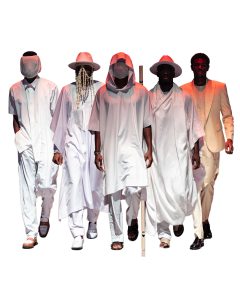
The lights in Ladbroke Hall dimmed to a faint silver glow. A soft hum filled the room, and for a moment, the audience went completely still. Out of the quiet emerged the first figure, cloaked in light, and it became instantly clear that Yusuf Kareem’s White Oracle was not just a collection. It was a spiritual encounter.
Presented under his label OOMO AJADI, this SS26 collection was an exploration of purity, silence, and the sacred power of white. It moved beyond fashion into something more meditative, more human.
Kareem’s concept was rooted in Yoruba cosmology, where white holds divine significance. In that belief system, white represents clarity, wisdom, purity, and ancestral connection. It is the color of the orisha Obatala, the creator spirit who embodies peace and reason.
Kareem translated this philosophy into a sequence of garments that reflected calmness, strength, and reflection. Each look became a chapter in a quiet conversation about spirituality, identity, and the healing power of simplicity.
The first look established that language with absolute clarity. The model stepped forward in a perfectly tailored ivory suit that balanced structure with grace. The lines were clean, the silhouette deliberate.
There was no embellishment, no noise, only purity of form. The jacket curved gently at the shoulders and flowed into relaxed trousers that skimmed the floor with quiet movement. Underneath, a simple inner tunic softened the structure. It was both modern and timeless, carrying the poise of ceremony and the ease of contemporary tailoring.
This opening look spoke of discipline, of a man who understands power but carries it with stillness.
The second look brought the divine element closer to the surface. The model appeared in a voluminous agbada rendered entirely in white, each layer moving like breath.
The cut was wide and fluid, the fabric catching the light with every motion. It was less a garment and more a vessel, embodying presence rather than form. The model held a tall wooden staff, transforming the runway into a place of ceremony.
The quiet dignity of this look reminded the audience that in Yoruba tradition, white clothing is not fashion but invocation. It is worn to commune with ancestors, to honor the divine. On the stage at Ladbroke Hall, that symbolism felt deeply alive.
The third look introduced mystery and transformation. A wide-brimmed white hat concealed the model’s face behind cascading strands of ivory beads.
Beneath it, a layered robe flowed in perfect rhythm, blurring the boundaries between body and spirit. The beaded veil moved like light rain, obscuring identity and inviting contemplation. This figure was not a model but a messenger, a symbol of the unseen. The outfit combined Yoruba ceremonial dress with avant-garde restraint, bridging tradition and futurism in one breath. The audience fell into silence as this figure passed, every footstep deliberate and sacred.
The fourth look grounded the sequence in realism without breaking the collection’s spiritual current. A short-sleeved shirt and relaxed trousers in crisp white cotton introduced structure again but in a more utilitarian way. The fabric’s matte finish contrasted beautifully with the soft sheen of earlier looks.
The model’s face was covered with a light cloth, softening features into anonymity. The ensemble reflected the idea that clarity often requires detachment. The cut was contemporary, even minimal, but its calm confidence made it resonate. The way it moved, the way it resisted excess, turned simplicity into strength.
The fifth and final look offered closure, the calm after revelation. A model entered in a long hooded tunic layered over loose trousers, his face partially hidden beneath a soft veil. The hood framed the head like a halo, transforming the silhouette into something monastic.
The layered folds gave the garment sculptural presence without heaviness. It felt like the final moment in a spiritual journey, the moment after enlightenment when stillness becomes truth. The fabrics were light, almost weightless, suggesting ascension. As the model reached the end of the runway, the hall felt suspended in time.
Throughout White Oracle, Kareem demonstrated an extraordinary command of restraint. The collection was monochrome, but within that singularity, he found infinite variation. Matte cottons, polished silks, and crisp linens interacted subtly under the light. Every shift of texture became a quiet revelation.
The silhouettes alternated between tailored precision and free-flowing drape, evoking the duality between human discipline and divine grace. The absence of color forced the audience to pay attention to structure, detail, and intention.
The atmosphere in the hall reinforced that meditative tone. There was no music to dictate mood, only the soft shuffle of fabric and the echo of bare footsteps on marble. Each model walked slowly, as if participating in a rite rather than a show.
The lighting bathed them in soft gradients, highlighting shadows rather than brightness. In that environment, white took on dimension and emotion. It was not absence but presence.
As the collection progressed, it became clear that White Oracle was not about spectacle or grand gestures. It was about purification. Kareem used clothing as a metaphor for cleansing — cleansing of the eye, of the mind, of the soul. By stripping away color, pattern, and decoration, he revealed what remains when all distractions are removed: proportion, purpose, and spirit. The result was powerful because it was honest.
Within the larger context of the UDGN Cultural Threads showcase, White Oracle provided a vital counterpoint. Where other designers celebrated color, texture, and cultural exuberance, Kareem offered stillness. His message was not louder but deeper. It reminded the audience that fashion can be a spiritual language, a means to reconnect with meaning in a world that often values speed and noise. His all-white palette became both rebellion and reverence.
For OOMO AJADI, this collection marked a defining statement. Kareem has always worked with a quiet confidence, but White Oracle revealed his full maturity as a designer and thinker. His craftsmanship was meticulous, his compositions poetic. He fused Yoruba tradition with modern minimalism to produce something that felt both ancient and futuristic. It was not just a showcase of clothing; it was a philosophical inquiry into what it means to create and to be.
As the models returned for the finale, the runway resembled a procession. The figures in white moved together like spirits crossing a threshold. Their garments caught the light in slow, rhythmic pulses, reflecting off the marble floors like ripples of energy. The audience remained silent until the final turn. When applause came, it was soft and respectful, the kind reserved for moments of genuine reverence.
White Oracle lingered in the mind long after the lights rose. It was an act of devotion, a work that asked not to be seen quickly but to be felt slowly. Through purity of color and discipline of form, Yusuf Kareem reminded everyone present that true innovation is not always found in excess but in essence. His vision of white was not blankness but clarity, not absence but presence, not fashion but faith.