Follow Us on Google
By Henry Akubuiro
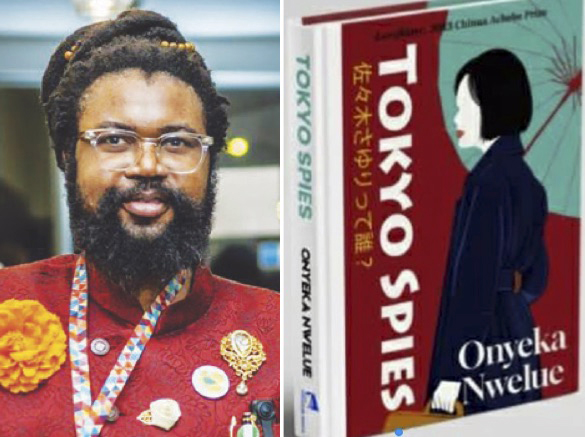
Nigerian writer, Onyeka Nwelue, has made steady progress since 2009 when he debuted with the novel, Abyssinian Boy, at 21, which fetched him the T.M. Aluko Prize for Fiction. He has since written over 40 books, which have garnered rave reviews and awards. Needless to say, his forthcoming literarary fiction, Tokyo Spies, has been touted a potential 2026 bestseller on account of its ratcheting merits.
To be released in June, 2026, recent conversations around the novel have centre around a potential Y=85 million ($600,000 USD) publishing deal in Japan. Not every work written by an African writer attracts such a payday cheque. Tokyo Spies is an engrossing cross-cultural introspective work, interrogating what we truly owe to those we love, and what we lose when we run from the answer.
The plot
Tokyo Spies, set in 1887, trails Zenjiro Ito, a young Japanese calligraphy student at Tokyo Imperial University. When news arrives that his entire family has fallen gravely ill, Zenjiro, gripped by fear and shame, does not return home. Instead, he flees to China — to Tianjin — under the pretence of advancing his art. There, he becomes entangled with two women: Lin Ruo, warm and grounding, and Mei, disciplined and philosophical. His deception, however, cannot hold. As his lies unravel, Zenjiro loses everything: his home, his art, his lovers, and his dignity.
Reduced to living on the streets of Tianjin, Zenjiro begins creating calligraphy that no longer seeks perfection, but truth. He invents a new style that blends Chinese and Japanese traditions — a form born of exile and humility. A devastating letter eventually forces him back to Japan, where he must confront the family he abandoned, the losses he caused, and the man he has become.
Tokyo Spies: Ingredients of a bestseller
Tokyo Spies is coming at a period when literary works with thematic preoccupations of migration, identity, and cultural belonging have occupied the front burner of literary discourse in world literature. Setting it in the past also adds to the infectious curiosity and heightened expectation. There is a bonus still: the novel goes beyond a Japanese emigrant in neighbouring China. It echoes a meditation on the emotional cost of escape, asking a vital question that echoes from the north pole to the south pole: what happens when ambition becomes a mask for avoidance?
In the novel, Zenjiro may not be considered a villain but a talented individual who cannot come to terms with grief. His emotional trajectory offers glimpses into a turbulent universe. Nwelue renders this with extraordinary empathy; never condemning his protagonist, but never excusing him either.
Tokyo Spies weaves together several themes that feel urgently relevant to contemporary readers:
Identity and belonging: Zenjiro exists between cultures: a Japanese man shaped by Chinese exile, neither fully at home in Tokyo nor Tianjin. His story speaks to anyone who has ever felt caught between two worlds, two versions of themselves.
Duty, guilt, and the cost of abandonment: The novel does not romanticise escape. It shows, with unflinching honesty, the ripple effects of a single act of cowardice — and the long road back from it.
Art as transformation: The invented calligraphic style Zenjiro creates is one of the novel’s most beautiful conceits — a form born not of mastery but of honesty, blending two traditions into something wholly new.
Cross-cultural empathy: Rooted in Japanese and Chinese philosophical traditions, the novel invites readers to move across cultures with curiosity and care, finding the universal in the specific.
Reinvention and redemption: Ultimately, Tokyo Spies is about whether a person can become worthy of the life they’ve damaged — not through grand gestures, but through honesty and discipline.
Asha Seth, Founder of the MissBookThief, leading Indian book agency, said, “Nwelue writes with rare empathy, crafting a protagonist who is flawed and human, and that’s what makes it unforgettable.”
novel also makes a powerful case for art as a path to self-knowledge. Calligraphy in Tokyo Spies is not mere decoration; it is the mirror that eventually forces Zenjiro to see himself in the true light. This elevation of artistic discipline as a vehicle for personal reckoning gives the book a philosophical depth that literary readers will savour.
Shobhaa De, a celebrated author and columnist, said in praise of the book, “Love his work. This is his best book so far.” Tokyo Spies is available on https://www.amazon.com/dp/1919556516.
Onyeka Nwelue is an important Nigerian writer, filmmaker, jazz musician, and trained anthropologist, who has published over 40 books. His previous work includes The Strangers of Braamfontein, winner of both the Crime Awards and the ANA Prize, which Nobel Laureate Wole Soyinka described as ‘raunchy.’ He is the founding director of the James Currey Society in Oxford, and has held academic positions at the Universities of Oxford, Cambridge, Ohio, and Johannesburg simultaneously at various points in his career.
His films have been screened at the Africa Movie Academy Awards and the Toronto International Film Festival, and he is currently a student of calligraphy in Osaka, Japan.