Follow Us on Google
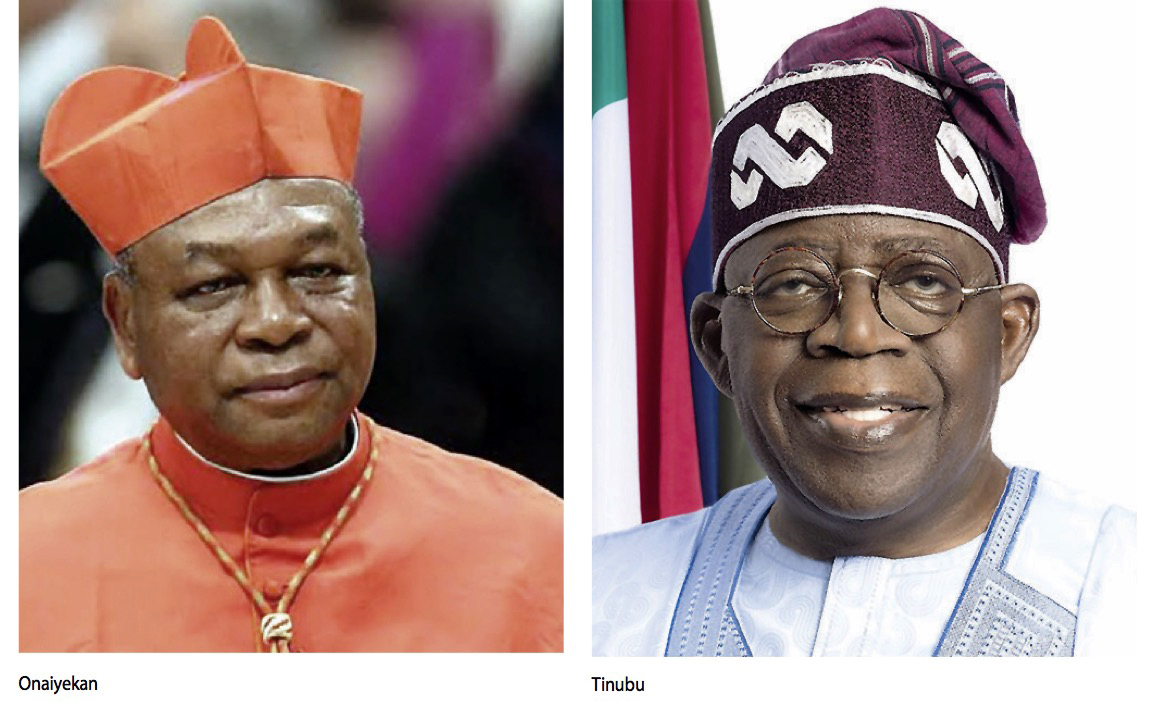
By Fred Itua, Abuja
The dispute between the presidency and the Catholic Bishops’ Conference of Nigeria (CBCN) has entered a phase few anticipated when it began. Attention has now shifted from the exchange itself to a question of no one is bold enough to ask within the ruling All Progressives Congress (APC). The ruling party and its allies count among their most senior figures a substantial number of practising Catholics. They occupy the Senate presidency, the office of the Secretary to the Government of the Federation, the chairmanship of the Progressive Governors Forum, and several government houses across the South East, South South, South West and the Middle Belt.
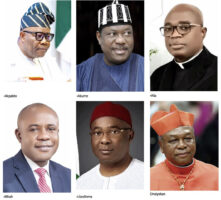
In the two weeks since presidential aides publicly criticised Cardinal John Onaiyekan, none of them has issued a statement on the matter. The roll call is not in dispute. Senate President Godswill Akpabio described himself last November as “the most ranked Christian in government.” Speaking at the blessing of the Regina Coeli Parish Rectory in Uyo, he added: “I belong to all denominations, but I am lucky and happy to be a Catholic.”
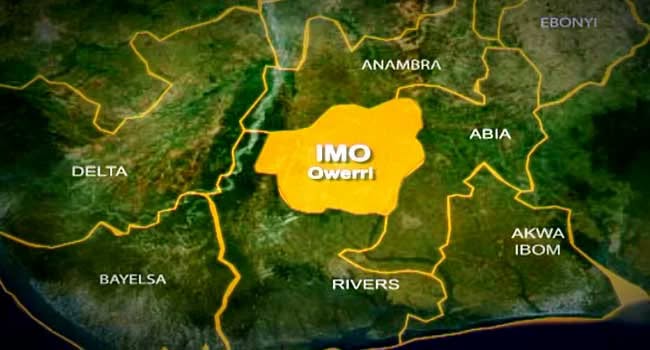
George Akume, Secretary to the Government of the Federation, holds the rank of Knight of the Order of St John International, a distinction conferred by the church. Simon Lalong, former Minister of Labour and Employment and former governor of Plateau State, is a Papal Knight. Hope Uzodinma governs Imo State, chairs the Progressive Governors Forum, the umbrella body of every governor elected on the ruling party’s platform, and also chairs the South East Governors Forum. He is described in his own official biography as a devout Catholic.
Hyacinth Alia governs Benue State and is an ordained Catholic priest who has not been laicised. Peter Mbah, governor of Enugu State, has been publicly commended by the Apostolic Nuncio. Charles Soludo governs Anambra on the platform of the All Progressives Grand Alliance (APGA) rather than the ruling party, but has been consistently supportive of the Tinubu administration and is widely described, along with his wife, as strongly rooted in the Catholic faith.
Ebonyi State Governor, Francis Nwifuru is a Catholic. He is a practising Catholic who frequently participates in church events, hosts masses, and has family milestones tied to the Catholic faith. Like others, he has maintained a dignified silence. The aforementioned are not alone. There are other ranking senators, members of the House of Representatives and ministers who are ardent Catholics and are members of the ruling APC.
That is a concentration of Catholic office holders unusual by the standards of any recent Nigerian government. It spans the legislature, the federal executive, and the governors’ forums that coordinate the ruling party’s state level politics. The events that prompted the present controversy are well documented. On 28 July, the CBCN, led by its president Archbishop Matthew Man-Oso Ndagoso, met President Bola Tinubu at the State House. The bishops presented a position paper on the economy, insecurity, the condition of Nigerian democracy and the funding of the electoral commission ahead of 2027.
The president rejected their assessment. The presidency then issued an account of the meeting emphasising its commitment to stabilising the economy and repositioning security operations. That account made no reference to the disagreements. Three days later, Cardinal Onaiyekan, Archbishop Emeritus of Abuja, gave a television interview describing what had occurred. “When the nation is bleeding, you cannot expect a polite meeting with the Head of State,” he said. “We told him the economy is not helping our poor people; he told us the economy is doing fine.”
The presidency’s reaction followed quickly. Temitope Ajayi, Senior Special Assistant to the President on Media and Publicity, published an article accusing the cardinal of abusing clerical privilege by discussing a private meeting publicly. Daniel Bwala, Special Adviser on Policy Communication, described Onaiyekan as “more political than spiritual” and suggested his remarks aligned with the interests of opposition candidate Peter Obi. Bwala also argued that the cardinal spoke for Catholics rather than for Christians generally, adding that the Christian Association of Nigeria (CAN) maintains a neutral position on political questions.
Social media accounts identifying with the ruling party circulated altered images of Onaiyekan on the internet, including depictions of him with horns. The presidency has not commented on those materials. Reaction from outside the ruling APC has been prompt and firm. Atiku Abubakar, presidential candidate of the African Democratic Congress (ADC), issued a statement through his spokesman Phrank Shaibu describing the presidency’s language as unbecoming of a government.
“Perhaps the Presidency has become so accustomed to inviting fake bishops that it now assumes every cleric can be recruited into political propaganda,” the statement read. “But Catholic bishops are different. They are not political props, rented cheerleaders or praise singers.” The Northern Christian Association, drawn largely from Protestant and Pentecostal congregations, warned that the aides’ conduct could divide the Christian community. Its chairman, Reverend Joseph John Hayab, maintained that the bishops had spoken on matters affecting all Nigerians. The Human Rights Writers Association of Nigeria described the attacks as disrespectful and amateurish.
Within the ruling APC, the response has been different in character. Rotimi Amaechi, former governor of Rivers State and former Minister of Transportation, spoke on a national television and called on the president to end the criticism. “I came here simply to say, please ask the President to stop insulting the Catholic Church, to stop insulting Christians,” Amaechi said. “They should respect God and respect the Christian faith.” He added: “When it’s time for politics, we’re ready to abuse anybody and descend as low as they want.” Amaechi said he had interrupted a period of mourning for his late mother to make the intervention. He is, however, no longer in the ruling party. He is vice presidential candidate of the ADC. Unfortunately, the only prominent Catholic politician of national standing to comment publicly is the one who has already left the ruling party.
The silence of those who remain has attracted commentary from several quarters, and pundits have offered competing readings of it. One view holds that cabinet and party discipline in Nigeria does not readily accommodate public dissent on matters involving the president’s media team, and that office holders may be raising concerns through internal channels that are not visible to the public.
Other News
A second view, advanced by political observers more critical of the administration, holds that the calculation is not complex. Positions within the ruling APC are held at the pleasure of party leadership, and the cost of a public intervention on behalf of the church may be judged higher than the cost of saying nothing. A third observation, offered by some pundits, is that the matter is regarded within the APC as a dispute over one cleric’s television appearance rather than an assault on the church as an institution, and therefore does not warrant a denominational response at all.
What is not disputed is the comparison now being drawn in public commentary. Political observers have raised the question of how a similar episode involving a senior Islamic cleric might have unfolded, and whether Muslim office holders of comparable rank would have responded with equivalent restraint. However, that comparison is necessarily speculative. No parallel episode has occurred against which it can be tested.
There is a precedence that extends beyond the personalities involved, and observers consider it more durable than the immediate row. Nigerian political practice has generally treated the Catholic hierarchy as a category apart. Catholic bishops criticised successive military governments at a time when public criticism carried the risk of detention. They criticised the administration of Olusegun Obasanjo. They criticised Goodluck Jonathan. They criticised Muhammadu Buhari, including through years when churches were being attacked by insurgents and the security response was widely judged inadequate.
Those administrations disagreed, sometimes sharply, and occasionally complained in private. None of them responded with a sustained public campaign directed at the individual clerics involved. Analysts of church and state relations attribute that restraint less to deference than to calculation. The Catholic Church in Nigeria operates hospitals many state governments have not built. It runs schools many education ministries cannot match. Its parish networks reach communities that federal programmes have never serviced. Successive governments weighed that institutional footprint before choosing how to respond to criticism from it.
The current episode marks a departure from that pattern. Whether the departure proves durable, or is treated within the ruling APC as an isolated communications failure, is among the more questions the next several months will settle. Political observers point out that norms established in one dispute seldom remain confined to it. If the practice of responding to institutional criticism through personal attack becomes established, the office holders who declined to object may find the practice available for use in disputes where they, rather than a cardinal, are the subject.
Attention has also turned to the wider Christian response. The Northern Christian Association spoke, as did the Human Rights Writers Association, though the latter is a rights body rather than a religious one. Beyond those interventions, the field has been notably quiet. The Christian Association of Nigeria (CAN), the umbrella body constituted in 1976 to present a collective Christian voice to the Nigerian state, has issued no statement on the dispute.
Bwala has characterised CAN as politically neutral. CAN’s current president, Daniel Okoh, comes from the Organisation of African Instituted Churches rather than the Catholic bloc. The relationship between the CBCN and CAN’s national leadership has been strained in the past. The Conference suspended participation in CAN national activities in 2013, citing concerns that the body was being drawn into partisan politics, before later resuming engagement. Analysts of Nigerian church politics argue that the current silence should be read against that history rather than as a novel development.
Nigeria’s most prominent Pentecostal leaders have similarly not commented. Several command congregations numbering in the hundreds of thousands and maintain regular access to government at the highest levels. Political observers have offered two explanations. The first concerns exposure. Large ministries hold significant regulatory interests, including land, broadcast licences, tax positions and foreign exchange access for imported equipment. A government inclined to register displeasure has instruments that never appear in the public. The second explanation is proximity. Some of the Christian figures maintain established relationships with the administration and may see limited advantage in disturbing them over a dispute involving a denomination other than their own.
What the row has exposed, pundits argue, is less a division within the Christian community in Nigeria than the absence of a functioning mechanism for collective response. The Muslim community’s capacity for rapid and unified reaction on questions of perceived religious insult is well documented in Nigerian public life. The Christian community in Nigeria, on the evidence of the past fortnight, possesses no comparable reflex. Bwala’s assertion that Onaiyekan spoke for Catholics rather than Christians was, according to observers, was an attempt to isolate one denomination from the others. The Northern Christian Association identified and rejected that framing directly. Most other bodies did not respond, which in practical terms left the framing unchallenged.
The electoral dimension is where observers differ most sharply. Nigeria’s Catholic population is estimated at between 27 and 30 million, making it the largest single Christian denomination in the country. It is concentrated in the South East, South and the Middle Belt, with substantial presence across parts of the South West. Whether that population functions as an electoral bloc is a separate question, and most political observers argue that it does not. Nigerian voters are often moved by economic conditions, security, ethnicity, patronage and candidate quality, generally before religious affiliation enters the calculation. Bishops rarely instruct congregations how to vote, and Nigerian congregations have not historically voted as directed.
The other argument concerns margins rather than blocs. In the 2023 presidential election, President Tinubu won Benue State with 310,468 votes against Peter Obi’s 308,372. The margin was 2,096 votes. Benue is a state where the Catholic Church is among the largest institutions and where the sitting governor is an ordained priest. Nationally, Tinubu was elected with approximately 37 per cent of the vote, a plurality rather than a majority, and the constitution additionally requires a winner to secure at least 25 per cent in two thirds of the states and the Federal Capital Territory. He fell short of that threshold in the FCT in 2023, a shortfall his opponents raised in court. Under those conditions, small shifts in states won by four figure margins carry disproportionate weight.
Cardinal Onaiyekan has himself raised the turnout question, though from a different direction. Speaking on Eagle 102.5 FM in Ilese Ijebu this week, he warned that a public perception of predetermined outcomes would depress participation. “My fear is that if it becomes very clear to Nigerians that no matter what happens, the APC will win, then most people won’t even bother to go to the election,” he said. He framed the concern as one of legitimacy for whichever government emerges.
The office holders named above will each face electorates in due course. Uzodinma will return to Imo voters, Alia to Benue, Mbah to Enugu, Soludo to Anambra, Akpabio eventually to Akwa Ibom North West. In the South East states, the ruling party’s 2023 presidential performance was negligible; Tinubu polled 4,772 votes in Enugu and 5,111 in Anambra, and the five South East states together contributed 127,605 votes, under two per cent of his national total. Observers believe that the region represents growth opportunity rather than existing strength for the ruling party, and that growth strategies are more sensitive to reputational damage than consolidation strategies are.
The presidency, for its part, maintains that its position has been mischaracterised. Bwala has argued consistently that the president was entitled to reject an economic assessment he believes the available figures do not support, and that his response rested on data rather than sentiment. Government officials have also noted a procedural distinction that has received limited attention. Catholic bishops have traditionally issued its criticism through written communiqués. Onaiyekan spoke in a live television interview. Officials argue that difference alters the character of the exchange and invites a different order of response. Former senator Shehu Sani, while defending the bishops’ right to speak, has urged them to weigh this administration’s record against those of its predecessors rather than in absolutes.
Cardinal Onaiyekan has indicated he does not intend to prolong the exchange. “We have spoken,” he said, “and the only response we are waiting for is whether it is affecting the way they are governing.” The CBCN has issued no further statement since the original meeting. Whether the matter subsides as a communications dispute, or becomes a durable feature of the ruling party’s relationship with Christian voters ahead of 2027, remains unresolved.
What can be observed is that the ruling APC contains an unusual concentration of senior Catholic office holders, that none has publicly addressed the dispute, and that this fact has itself become part of the public record the church and the electorate will assess.