Follow Us on Google
“True patriotism is not a short, frenzied outburst of emotions, but the tranquil and steady dedication of a lifetime time”
—Adlai Steveson
By Omoniyi Salaudeen
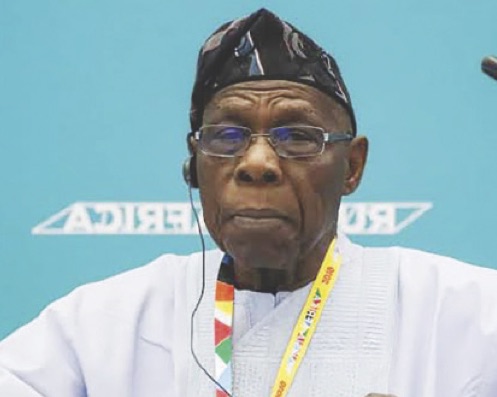
Though with some myths around him, former President Olusegun Obasanjo is one of Nigeria’s most visible living legends bestriding the political firmament. His matchless courage, steely will, razor-sharp mind, an uncanny ability to anticipate the future, proclivity for controversy, prodigious capacity to absorb insults, as well as infinite forbearance under all manner of circumstances stand him out among his contemporaries. He is a grandmaster in a political chess game and a legendary schemer. Even years after his exit from power, he remains an enigma, but very difficult to understand because there is in him a strange mixture of patriotic zeal, vindictive tendency, and self-preservation instinct. What Obasanjo is to the Yoruba is different from what he is to the Igbo in the East and their counterparts in the North. He is more or less like an elephant; where you stand determines what you perceive of him.
The spotlight now is on the rapidity with which he has been churning out letters in recent times as political events cascade with an alarming profusion. This is partly borne out of the presumption that he has solutions to Nigeria’s many problems, the more reason he has assumed the toga of self-acclaimed supervisor of the Nigerian project.
The latest is the series of treatises that have caught public attention is the letter addressed to the Chief Clerk, the Central Criminal Court, Old Bailey, in London, where he asked the UK government to appeal to the Court to temper justice with mercy in respect of a case involving the embattled former Senate President, Senator Ike Ekweremadu, and his wife.
Ekweremadu is currently standing trial along with his wife Beatrice, a doctor, Obinna Obeta, and his daughter, Sonia, over an alleged plot to harvest the kidney of a 22-year-old street trader in Lagos.
In Britain, it is legal to donate a kidney, but not for reward. The prosecutor said the defendants allegedly planned to have a kidney removed from the victim so that it could be given to the senator’s daughter, Sonia, who has been on dialysis and, therefore, needed a kidney transplant.
Ekweremadu is at risk of being sentenced to years of imprisonment in line with the Modern Slavery Act 2015 of the United Kingdom after a London court found him and his wife guilty of organ trafficking.
While pleading for clemency in a highly emotion-laden tune, Obasanjo described Ekweremadu as a God-fearing person who had dedicated himself to the service of humanity through the Ikeoha Foundation, a non-governmental organization founded by him and his wife.
The letter reads in part: “It is with great pleasure that I write in respect of Senator Ike Ekweremadu, who I have known for over two decades. Within this period, I have followed and watched, with keen interest, Ike Ekweremadu’s inspiring career, which traversed private legal practice and public administration. During my administration as a democratically-elected President of the Federal Republic of Nigeria between 1999 and 2007, Ike Ekweremadu and I had close relationship and interactions as staunch members of our political party, Peoples Democratic Party, PDP, and more so as he got elected into the Senate of the Federal Republic of Nigeria.
“Within this period of his service in the Nigerian Parliament, he has served as Deputy Senate President of the Senate and has headed so many Committees in various capacities and brought to bear his broad-based experience in legal practice and public administration. Sometime in 2009, he was appointed as the First Deputy Speaker of the Economic Community of West African States, ECOWAS, and made to lead ad hoc Committee to work for the return of constitutional order in the Niger Republic.
“I truly cherish his God-fearing, dispassionate, moderate, and pan-Nigerian approach to national issues and developments, in our multi-ethnic, multi-religious geo-polity. He dedicates himself to the service of God and humanity and he continues to play visible roles in national development.”
For his show of compassion, many people have applauded the former president for the intervention, while others have questioned the motive behind the belated effort to secure the release of the Senator who has been languishing in prison for close to one year.
The cynics, who view the gesture with suspect, see it as part of the scheming to achieve cheap political scores by strengthening his alliance with the Igbo’s aspiration to achieve Peter Obi’s presidency to the discomfiture of the Yoruba who are supporting Bola Ahmed Tinubu, who has been declared the President-elect by the Independent National Electoral Commission (INEC) amidst allegations of rigging and other electoral malfeasances.
At the risk of name-calling, Obasanjo was the first to criticize the poor performance of the INEC, asking for the cancellation of the results of the president and National Assembly elections held on February 25. Since then, he has been at loggerheads with his kinsmen with occasional punches. Nonetheless, the persistent verbal vitriol, he remains undaunted in his campaign for fairness, justice, and equity.
On one hand, his patriotic fervor borders on the rare courage of being able to stand up to take a clear position whenever the stability of the nation seems to be threatened by a looming crisis. And in most cases, he does so in a manner that is both charming and disarming, making him feel good as a self-acclaimed supervisor of state affairs.
You can’t take away from him the brilliance with which he addresses issues with a forthright and fearless disposition while speaking to the power that be. Among the present and past leaders, no one else has developed the kind of reputation he has carved for himself as a Letterman.
Where some leaders will develop cold feet when a certain situation arises, Obasanjo will stand up to take a position and stand by it. From the tenure of administration of his immediate successor as a civilian president, the late Umar Yar’Adua, to Goodluck Jonathan and lately President Muhammadu Buhari, he has kept an abiding faith in the unity of Nigeria, calling a spade a spade regardless of whose ox is gored. For the most part of our recent political history, his interventions in national crises have always come as a soothing balm.
For instance, when the nation was dangerously drifting like a rudderless ship during the tragic-comedy drama that followed Yar’Adua’s ill health, Obasanjo took up the challenge and told the cabals in the presidency what they did not like to hear. “If you take up an appointment, a job, elected, appointed, whatever it is, and then your health starts saying ‘I will not be able to deliver’, to satisfy yourself and the people that you are supposed to serve, then there is the path of honour and the path of morality. And if you don’t know that, then you don’t know anything,” he said in an open letter to the late Yar’Adua.
He did the same thing to former President Goodluck in the wake of the power shift controversy that tore the PDP apart in the build-up to the 2015 general elections. For the failure to keep to his words not to seek a second term, he cast Jonathan as a man without honour, saying it would be “fatally morally flawed” for Mr. Jonathan to contest in 2015.” Thereafter, he turned his back on the PDP and tore his membership card publicly.
People must have also lost count of the letters Obasanjo has written to President Muhammadu Buhari to condemn the nepotism and ineptitude of his government. The one that resonates most in the minds of many aggrieved stakeholders was the one that raised the alarm about the alleged Fulanisation of Nigeria as well as the clannishness of the administration.
In a 13-page statement entitled; The Way Out: A Clarion Call for Coalition for Nigeria Movement, he said: “But there are three other areas where President Buhari has come out more glaringly than most of us thought we knew about him. One is nepotic deployment bordering on clannishness and inability to bring discipline to bear on errant members of his nepotic court. This has grave consequences on the performance of his government to the detriment of the nation.”
In the run-up to the 2019 general elections, he boldly told Buhari to step aside to give Nigeria a new lease of life. And ever since the second coming of the administration, he has never ceased to speak truth to the power mongers within the corridors of power. That is the rare courage that stands him out as a patriotic statesman.
But beneath the façade is rancid aura of vindictive tendency. His critics say he has been unhappy with the turn of events since his disgraceful exit from power following the defeat of his Third Term agenda. They claimed that he deliberately chose to visit vicious revenge on Nigeria by propping up Yar’Adua as his successor because it was a case of the unpatriotic cultivating the unprepared.
The fact that he allegedly compromised the National Assembly to achieve his objective of the Third Term also put a question mark on his rabid nationalistic posture. Besides that, Obasanjo has contributed his own quota to the growing culture of rigging in Nigeria through his do-or-die politics.