Follow Us on Google
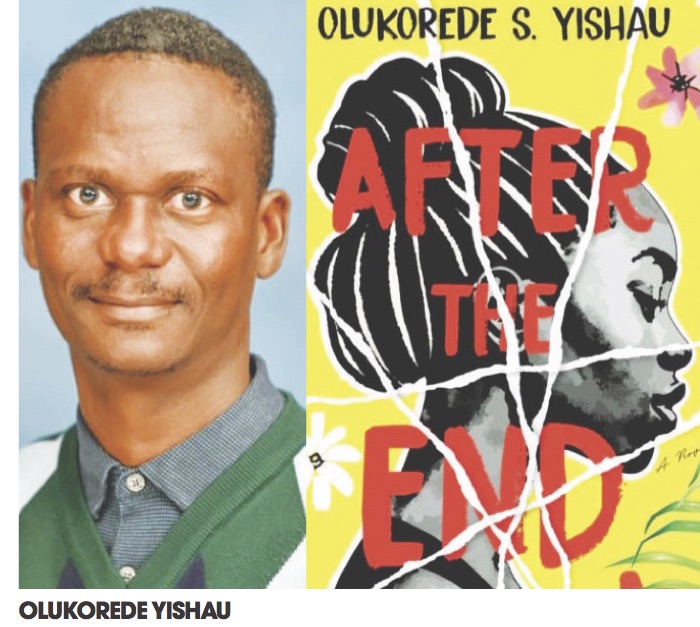
Olukorede Yishau is an award-winning journalist, novelist and short story writer. His first novel, In the Name of Our Father, has been a subject of theses by students in Nigerian universities. The novel, described by two-time Booker finalist, Chigozie Obioma, as a “work of deceptive simplicity”, was nominated for the 2021 Nigeria Prize for Literature. His collection of short stories, Vaults of Secrets, was published in October, 2020.
His second novel, After The End, was released earlier this year by Masobe Books. His poems were published in an anthology of poetry, ACTIVISTS POETS. His essays and short stories have appeared in different publications.
He has in his kitty honours such as: Nigeria Media Merit Awards (NMMA) Columnist of the Year (2015), NMMA Entertainment Reporter of the Year (2015), NMMA Capital Market Reporter of the Year (2013), NMMA Aviation Industry Reporter of the Year (2003), Finalist, Union Bank Banking and Finance Reporter of the Year (2003), Finalist, Olu Aboderin Entertainment Reporter of the Year (2001), among others.
The Nation newspaper’s United States Bureau Chief was interviewed by Henry Akubuiro on his writings.
You wrote your first novel at 24 and it stayed in gestation for 16 more years, why did it take you long to publish it?
I think every writer has this insecurity about their writing, the need to keep checking and re-checking. I believe it can even be worse for a new writer, especially one who has no background in literary studies, a self-taught creative writer. Because of this insecurity, I wasn’t sure it was good enough, but friends who read it felt I didn’t know what I was talking about for having doubts about the work. A particular friend was always asking me about it.
The publishing sector in the country was also ailing at some points during those gestation years, but at a point, I sent it to Toni Kan, and when he finished editing and told me it was well done, I got the courage to push it out and made it a bonafide citizen of what my first editor, now a professor of English in America, Maik Nwosu, called “Republic of Letters.” The rest, as they don’t often say, isn’t history yet as it is still unfolding with more and more academic papers, dissertations and projects being done on it. Just a few days ago, a graduating student of the University of Lagos got in touch with me, because he was writing his thesis on it. I’ve since lost count of how many such theses exist in the book.
Were you surprised when it made the Nigeria Prize for Literature?
Submitting it for the prize, in the first place, meant I thought it had some chances and I had people who kept urging me on; so, it didn’t come as a complete surprise. These people urging me on, including a professor who wrote me a beautiful letter after reading the book and saying it would be a good material for the Critical Literacy Class in her department, had before the nomination made me feel my fear about the book wasn’t founded on a solid ground. My first employer, Dame Comfort Obi, also couriered me a beautiful letter after reading the book twice. With such encouragement, I began to feel I had done something good, even if imperfect.
Were you demoralised with some criticisms that trailed In the Name of Our Father?
That book is like my first child and, of course, as a first time writer, some of the criticisms got to me. It looked like saying my child was ugly, but I’m also wise enough to know that beauty is in the eye of the beholder. A colleague, who didn’t like the structure I employed, refused to review it, but he gave it to a female colleague, who after reading it, rushed to him and asked: “Who is this writer? Fantastic book” and she wrote a beautiful but critical review of this book. I wrote long-hand as a 24-year-old reporter working with The Source magazine, then edited by Maik Nwosu, a writer in spirit and indeed.
The criticisms (which aren’t many) also made me determined to give my best, to follow all processes due before publication and to be more dedicated to the craft. I picked what I could pick out of the criticisms and left what I didn’t believe in. For every criticism, there were scores of praises, and the Nigeria Prize for Literature sealed it for me. The few criticisms were about style and not about the story and novel writing’s strength is more about having something to say, which is having a good story. That is not to say how it’s told isn’t important, it is important, but if you have the best of style and your story is wishy-washy, it is fundamentally wrong and its appeal won’t be much. What is there to enjoy in a fantastic prose and superb word play, which aren’t supported with a story that keeps one opening the pages because of its suspenseful plotting, crazy-but believable characters and heart-racing pacing? With such work, at a point, you will be forced to ask: So, where is the story?
I must also add that I believe none of the critics was just out to rubbish me deliberately. They were just giving their opinions, which no one has the right to stop them from giving and they have helped me to be more critical of what I push out.
Journalism and creative writing are closely related yet different fields, how do you navigate both fields?
They are closely related, but there is also a wall of difference. Journalism is about facts and facts alone; creative writing uses facts, logic, emotions and more to get us opening pages after pages. To transition to creative writing, I had to learn its tricks and I’m still learning it. I followed Professor Wole Soyinka’s advice that the best way to learn a craft is to study the works of masters, and this advice has helped me navigate these closely related but essentially different fields. Between my first work and the latest one, I’ve learnt more, and I believe this reflects in my new work. Being part of a six-month creative writing programme organised by the University of Iowa International Writing Programme also exposed me to new tricks and I met fantastic writers and lecturers whose insights remain useful till this day.
Compared to your debut novel with an overt political theme, you are concerned with more familial and relationship themes, what inspired this work?
One day, I was reading Chimamanda Ngozi Adichie’s Americanah, and this idea of doing a story built around one of Shakespeare’s popular quotes – “The evil that men do lives after them” – jumped at me, and I began work on the first draft. For me to be able to achieve this, the thematic concerns must be familial and about relationships, and politics must take a backseat. So, the thematic difference of the two novels was dictated by the ideas behind them, which are walls apart.
Retributive justice echoes in the novel, do you think teaching morals is as important as the storyline in contemporary fiction?
I’ll be telling a big lie if I claim to have set out to teach any morals with this particular work. With In The Name of Our Father, I wore my activist cap, but, with this, I simply set out to tell a story and leave each reader to make of it whatever he or she wants.
The storyline is the most important element in contemporary fiction. Morals can be there, but I don’t think they should overshadow the storyline, especially to the extent where they make the novel look preachy. Morals should never come in the way of plausibility. Other forms of writing, such as think pieces or essays, can be used to pass across morals. That doesn’t mean contemporary fiction should ignore some obedience to art for social relevance, but it must be moderately and brilliantly done so that it doesn’t look like a Reverend Father’s sermon.
There is a feeling Demola in the work is demonised, does it have to do with some verisimilitude or chiefly a product of imagination? Why did he take the same wrong steps as his father?
It’s strictly a product of imagination and experiences. I really didn’t set out to demonise anyone. I just told the story as the Muse directed. I wanted to paint a picture as realistic as possible, and I made generous use of materials from experiences shared with me over the years.
In the main, Demola’s attitudes show him as a great guy, but greatly flawed one like most of us and with women at the receiving end of his flaws, it’s expected that they will sort of ‘demonise’ him, anything short of this wouldn’t have been plausible.
Female readers have reacted in a way that portrays him as a bad person. It is not unexpected. Men have felt like he just made a mistake he couldn’t correct and they have been like “he who is without sin should cast the first stone”. For me, I’m having a whale of a time listening to conversations around the book, which was why when I appeared on the Worth Reading Podcast, I at a point just left the two hosts to discuss while I was smiling because of the juicy matureness of their exchanges.
What difficulties did you encounter in writing this work?
The difficulties aren’t much. A major one is setting the story in the UK, building it around Brexit and making it believable despite the fact that I don’t live in the UK. I was a frequent visitor to the UK and relied on my experiences, research and people who are residents to achieve this seemingly uphill task.
Another difficulty was using the first and the third person narrative techniques. Initially, it started as all third person narration, later it became all first person from Lydia and Idera’s points of view and eventually, the need to have Demola’s PoV tracing the last days of his life became necessary after feedback from a literary agent and Prof Maik Nwosu.
Your two novels have Nigerian and international settings, are there advantages that come with these locales?
The idea behind having my new work with an international and Nigerian settings was aimed at making it appeal to a larger audience and that also informed Demola’s nickname and the Brexit context. For my first work, its political and religious angles dictated the settings, which are more Nigerian and less international. As for advantages, I really can’t say. All I know is why I chose the settings, only the readers can say if there are advantages. The only thing I can think of is maybe it can make people in Nigeria and outside want to check them out.
Prison experiences have recurred in both works of fiction, are there deliberate correlations?
Let me make a confession: The prison part of After The End was planned as a continuation of In the Name of Our Father, but during rewriting and editing, some of the details didn’t fit in again so I had to abandon that ambition. If you notice, the two journalists-prisoners in the two books bear the same first name. I only changed the surname when rewriting didn’t make the details fit again.
You recently joined the japa bandwagon, how are you adjusting to life in the US? Are we expecting new works set in the US? How has the new location influenced your writing?
I will rephrase Dr Ukamaka Olisakwe to answer this question. Adjusting to life in the US after decades living in Nigeria is like learning to use the left hand as an adult. Unlike Nigeria, the US can be lonely. It is a society where everybody is for themselves and God for us all; it is to your tent oh Israel. Lagos is a mad place, but I remain a Lagosian in body, spirit and soul. Like Justus Kensington in After the End, I sleep and dream of Lagos. I should have left Nigeria five years before I did but I thought I would be miserable outside Lagos. Despite its chaos and all, I remain a proud Lagosian, a proud Nigeria. But, I’m here now, and it isn’t miserable like I assumed, and I believe, with time, my feet will be firmer on the ground and my writing and everything else will flower and flourish. It’s been challenging, but the struggle continues and victory is certain. I must add that my new environment has opened me up to new resources and helped tweak my writing in exciting ways.