Follow Us on Google
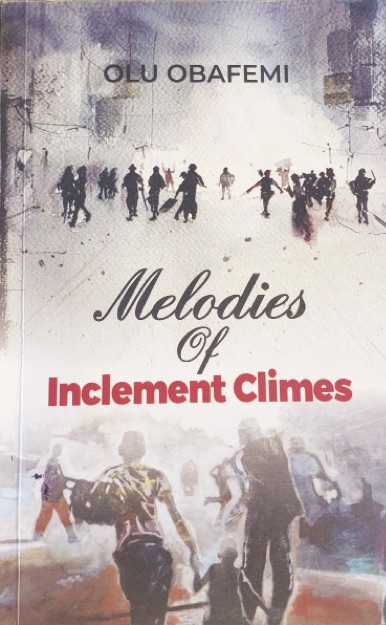
‘Melodies of Inclement Climes’, a newly published poetry collection by Prof Olu Obafemi, reminds of Kutukenge, a popular royal masquerade in Ijebu Remo, Ogun State.

Both share similarities with respect to their constitution and art: They are shrines of gems that beam contrasting, colourful rays all converging to form a lustrous cone!
A great entertainer and satirist, Kutukenge dazzles with his repertoire of poetic lore and songs as with his rich wardrobe of resplendent costumes made of diverse folds of colourful fabrics he likes to switch in display.
Akin to the famous mask’s garment of many layers, Obafemi’s anthology presents a carnival of engrossing spectacles, songs and drama that ironically mirror mostly adverse patterns of life, seasons and harrowing human experiences at a personal, group, national and even global levels.
Published by Kraftbooks Nigeria Limited under the Kraftgriots series, the volume immediately advertises the paradoxes it embodies with the title and the corresponding intriguing images of social disorder on the book cover which nevertheless has a dramatic effect and visual appeal with touches of vibrant colours.
Composed of 32 poems all in five clusters, each having an average of six poems, ‘Melodies of Inclement Climes’ bares and blares Obafemi’s frustration and anger about Nigeria’s dysfunctional polity with its many woes; depicts the picturesque natural beauty of his indigenous community in Kiriland, Kogi State in its contrasting serenity and exuberance; and how the people are resiliently fighting marauding herdsmen and terrorists’ invasion and attempt to desecrate their pristine homeland and cultural heritage. It also laments the terror, losses, pain and misery the deadly Covid-19 pandemic from which he apparently personally suffered, subjected the world to.
The remainder of the five movements consist of odes to some of Nigeria’s dead and still living cultural icons – notably Wole Soyinka, Chinua Achebe, Clarke;D. O. Fagunwa, Biodun Jeyifo, Fela Anikulapo-Kuti, Femi Osofisan, Niyi Osundare, Odia Ofeimun, Akachi Ezeigbo and Oya, Yoruba goddess/Queen of River Niger.
Cutting through all the strain, however, is the indicting questioning: why has the country failed to harness and profit from their labour and rendered their noble endeavours waste? It underscores his remarkable humility that the author omits mention of his membership of this pantheon of cultural icons.
Similar voice of despair permeates the dirges for the late Pius Aladesanmi, the erudite Nigerian-Canadian scholar and satirist who, in apparent foreboding, predicted his own death in a plane crash; and Tolulope Arotile, the first female combat aircraft pilot killed in a car accident on a military base in Kaduna. Obafemi bemoans the sudden and tragic deaths of these promising young stars and the abortion of the great dreams and hope this meant for the country. The duo were, like himself, part of Kogi’s critical contribution to Nigeria’s elite of rare high calibre manpower. Another elegy in the book pays tribute to Kofi Awoonor, the late Ghanaian writer and diplomat killed in the 2013 al-Shabaab-sponsored terrorist attack on a shopping mall in Nairobi, Kenya.
If, as has been observed, the late J.P. Bekederemo Clarke’s plays gave him away more as a poet than a playwright, the inverse can well be said of Obafemi, as his background and powerful skills as a veteran dramatist are all just too evident in this second published collection, coming after his first effort, ‘Songs of hope and illuminations’.
Beyond the rich lyricism and specious diction, laced with native wit, metaphysics, proverbs and idioms; the lines are so powerfully evocative that they make the people, scenes and situations being described “practically” come alive before the mind’s eye of the reader.
Even with the more contemplative ones, the poet compels the reader’s empathy for his views, moods and emotions – alternating from anger, disgust, sadness, joy to indignation, enthusiasm and all kinds.
Beyond the poetic ecstasy and epic theatrical spectacle he succeeds in arousing, one also encounters here a poet of deep sensitivity and sensibility, brutally frank with the truth and unable to live down his disappointment and angst at the political leadership for allowing mass suffering, deprivation, banditry, terrorism, crime, poverty, corruption, disease, economic distress, unemployment and other ills plaguing the society spin out of control and snowball into heart-rending human crisis. It’s either the political class was incompetent, complacent, clueless or downright conscienceless, he submits.
In poems such as “Those who gaze beyond today”, “Silent night”, “The Lekki turmoil” and “Songs that break the heart”, “The power game, again”, he decries the culture of waste, mis-governance, cycles of electoral charades as well as the brutal suppression of #EndSars and other pushback moves by the youths and the civil societies against official excesses and impunity, predicting freedom and triumph for the patriotic protesters in the next rounds of demonstrations he says will be formidable.
In “The power game, again”, for instance, he groans: “Now it’s time again/For the games/We should have played when we wore shackles and iron cast brand chains as bracelets and bangles/In our own homes and homesteads;/The politics of disinheritance/Which turned our innocent Virginia into vagabond mistresses,/ Our brilliant boys with their gazes set for endowed tomorrows/To prowling beasts, shelving their kid toys and baby gloves/For Killer guns and gauntlets.’
The poet devotes huge swaths of the book pages to meditate on the lethal and epidemiological blight caused by the insurgency of corona virus in 2019. In “Returning travellers to these shores”, “Love in the season of Koro”, Thoughts on Christmas eve” (I & Ii); “Only Stay at home” and “Travellers tarry a while” and “Lyrics in a time of strain”, he paints the pain sufferers underwent, and bemoans the massive social dislocation, sense of solitude, detachment, individualism, extermination of African hospitality and communalism; curtailment of friendliness, romantic love expressions as well as erosion the ecstatic joy of the Christmas festival and its replacement by terror – all imposed by health safety protocols to check the contagion.
He, however, concluded on a note of defiance and hope that: “Friendlier and kinder climes shall soon return/ And love shall visit these shores again,” in ‘Love shall visit these shores again.” And in ‘Thoughts on Christmas eve II, he boasted assuredly: “Still we live,/Live on,/Free from the stampeding-jackboot/Of your ravaging, soulless menace:/I shall live,/ We shall live/ I/We shall join the songs and dance/ Tomorrow.”
On the other hand, the poems offer insights into what could be the inner working of the mind of the sick person – an interplay of emotions – pangs of anxiety and dread mingled with hope and yearning for life – all providing a basin and pedestal for interrogation of life and existential questions. The illumination gained from the discharge of the burden yields grateful appreciation and acceptance of realities as well as assuaging relief.
Obafemi’s deep concern underscored by his generous treatment and repeated emphasis on the dreaded scourge probably explains why he dedicates the book to the memory of the victims of the deadly disease.
But beyond the morbid, the work is a whale of aesthetic delight. What with the poet’s stirring converse with nature both in the city and the countryside and his artistic genius in unravelling and presenting the diverse aspects of the eco-system and culture of his ancestral homeland with all the fascinating history, aphorisms, sacred beliefs, norms and taboos that go with them. No fitter bait can probably ever be found to promote eco-tourism of this heartland of Nigeria!
But the most remarkable highpoint of this grand work lies, as has earlier been observed, in its dramatic essence and performatory qualities. With the creative and imaginative manner Professor Obafemi succeeds in animating the alphabets and imbues them with vigour to dance, sing, wail, fight ‘Eke’ traditional wrestling matches and “snake”, like the routes of the rivulets, streams and brooks, through “the belly of the groves, /the forests, the crevices of the hills – clean and noiseless/As the headstrong and fount of origin/… unpalatable roads and pour inevitably into the troughs/Of the numerous scapes – hills and land/ Of Kiri mountains.”; it should be an easy but rewarding task for a resourceful thespian to explore and interweave the common and related themes for a good stage production of ‘Melodies of Inclement Climes’.
It is surely a challenge worth embracing for a slice of its beauty and to do full justice to the potential of this artistic leviathan!