Follow Us on Google
By Damiete Braide
At the Nike Textile Museum, along Abuja’s International Airport Road in Piwoyi Village, the air hummed with creativity and reflection as Nigerian multidisciplinary artist, Kolapo Olorunyemi, unveiled his seventh solo exhibition entitled Continuum (The Nutopia Project).
The show, which opened on Saturday, November 8, and ran till Sunday, November 16, 2025, was more than an exhibition, it was an immersive dialogue between the past, the present, and the imagined future of African identity.
Olorunyemi, whose artistic practice fuses tradition, identity, and futurism, is renowned for bridging ancestral memory with speculative vision. His art emerges from the crossroads of dreams, history, and technology, an expression of Afrofuturism that challenges how society preserves its cultural roots amid rapid transformation.
At the core of his creative philosophy is Nutopia, a visionary universe that imagines a future where innovation and heritage coexist beyond the boundaries of skin color and geography.
Curator and art publisher Susa Rodriguez-Garrido described Continuum as an invitation into a living memory. “In Continuum (The Nutopia Project),” she wrote in the foreword, “Kolapo draws us not only into an imagined world but into a living continuum where past and future converse and illuminate each other. The exhibition extends the Nutopian universe into an active field of resonance where every mark and gesture becomes part of a collective act of seeing.”
This exhibition continued Nutopia’s journey across continents, from earlier showings in Vigo, Spain, and London, UK, to New Delhi, India, before arriving in Nigeria for its most introspective chapter yet. Through paintings, sculptures, drawings, and an interactive projection installation, Olorunyemi reimagines ancestral narratives while questioning what it means to be African in a digitised world. His pieces, from Awelewa Awakening to Na Light Go Open Future Eye, pulse with an energy that is both prophetic and intimate, suggesting that the future is not distant but already unfolding through our consciousness.
Professor John Oyedemi of the University of Jos, who has followed Olorunyemi’s artistic journey since his 2018 residency at Alexis Galleries, Lagos, described the artist as “a poetic creator who fuses deep emotion with sculptural African traditions.” He notes that each of Olorunyemi’s works transports the viewer “into a surreal dreamscape where cubist forms blur the line between reality and imagination.”
Indeed, Continuum feels like a living organism, its works breathing rhythmically, carrying echoes of Yoruba symbolism, sculpted light, and spiritual energy. The textures, colours, and forms weave stories that traverse time, merging memory with possibility. Olorunyemi’s art is deeply rooted in his Nigerian heritage, yet his technique and philosophy resonate with global audiences who see in his works the shared human desire to connect the ancient with the futuristic.
Curator Katurag Chinyio, who coordinated the Abuja exhibition, described Olorunyemi’s work as a “meditation on time and transformation.” She observed that the artist’s practice “extends beyond painting into sculpture and installation, reflecting a continuous inquiry into how history and culture can be carried forward into the future.” For the artist, Continuum was not simply an art show, it was a journey through identity, a mirror that invited viewers to look deeper into themselves.
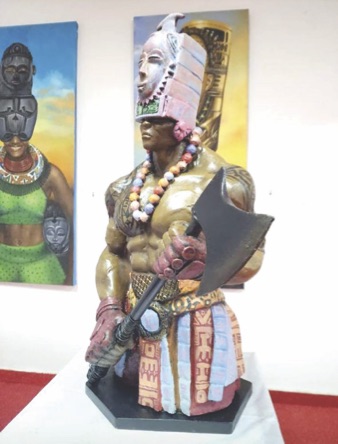
Among the 24 works on display, comprising 16 paintings, five drawings, two sculptures, and one interactive projection, each piece invited the audience to engage not merely as spectators but as participants. One of the standout works, The Portal, captured the essence of Nutopia. Olorunyemi recalled that the piece was inspired by a dream in which he saw “people made of light walking through thin veils, their bodies carrying patterns like circuits.” He interpreted this vision as a metaphor for continuity, how the past remains alive within us, shaping what we are becoming.
“When people stand in front of The Portal,” he said, “they don’t just look at it; they feel drawn in. Some say the painting looks back at them. That’s what I wanted, for the viewer to become part of the journey.”
Olorunyemi explained that The Portal served as a bridge between his earlier Awelewa Awakening series and Nutopia, symbolizing the awakening of African self-awareness beyond borrowed perspectives. “To imagine the world ahead,” he reflected, “we must carry the world behind us with tenderness and truth. Art becomes a doorway, every brushstroke a step, every light a memory, every viewer a traveler.”
In Nutopia, technology is not a threat to tradition but its companion. The artist envisions a future where culture and innovation exist in harmony. “The story of Nutopia,” he said, “is not just about what’s possible with technology; it’s about what we choose to value. African culture is alive and evolving, not something from the past.” This philosophy comes alive in works like When the Surrogate is a Surrobot, a thought-provoking piece exploring the ethics of artificial birth and emotional connection. “Can steel replace flesh?” Olorunyemi asked. “If a robot becomes the surrogate, does it also become the mother, or is something lost in translation?”
Beyond his creative vision, Olorunyemi remains deeply grounded in gratitude. He attributed his journey to divine guidance and the unwavering support of his wife, family, and friends. He also acknowledged the instrumental role of Susa Rodriguez-Garrido, founder of Agama Art Publishing and Agency Ltd, who had helped promote his art globally.
Ultimately, Continuum (The Nutopia Project) is a mirror and a map, an invitation to slow down, to see, and to remember that the threads of our past continue to shape our unfolding future.
For Olorunyemi, art is not just expression; it is revelation, a luminous bridge between ancestors and algorithms, between who we were and who we are becoming.