Follow Us on Google
From Adesuwa Tsan, Abuja
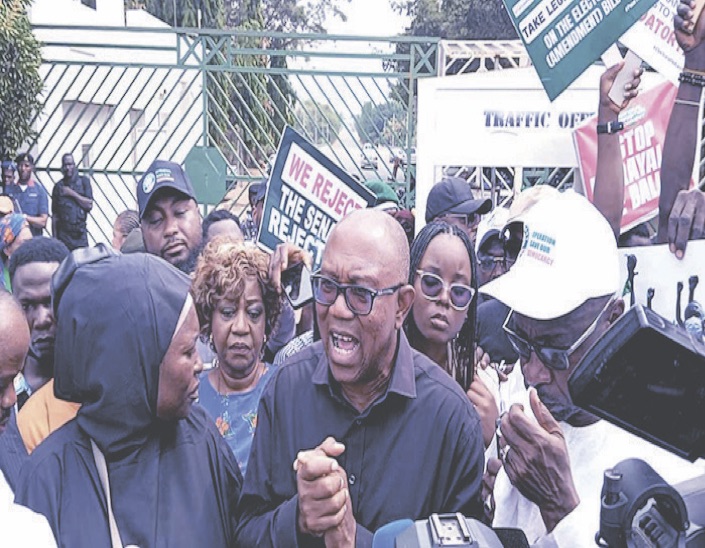
Former Labour Party (LP) presidential candidate, Mr Peter Obi, yesterday led hundreds of protesters, including civil society organisations and prominent activists, to occupy the National Assembly Complex in Abuja, against the Senate’s rejection of real-time electronic transmission of election results.
Among the leading voices at the protest were Co-convener of the #BringBackOurGirls movement, Mrs Aisha Yesufu; human rights lawyer and activist, Mr Deji Adeyanju and the Convener of the Concerned Nigerians group, Mr Damilare Adenola, alongside other civic leaders and members of the Obidient Movement.
The protest followed the Senate’s decision last Wednesday, during clause-by-clause consideration of the 2022 Electoral Act Amendment Bill 2025, to vote against a recommendation by its Ad-hoc Committee on Electoral Matters, seeking to amend Section 60(3) of the Electoral Act to make electronic transmission of results mandatory.
Defying heavy security presence, the protesters converged early on the main entrance and adjoining gates of the National Assembly, chanting solidarity songs and displaying placards demanding transparency, accountability and credible elections.
Security operatives drawn from the Nigeria Police Force, the Nigerian Army and the Nigeria Security and Civil Defence Corps (NSCDC), were deployed across the complex to manage the crowd and restrict movement in and out of the legislative premises.
Addressing the crowd, Obi described the Senate’s action as a grave setback to Nigeria’s democratic progress, warning that it could erode public trust in elections ahead of the 2027 general polls. He added: “The refusal to make electronic transmission of results compulsory is a serious threat to the credibility of our electoral process. We saw in the 2023 elections how lack of transparency in result transmission fuelled disputes and public anger. This decision risks deepening that crisis.”
While dismissing claims that technical challenges and infrastructure gaps justified the Senate’s position, he said: “Several African countries have adopted electronic transmission successfully. Nigeria cannot continue to hide under excuses. Technology should strengthen democracy, not weaken it.” Also speaking, Yesufu described the Senate’s decision as a deliberate attempt to weaken electoral accountability, warning that citizens would resist any legislative effort aimed at reversing the hard-won democratic reforms.
Other News
“This is about the future of Nigeria. We will not allow a few lawmakers to mortgage our democracy. Nigerians are watching and history will judge every action taken here,” she said.
On his part, Adeyanju accused the Senate of attempting to roll back electoral reforms achieved through years of advocacy and public pressure, describing the amendment as “an invitation to electoral manipulation.”
“This is not just about technology; it is about trust. When you remove transparency, you create room for fraud. Nigerians will not accept this,” he said.
Several civil societies who spoke at the event warned that failure to reverse the amendment could deepen voter apathy and undermine confidence in democratic institutions.
Meanwhile, the Nigeria Labour Congress (NLC) has threatened to mobilise nationwide protests and consider election boycotts should the Senate fail to reconsider its position.
In a statement, the NLC said credible elections remained central to democratic stability and warned that any attempt to weaken electoral transparency would trigger widespread public resistance.
The demonstrators vowed to sustain pressure on the National Assembly until lawmakers reverse the decision and fully restore electronic transmission of election results in the Electoral Act Amendment Bill.