Follow Us on Google

By Dotun Olayemi
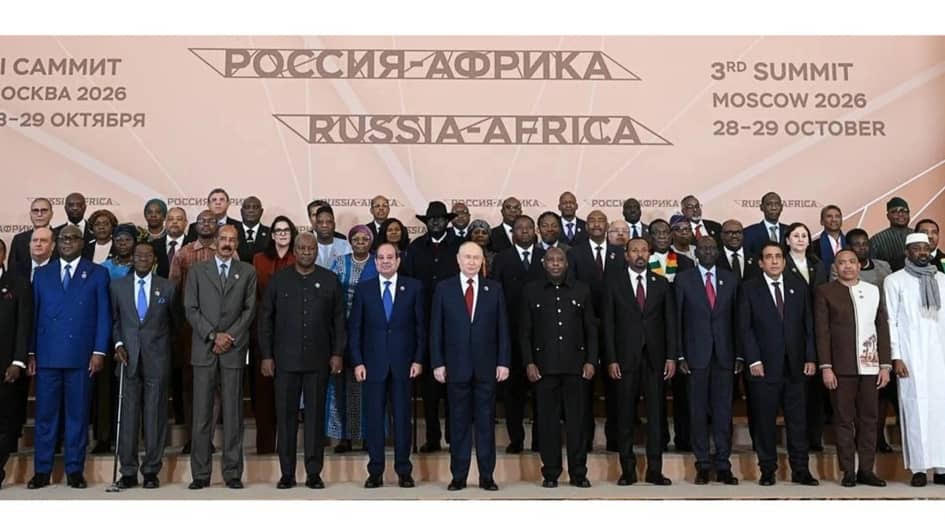
Now that the Russia-Africa Summit is over, it is pertinent that Africa takes stock of the promises made at the Grand Kremlin Palace on 28 and 29 October. Since the dust have settled, the real questions must be asked. Was this a meeting between equals, or a market where one side knew exactly what it wanted while the other left with a handful of assurances?
To begin with, let us look at the big promises. Speaking at the third Russia-Africa Economic and Humanitarian Forum in Moscow, President Vladimir Putin said Russia would double its trade with Africa to more than $50 billion. That sounds like a feast. But look at the plate. Trade between Russia and Africa reached about $27 billion last year, far below what the continent does with China, the United States or Britain. Worse, that figure missed the $40 billion target set at the 2019 Sochi summit. So Africa is being offered a bigger promise by a partner that did not deliver the last one. Imagine a trader who sells almost everything to three big buyers and a tiny portion to a fourth. When that fourth buyer says, “I will double my orders,” the trader should smile politely and ask for the agreement in writing. Double a small figure is still a small figure.
Putin did not come empty-handed, and the list of offers deserves a fair look. He spoke of using national currencies for payments, so that trade can bypass Western financial systems. He spoke of more than 30 energy projects across 16 African countries, including possible floating nuclear power plants supplied by Rosatom. He also reminded his guests that Russia sent 13 million tons of grain and fertiliser to over 40 African countries in the first nine months of the year. Some of this could help. Africa needs power and food. But every offer on that list also binds the receiving country to Russian suppliers, Russian technology and Russian terms, and no African leader should sign anything before asking who owns the plant, who sets the price and who pays when it breaks down.
Speaking on this optics and true stance of the terms of negotiation at the summit, Journalist and foreign policy analyst Olugbenga Ayanuga posited that:
“Every summit has two agendas, the one on the programme and the one in the photographs. The programme says trade, energy and food. The photographs say something else. When a leader stands beside Putin in the Grand Kremlin Palace, Moscow is telling the world that it still has friends and that the isolation story is false. That image is worth more to Russia than any contract signed in the corridors, and Africa hands it over for free. That is the quiet trade beneath the headline trade.”
To his credit, African Union chair and Burundi’s President Évariste Ndayishimiye did say something sensible in the hall. He urged Russian firms to go beyond digging up raw materials and invest in local processing, manufacturing and job creation. That is exactly the right message, because Africa has sold raw materials for generations and stayed poor. The test now is whether that request is turned into a written commitment or left as a polite line in a speech.
Nigeria’s own story illustrates the point. Vice President Kashim Shettima had first been slated to lead the delegation, but the federal government downgraded it, and Minister of State for Foreign Affairs Ambassador Sola Enikanolaiye delivered the national statement instead. Notwithstanding, Nigeria did come away with something. Aviation Minister Festus Keyamo opened talks to rewrite the 1967 Bilateral Air Service Agreement, and the Nigeria Customs Service signed a cooperation pact with its Russian counterpart. Those are useful steps. But Africa’s most populous nation sent a lower-level team to a table where weight matters, and everyone in the room could see it.
Efforts to obtain comments from the office of the Honourable Minister of State for Foreign Affairs, Ambassador Sola Enikanolaiye, on Nigeria’s participation at the summit, including the decision to field a lower-level delegation, were unsuccessful, as messages sent to the office had not been responded to at the time of filing this report.
“The attendance figures tell the other half of the story. Forty-three leaders at the first summit and 22 at the third is not a casual drop. It is a market signal. A buyer who walks in divided is a buyer who can be played, and Moscow can see that. Russia can offer one country a defence pact, another a scholarship quota and a third a nuclear plant, and none of them will compare notes. That is how a continent of more than a billion people ends up negotiating like a collection of small traders.
“Africa holds real cards. It has the votes at the United Nations, the minerals, the young population and the market. But cards only count when they are played together. The African Union and the African Continental Free Trade Area give us the platform to do that. What we lack is the discipline to say, as one bloc, that nobody gets our votes, our workers or our resources without written, enforceable terms. Until we find that discipline, we will keep leaving these summits with warm words while the other side leaves with the photographs,” Ayanuga submitted.
So, now, what is the real danger? It sits in the fine print nobody is reading, and it has a human face. Behind the trade figures is a quieter business; the recruitment of young Africans into Russia’s war machine.
Ministers across the continent have reported hundreds of recruitment agencies offering jobs in factories, construction and hospitality in Russia, through which some recruits ended up conscripted into the army. Ministers across Africa have reported the presence of hundreds of recruitment agencies offering jobs in factories, construction and hospitality across Russia, through which recruits have ended up being conscripted into the Russian military. Kenya’s own foreign minister admitted in April that at least 252 Kenyans had been recruited, many through illegal networks. Ghana, Kenya, Nigeria, South Africa, Cameroon and The Gambia have all raised alarm about their citizens.
At the summit, two presidents pushed back. President William Ruto said Putin confirmed that Kenya has been categorised as a non-source country for recruitment into the Russian military, and that a Defence Attaché in Moscow would work with Russia’s Ministry of Defence to process compensation and help Kenyans return home. Ghana’s President John Mahama raised the matter too. Ghana’s Foreign Ministry says Putin declared that Ghanaians are no longer allowed to take part in the war, which reportedly claimed dozens of Ghanaian lives. Ghana says the ban covers both voluntary enlistment and irregular recruitment.
These are welcome gains, and both leaders deserve credit for raising the matter face to face. But look closely at what was actually secured. The Ghana account comes from its foreign minister, and the Kremlin record published so far does not mention the recruitment ban, and it is unclear how it would be enforced. Within days, the Russian embassy in Accra described allegations of deceptive recruitment of Africans as “blatant lies” and accused Ukraine of recruiting foreigners too. That is not the language of a government that has accepted a binding duty. An assurance is not a law, and a promise made to one country protects no other. As far as the coverage shows, no comparable assurance has been reported for Nigerians, even though Nigeria is among the countries that raised concerns.
There is also a second door that few are watching. Kenya’s talks with Putin included plans for a bilateral labour agreement that would let Kenyans live and work in Russia. Labour deals can be good for workers, but the same label can hide a trap.
That brings us to Alabuga. Investigations by this newspaper, other international media and rights groups have suggested that hundreds of young African women were recruited through a programme called Alabuga Start. Young women are recruited to provide labour for the Alabuga military-industrial complex in Tatarstan, and they are promised training and a good salary. The brochure speaks of a career, a salary and a new life abroad. The factory floor, according to those same reports, is a drone-manufacturing site feeding the war. These women never carry a rifle. Yet they are made part of the war effort, often without knowing it, and a promise that “Africans will not fight” says nothing about them at all. A government can win a ban on soldiers and still lose its daughters to a drone factory.
The problem is not imaginary, and it is not confined to the battlefield. In South Africa, police announced the arrest of nine foreign nationals, aged 20 to 26, suspected of breaching the country’s mercenary laws by trying to travel to Russia to fight in the war with Ukraine.
They were picked up at O.R. Tambo Airport and at a hotel in Johannesburg’s Bruma neighbourhood, after an investigation involving Interpol. Police did not name their nationalities or say which side they meant to join, but the case shows that young people are being moved across borders towards this war, and that only vigilant officers stood in the way.
Meanwhile, labour and industrial cooperation deals are moving ahead with far less attention. A young man or woman offered “factory work” abroad rarely sees the small print. Who checks the contract? Who confirms the factory is not feeding a war machine? Who brings the worker home if things go wrong?
This is why African governments must ask for more than a promise that their citizens will not be sent to Ukraine. They should demand protections with teeth, starting with recruitment transparency. Every agency and every job offer must be openly registered, so that no young person is lured by a faceless middleman. Contracts must also be clear, with pay and duties written in plain language the worker understands, not buried in legal jargon or a language he cannot read.
Once a worker arrives abroad, his safety must not be left to chance. African officials should be able to inspect workplaces and verify conditions for themselves, rather than relying on the employer’s word. Freedom of movement must be guaranteed as well, which means no confiscated passports and no workers held against their will. Embassy staff should be able to visit their citizens at any time, so that no African is left alone in a foreign land with nobody to call.
If things go wrong, the worker must have a way out. That means a guaranteed ticket home and fair payment for injury or loss, so that families are not left to bury their sons or nurse their daughters at their own expense. Above all, there must be a firm ban on placing any African in a military-production facility, Alabuga included. A promise that Africans will not fight is empty if they can still be made to build the weapons.
None of this can be won country by country. It calls for a common negotiating framework, with the African Union speaking for the continent, and with every assurance written into a signed agreement rather than announced after a handshake. Alone, each nation is a small trader begging for a fair price. Together, Africa is a market of well over a billion people that no power can wave aside.
Russia has made clear that it wants Africa. The harder question, now that the dust has settled, is whether Africa will name its price, put it in writing and stand together to collect it.