Follow Us on Google

From: sunday ani <[email protected]>
Date: Thu, 26 Nov 2026, 18:23
Subject:
To: <[email protected]>
By Sunday Ani
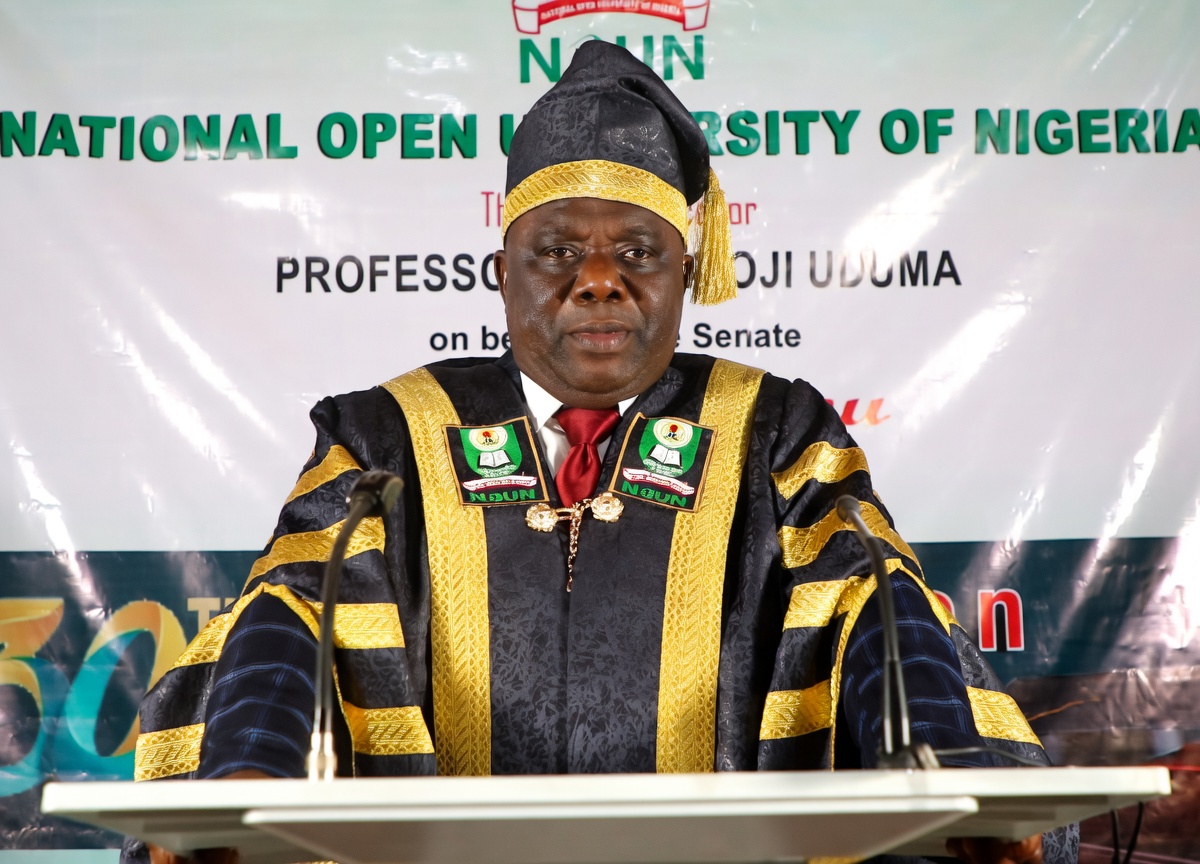
The Vice-Chancellor of the National Open University of Nigeria (NOUN), Prof. Uduma Oji Uduma, has charged the global education community to ensure that Artificial Intelligence remains a servant of learning and not a master over humanity.
Speaking at the opening plenary of the UNU Macau AI Conference 2026, themed, “AI × Education: AI for Learning, Learning for AI,” Uduma insisted that every AI policy, tool and innovation must place the human being at the centre.
“AI should not be made to replace but assist human beings,” he declared. “In all we do with AI, let us put the human being at the centre. Let AI assist us. Let us interrogate information and let us ensure that as education expands, humanity is not lost.”
The conference brought together policymakers, lecturers, researchers and young innovators from over 114 members of the network across six continents to examine how AI is reshaping teaching, learning and assessment.
A veteran of Open and Distance Learning, Uduma said AI was not new, but its rapid entry into schools and daily life had changed everything. In distance learning, he noted, technology had always been the bridge but AI is now making that bridge wider, helping teachers reach more students, helping students learn at their own pace and making a class of thousands feel more personal.
But he warned that AI should help teachers teach, not take over teaching.On examinations and assessment, he said students and teachers must not copy what AI gives them blindly but check it, question it and improve on it.
“Put AI answers in parenthesis,” he said. “Information should be interrogated.”
He said Africa cannot sit and watch while others decide how AI will be used in education. Africa must have a say and must shape it.
He warned that while big tech companies now see Africa as a new market and want to invest, such an investment must actually help Africa grow, not just take from it.
He accused big tech companies of wanting to “fatten the cow before eating it” instead of building Africa first, building its people and its systems, before talking about profit.
He listed the real barriers holding Africa back to include power, internet, security and governance.
“Without light, there is no learning. Without the internet, AI cannot reach the child in a village. Without security, schools and students are not safe. And without good leadership and clear policies, even the best tools will go to waste,” he said.
“Africa requires more infrastructure to be able to keep pace with the developed world,” he added, calling for serious, long-term investment and global support.
“AI has come to stay, and the question now is whether Africa will be ready for it,” he wondered.
That readiness, he said, starts with teachers. Teachers must be properly trained and the most important skill is learning how to talk to AI, how to ask the right question. A good question gives a good answer, while a careless question gives confusion.
Africa must also rethink how it teaches, tests, trains teachers and how it deals with big tech companies.
He concluded that inclusion must mean something real: the woman in a remote community, the student with a disability, the worker who studies at night and the mother who cannot leave home to attend lectures.
AI should make life easier for them and break down barriers of language, distance and cost. But that will not happen by itself. If the tools are built without thinking about African languages, African realities and African learners, they will only widen the gap between rich and poor.
Institutions, he said, must be deliberate, build their own capacity and make sure nobody is left behind.
Addressing the dangers of fake information, cheating and over-dependence on machines, he urged schools to teach students to question, check and think for themselves and to put proper rules and human oversight in place.
As the conference moved into workshops and the youth innovation competition, his message lingered: AI is a tool, not a master. Access must come with quality. Trust must be earned. People must lead.
AI will not replace teachers, he concluded. It will change their work, from givers of notes to guides and mentors who help students think clearly. Universities will not disappear, but they must rethink how they teach, test and support students in this new age.
What is needed now, he said, is leadership, training, better infrastructure, clear rules and research done by Africans, about African problems.
With the youngest population in the world and growing demand for flexible, affordable university education, he said distance learning, done well with AI, could help meet that need, but only if it is built on human values.