Follow Us on Google

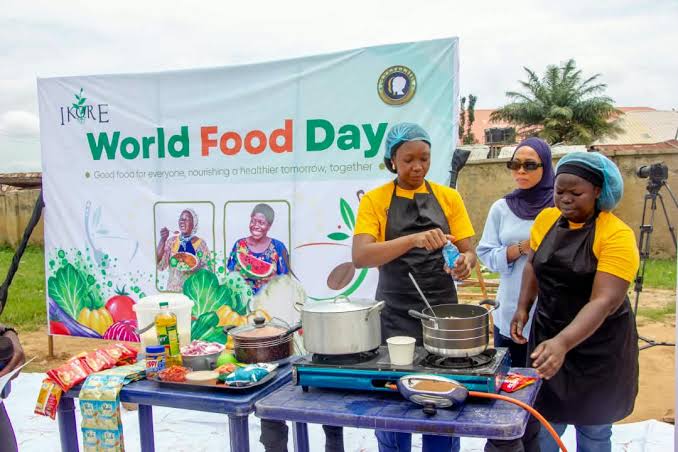
The Rotary Club of Abuja Renaissance has distributed food and provided health services and skills training to internally displaced persons (IDPs) at the Area 1 Durumi IDP Camp in Abuja as residents continue to face food insecurity, poor sanitation and limited livelihood opportunities.
The intervention took place on Friday as part of activities marking the 2026 World Food Day. It included nutrition education, health screenings and practical skills training for women in the camp.
Speaking at the event, the Charter President of the Rotary Club of Abuja Renaissance, Pat Ofik, said the programme was designed to address the immediate needs of residents while helping some of them develop skills to earn a living.
She said four training sessions were held, with at least 40 participants expected to benefit from the skills acquisition programme.
According to her, the club would follow up with participants to determine whether they were applying the skills acquired and identify areas where further assistance might be needed.
“As Rotarians, we believe in service above self. We try to identify the needs of communities and provide assistance where we can. “We have a team that will follow up with those trained to find out whether they are putting what they learnt into practice,” she said. Ofik added that the programme would be implemented in phases, beginning with practical training and the provision of basic equipment, including frying pans.
Subsequent phases would focus on digital marketing and using social media to promote participants’ products.
Also speaking, the camp’s Public Relations Officer, Umaru Gola, said residents had depended largely on donations from individuals and organisations for more than 13 years.
“Our feeding and other basic needs depend largely on the support we receive from well-meaning Nigerians,” Gola said.
He said the camp also relied on the Rotary Club for access to drinking water, adding that the community needed more support from government and humanitarian organisations.
Gola appealed to non-governmental organisations, private individuals and Nigerians in the diaspora to assist residents.
The camp’s women leader, Leatu Ayuba, said the food and other items provided offered relief to residents who had faced prolonged hardship.
“Today feels like Christmas or Sallah for us. From January to October, we had not received this kind of support, with so much food, medicine and other essential items provided for the community,” Ayuba said.
She said the Rotary Club had supported the camp with food and water since 2017 but noted that residents continued to face inadequate sanitation, poor shelter, unemployment and limited access to education.
Ayuba expressed concern about the shortage of toilets and poor ventilation in the camp, saying the conditions posed health risks, particularly to women and children.
She also said many children were unable to attend school because their families could not afford the associated costs.
According to her, about 600 children attend the school within the camp, while many others remain out of school.
She called on the government and humanitarian organisations to provide more support for education and livelihood programmes.
As part of the event, the Dietitians Association of Nigeria provided nutrition education, health screenings and food demonstrations to help residents understand healthy eating and the prevention of malnutrition.
The chairman of the association, Uchenna James, said dietitians helped individuals and families understand how food choices affect their health and how to prepare nutritious meals with available resources.
She said the team’s activities included measuring residents’ weight and height, checking for possible signs of malnutrition and demonstrating healthy food preparation.
James said proper nutrition was important for children’s growth, brain development and overall well-being. She urged parents and caregivers to provide balanced diets and adopt appropriate feeding practices, including breastfeeding.
Lead facilitator for the End Polio Now learning seminars worldwide and a past district governor of Rotary District 9400, Stella Anyangwe, said annual global polio cases had declined from about 350,000 to fewer than 100 following decades of vaccination campaigns.
She identified Afghanistan and Pakistan as the two countries where wild poliovirus remained endemic and urged parents to ensure their children received routine immunisation.
Anyangwe also called for sustained funding for vaccination programmes, noting that the remaining cases continued to pose a risk to children.