Follow Us on Google

•Electricity consumers rail against FG, discos over outrageous bills, unavailability of prepaid meters
Tessy Igomu
Pa Ephraim Adefuwa, a landlord on Peter Agha Street, Oke-Afa, Isolo, Lagos, clutched an electricity bill that he found wedged beside his analogue meter. His face was a picture of palpable anger.
“This is crazy,” he exclaimed. “How can I pay N17,000 this month after paying N12,000 last month? I wonder the ridiculous amount they would bring next month. Is it not better for me to rely only on my generator for electricity?”
 For Wale Komolafe, a small-scale manufacturer in the same area, the last two years had him experiencing what he termed “colossal losses” in his business due to frequent power outage and outrageous electricity bills.
Of late, he has been groaning under the huge financial expense of running his two giant generators interchangeably, a decision borne out of the bitter experience of incurring huge losses due to electricity outage at the peak of production.
“I feel highly betrayed and cheated by this government. This was not the change I anticipated. How can I pay so much for electricity yet get darkness in return? I am not happy because the crippling effect on my business is distressing,” he said.
“For two weeks now, the electric bulbs in my apartment have not flickered while the sound of generators have become deafening. For some time now, we have not been able to even boast of a whole day’s electricity supply,” lamented Teju, a full-time housewife.
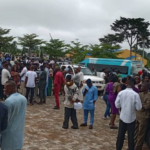
So, when there was a call for residents to stage a protest to the nearest Electric Distribution Company office (EKDC), to register their grievances, these aggrieved residents were among the first to arrive at the take-off point.
They joined other residents and marched in their numbers, bearing placards with inscriptions demanding to know why they were constantly handed outrageous bills despite persistent epileptic power supply to the area. The placards also urged residents not to pay for darkness.
Defiant and determined to get answers, they were undeterred by the scorching sun. At the EKDC office, they complained bitterly about living in darkness despite continued assurances by the federal government through the Minister for Works, Power and Housing, Mr. Babatunde Raji Fashola, that power generation had improved tremendously. Their anger was further fuelled by the fact that their formal complaints through letters were never addressed by the company’s management.
Angered by endless blackouts
That protest was not an isolated case. Pockets of protests have rocked various areas in Lagos and other states of the federation. The anger of many residents mirrors the rage and silent grumbling of most Nigerians at this time due to abysmal power supply. The discontentment reflects the grievances of consumers, both households and businesses, who have suffered years of incessant power outage and blackouts that have blighted lives and curtailed production activities.
With a hike in electricity tariff by 45 per cent, a rate approved by the Nigerian Electricity Regulatory Commission (NERC) and implemented by the distributing companies (discos) effective from February 1, 2016, consumers were of the belief that electricity supply would drastically increase.
Disappointed by the turn of events, residents are now forced to register their anger.
From the east to the west, north and south, there are cries of disenchantment from bewildered Nigerians. In many parts of the country, where people are not enjoying steady electricity supply and are forced to pay crazy bills for services not rendered, consumers are now taking the fight to the doorsteps of the relevant power distributing companies to demand better service.
The deluge of lamentation against abysmal power supply is not just coming from the poor. Also involved are middle-income earners and the rich, who all believe it is time to take hold of their destiny.
Trying to wriggle free from the estimated billing system has become an effort in futility for several consumers, as getting a pre-paid metrer has become a harrowing experience, while those lucky to have paid for the commodity have not had them delivered or installed at all.
For Nigerians who are presently hard-hit by harsh economic realities, the condition of service rendered by power distribution companies are simply unacceptable.
In many areas now, the mere sight of any of the electricity companies provokes so much anger such that, on several occasions, some elctricity officials have been attacked by angry consumers for even trying to distribute electricity bills.
Hindered development
Amid this unstable or non-existent power supply, economists have posited that adequate power supply is an unavoidable prerequisite to the development of any nation, as indices indicate that any country without constant power would remain stagnant.
Electricity plays a very vital role in the socio-economic and technological development of every nation. Sadly, the electricity demand in Nigeria far outstrips supply, which has always been epileptic in nature.
Since the invention of electricity by the legendary Michael Faraway, it has turned to be a crucial force in man’s daily existence.
The history of electricity in Nigeria is familiar. It is one basic amenity that is inadequate, irregular and non-existent in many quarters.
This is despite the recent assurance by the federal government that, as part of its new Power Sector Recovery Programme (PSRP) developed with the World Bank to revive Nigeria’s electricity industry from its declining status, it would ensure that the minimum amount of electricity generated and supplied to homes and offices across Nigeria daily would not be less than 4,500 megawatts, starting from 2018.
Nigeria, without gainsaying, is faced with acute electricity problems, which are hindering its development notwithstanding the availability of vast natural resources.
The consequence of this on businesses has been catastrophic and its rebounding, distressing effects, especially on small and medium-scale businesses can be seen everywhere, as many have folded up. Those still in partial operation, naturally, pass the high cost of production to consumers.
Indeed, there is widespread unemployment, as companies and commercial houses have downsized after groaning under cut-throat bills and epileptic power.
Years back, the total shutdown of Michelin Tyre factory, which had been in operation in Nigeria for decades, and the consequent retrenchment of 1,200 employees, was blamed on epileptic power. As more companies close shop in Nigeria, countries like Ghana and Benin Republic are reaping from the mass exodus, as their uninterrupted power supply has been attracting Nigerian businessmen.
A gas giant reliant on generators
Lack of constant electricity is unarguably the country’s biggest headache. It remains a forlorn dream that has made citizens embrace a more ‘reliable’ source of power supply, generators. Emir of Kano, Sanusi Lamido Sanusi, said, while addressing the challenges in the power sector in a forum years back, that generators produce 70 per cent of the nation’s power needs, and Nigeria has the unenviable record of being the largest importer in the world
As it stands, Nigerians are forced to fill the debilitating lacuna created by irregular power supply with generating sets, while the side effects cannot be ignored. The noise pollution these contraptions cause and the poisonous clouds of smoke they emit have left a trail of anguish and death across the country. Cases of entire families suffocating to death in their sleep, due to inhalation of carbon monoxide, are too numerous to mention.
Health facilities are not also left out of this malaise as instruments and equipment that depend on electricity for diagnosis and treatment of patients now lie idle.
The Egbin thermal plant in Lagos, one of the biggest in the country, with a capacity to produce 1,320 megawatts, is said to be producing less than half of its capacity, while Nigeria’s power grid, with an installed capacity of 6,500MW, generates less than 50 per cent of the amount. It has been stated that about 50 per cent of Nigerians do not have access to the national electricity grid and only 18 per cent of people living in rural areas are connected.
According to experts, ideally, Nigeria, with its 180 million people, needs above 40,000MW.
According to reports, Nigeria has an estimated 176 trillion cubic feet of proven natural gas reserves, giving the country one of the top 10 natural gas endowments in the world and the largest in Africa.
Indeed, if there is anything that has been of great concern to many Nigerians now and which makes them agitated, it is the problem of erratic electricity supply. The problem, like a hydra-headed monster, appears to be beyond redemption, as efforts by successive governments to revive the sector have failed.
Failed resuscitation efforts
In trying to improve the reliability of the power system, the federal government had over the years merged the Electricity Corporation of Nigeria (ECN) and Niger Delta Authority (NDA) to become the National Electric Power Authority (NEPA), in 1972; changed NEPA’s nomenclature to Power Holding Company of Nigeria (PHCN) in 2005 and, finally, in 2012, split PHCN into 18 companies with a view to privatising and restructuring them.
In the long run, it seems all the unbundling and name change have had little or no positive impact on the availability of electricity. Years after, the power generating and distributing companies are still trailed by scepticism, eyed with suspicion and greeted by widespread complaint by consumers. The appalling state of electricity supply witnessed across the country before the unbundling, many consumers lamented, has deteriorated into absolute darkness in some areas. Aggrieved consumers have maintained that, like their predecessors, they have not fallen short of being inefficient.
Unending blame game
Till date, the blame game continues. Fashola has blamed the inadequate electricity supply to consumers on insufficient financial investments in the power sector.
Inasmuch as he admitted that trillions of naira were in past years injected into the sector to revamp it, he maintained that “the money so far spent was inadequate to address the current challenges.”
Speaking not so long ago at the Nextier Power Dialogue in Abuja, Fashola also shifted the blame of the sector’s inability to generate 7,000MW of electricity on sabotage of power assets by militants.
He tried to dismiss the assertion that the national grid is not more than 5,000MW, stressing that it keeps growing every day. He maintained that, at its most frugal, the nation’s power grid would support 6,500MW and when pushed to its limit, would carry 7,200MW.
Many social critics have faulted Fashola’s summation, describing it unacceptable.
Investment made in futility
For someone like Mr. Raphael Ojo, a retiree with the defunct NEPA, it was sad that, instead of being a major power distributor, the power sector has metamorphosed into a bottomless pit that endlessly guzzles taxpayer’s money without any meaningful improvement to show for it.
Prof. Bartholomew Nnaji, former Minister of Power, once revealed that it costs about N8 billion to run PHCN annually and the amount was spent on recurrent expenditure such as salaries and retirement benefits.
Also, according to reports, over the years, government has been spending over $3.5 billion annually on power with nothing to show for it.
In the same vein, an estimated investment profile of about $8.2 billion sunk by the federal government through the Independent Power Project (IPP) and which was expected to add 5,454MW to the national grid also failed to deliver electricity to Nigerians years after the initiative was conceived.
The inability of the power sector to maximise the huge amount of money injected into it to revitalise its services, many believe, has made the country a dumping ground for all manner of substandard generators. Already, Nigeria has been rated as one of the world’s largest importers of generators.
In 1999, former President Olusegun Obasanjo raised the hopes of Nigerians when he promised that the country would start enjoying regular, uninterrupted power by the end of 2001.
The administration later went ahead to set a target of generating 10,000MW up from the 1,800MW that it met and billions were spent to resuscitate the power sector. NEPA, later PHCN, was divided into 18 companies and contracts were awarded to build independent power projects (IPPs) across the country. The National Integrated Power Projects were also designed to provide power plants in the Niger Delta and other states.
However, years down the line, the problem of endemic, intermittent electricity supply still pervades the country.
Nigerians were bewildered years back by a revelation of how the Obasanjo administration spent $16 billion on power. And to them, it was more of dashed expectations and betrayed hopes. The Godwin Ndudi Elumelu Power Probe Committee of the House of Representatives exposed that administration’s flagrant abuse of due process, ineptitude and corruption.
More disheartening was the discovery of abandoned equipment worth N4 billion in the warehouse of the Energy Ministry years back. Among the equipment left to rot for 10 years were cables, concrete poles and about 600 transformers.
Feeling exploited
Across board, Nigerians believe that they have been cheated and exploited for decades, and have experienced the worst form of service delivery by electricity discos. Many have opined that the pockets of protests are ways to demand better treatment.
For them, the fact that many businesses have collapsed, industries shut and residents unable to sleep comfortably at night due to inefficiency of the power industry was an indictment on past and present administrations.
According to an economist, Funsho Olujimi, investors are sceptical about putting their money in an economy that barely survives on poor power supply. He averred that government’s inability to manage the power situation effectively has left Nigerians feeling exploited, especially through the estimated billing system with its outrageous bills as well as the refusal of the discos to make pre-paid meters available.
In the words of a public analyst, Uche Nzeribe, Nigerians are not demanding too much by asking for an improved power sector, adding that, as it stands, consumers would no longer bear the brunt of the power providers’ ineptitude.
He maintained that, with the power situation still being treated with lethargy by the federal government, it would be a herculean task to convince electricity consumers to keep paying for darkness.
“The trauma of Nigerians living without steady electricity supply remains overwhelming and distressing. More painful is the realisation that the wait for revamping of the sector would be an endless one. Nigerians are defiant and aware; they want to know when this giant of Africa would stop groping in the dark. Constant electricity is the most basic thing to demand. It remains our inalienable right,” he said.