Follow Us on Google
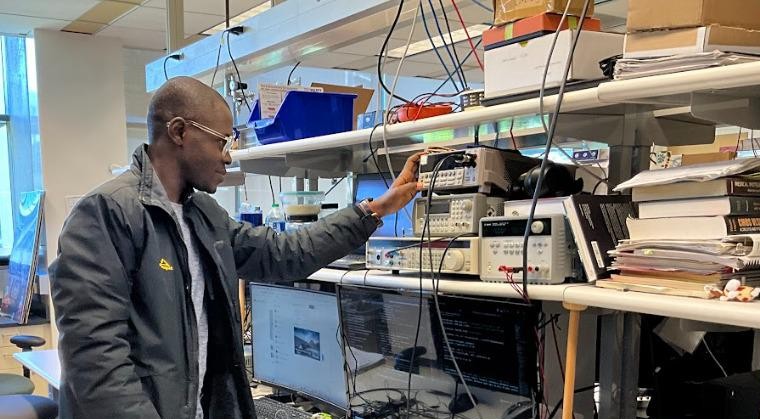
In laboratories at the University of California, San Diego, Nigerian bioengineer Omowuyi O. Olajide is helping advance one of the most complex frontiers in modern science which is understanding how the human brain communicates.
Olajide, a doctoral researcher in UC San Diego’s Department of Bioengineering, recently developed a 1,024-channel neural interface chip designed to record and interact with living human brain organoids in real time. The work was presented at the 2025 IEEE International Conference on Neural Engineering, where researchers from around the world gather to showcase breakthroughs in neurotechnology.
Brain organoids, which represent small three-dimensional tissues grown from human stem cells, have become an important tool for studying neurological diseases such as Alzheimer’s disease, epilepsy, and other brain disorders. However, scientists have long struggled with a major limitation: existing tools often cannot monitor the complex electrical activity occurring across these miniature neural networks.
Olajide’s chip addresses that challenge by enabling high-density neural recording across more than a thousand microscopic electrodes on a single device.
To improve performance, the chip incorporates graphene-based electrode coatings, which significantly enhance electrical conductivity between the device and biological tissue. Tests showed the graphene interface reduces electrical resistance and produces more consistent neural recordings across the entire array.
The technology allows scientists to monitor neural activity with far greater precision while also delivering controlled stimulation to living neural tissue.
Researchers say tools like this are critical as neuroscience moves toward more sophisticated models of the human brain and new approaches to studying neurological disease.
For Nigeria’s scientific diaspora, Olajide’s work reflects the growing global influence of Nigerian researchers contributing to breakthroughs in science, engineering, and biotechnology.
As research into brain organoids expands worldwide, innovations like this may help unlock deeper insights into how the human brain develops, communicates, and responds to disease.