Follow Us on Google
• NASS vows not to approve further budget rollovers
From Adesuwa Tsan, Abuja
The Senate has said despite public opposition, the Nigerian government would continue borrowing to finance budget deficits which stood at N25.91 trillion in the 2026 budget proposal presented by President Bola Tinubu in December, 2025.
Chairman of the Senate Committee on Appropriations, Solomon Olamilekan Adeola, who disclosed this yesterday, also declared that the National Assembly would no longer approve extensions of budget implementation cycles, emphasising that strict timelines, stronger oversight and improved fiscal discipline would guide the execution of the 2026 Appropriation Act.
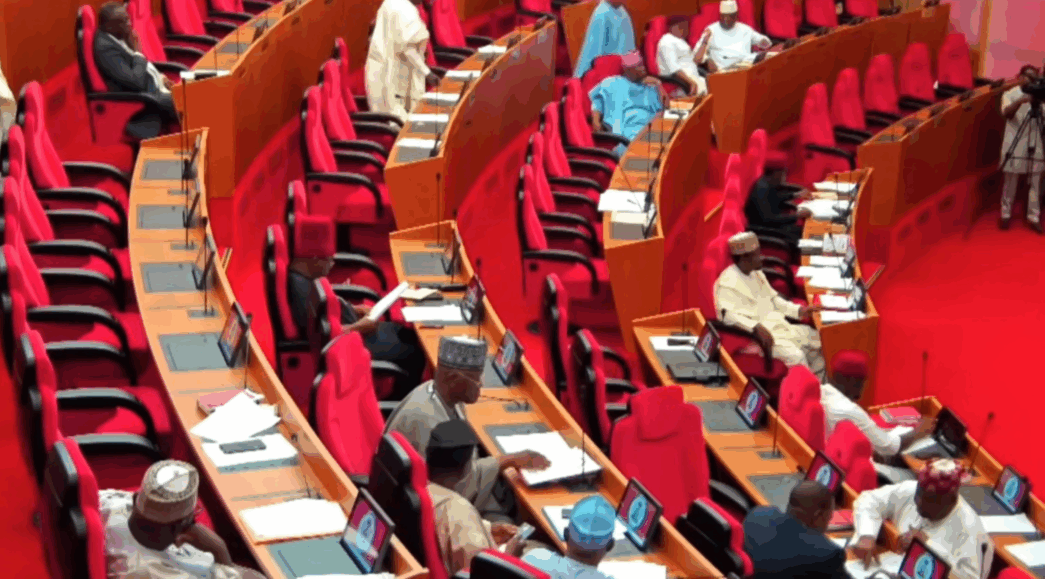
Adeola made the remarks during his welcome address at the public hearing on the 2026 Appropriation Bill at the National Assembly, which was attended by the Minister of State for Finance, the Accountant General of the Federation, economists, fiscal policy experts, and senior government officials.
“Never again will the National Assembly approve budget extensions. We must discipline our budgeting cycle, enforce strict adherence to appropriation timelines, and ensure better coordination between policy design and implementation,” he stated. He stressed that Nigeria’s development challenges and infrastructure deficit make borrowing inevitable, but warned that the government must adopt smarter, more sustainable deficit-financing strategies.
“Nigeria cannot help but keep borrowing because revenue inflows are unpredictable and development needs are enormous. What matters is how we borrow and how we fund our deficits,” he said.
While acknowledging that debt servicing remains a challenge, he said Nigeria must continue to honour its obligations to protect its sovereign credit rating and global economic standing. The appropriations chairman explained that, rather than relying heavily on domestic borrowing, which could crowd out private sector credit, the government is exploring asset optimisation, privatisation, Public-Private Partnerships (PPPs), joint venture asset leveraging, and Eurobond issuances.
“The government is deliberately avoiding excessive domestic borrowing that could crowd out private sector credit. Instead, we are exploring external financing, asset sales, and privatisation to bridge revenue gaps,” he said.
Earlier, economist and fiscal policy expert, Dr. Olatilewa Adebanjo warned that Nigeria’s rising budget deficit could become unsustainable unless urgent measures are taken to strengthen revenue mobilisation and enforce fiscal responsibility.
He called for a comprehensive review and stricter implementation of the Fiscal Responsibility Act (FRA), describing it as a powerful but under-utilised legal instrument.
“We need to remain alert and proactive. All stakeholders must closely monitor critical sectors to ensure revenues meant for the government actually reach government coffers,” he said.
He specifically warned of massive revenue losses in the mining and solid minerals sector, alleging that foreign interests, particularly Chinese companies, are extracting Nigeria’s resources with minimal financial benefit to the country.
“What we continue to see is a situation where foreign actors, especially Chinese interests, come into the country, extract our mineral resources, and leave with enormous value, while Nigeria earns little or nothing in return. This is a wake-up call,” he stated.
He also faulted unrealistic revenue projections, insisting that the government must budget based on credible, achievable figures.
“The government must deal with realistic figures, not just projections on paper. Revenue agencies must be compelled to work with actuals and be held accountable for performance,” he said.
While commending some agencies for improved performance, he urged sustained pressure to ensure higher revenue inflows, noting that rising revenue is critical to strengthening government capacity. On deficit financing, Adebanjo said he was reassured by Adeola’s clarification that the government intends to rely more on asset sales and joint venture asset leverage rather than excessive borrowing.
Also speaking, the Chief Commissioner of the Public Complaints Commission (PCC), emphasised that accountability and strong legislative oversight remain the most effective tools for addressing budget deficits and waste. He lamented persistent cases of abandoned projects, inflated contract costs, arbitrary cost variations, and poor execution by Ministries, Departments and Agencies (MDAs), noting that such practices deepen fiscal stress and erode public trust.
“Funds are appropriated, yet outcomes are often disappointing. In some cases, projects are abandoned or executed with very poor quality. Strong oversight and accountability mechanisms are essential to derive full value from public spending,” he said.
Responding, Adeola urged the executive to aggressively deploy Public-Private Partnerships (PPPs), particularly in infrastructure development, to reduce pressure on public finances.
“The government should invite the private sector to develop public assets, operate them for a defined period, and eventually return them to the government. Roads and other infrastructure should be concessioned to generate steady revenue and reduce endless public spending,” he said.
He further stated that the full unbundling of, and subsidy removal in, the electricity sector would unlock massive resources for funding critical projects. The lawmaker noted that although states are now empowered to generate electricity, subsidy reforms in the power sector must be completed to free additional revenue for national development.
“Trillions of Naira were spent annually on fuel subsidies, money that did not exist. We borrowed to fund it. The President took the bold step of removing subsidies, and that decision laid the foundation for the reforms we see today,” he said.
On the N58.47 trillion 2026 budget, he said it is anchored on ongoing reforms, including subsidy removal, tax system overhaul, public finance restructuring, and electricity sector reforms, describing it as a “Budget of Consolidation.”
He noted that most allocations were predicated on the expected performance of these reforms and warned that their success depends on effective implementation and people-oriented outcomes.
“These reforms were not implemented by the legislature alone. They are the product of collaboration between the executive and legislative arms, supported by the resilience and sacrifice of Nigerians,” he said.
Speaking on Nigeria’s budgeting cycle, he said the country must transition to a more strategic and disciplined framework, similar to global best practices, to manage limited resources amid enormous development needs.
He cited the example of the Ministry of Works, which may receive ₦500 billion when actual road infrastructure requirements exceed ₦2 trillion.
Other News
“This mismatch makes effective planning extremely difficult. We must prioritise critical sectors and avoid opening the floodgates to unsustainable demands,” he said.
He also pledged stronger legislative backing for the Fiscal Responsibility Commission, noting that although the Fiscal Responsibility Act is robust, its enforcement has been weak due to funding and capacity constraints.
“We will revisit the Act section by section and enforce compliance. The Commission’s reports will greatly strengthen legislative oversight,” he added.
He further stressed that all government funds, including Service-Wide Votes and special intervention allocations, remain subject to National Assembly oversight.
“There can be no claim that any fund falls outside legislative scrutiny. Without budgetary approval, no executive authority exists to spend public money,” he declared.
The chairman urged all stakeholders to remain engaged in ensuring that the 2026 budget delivers tangible benefits to Nigerians, while assuring that the Senate would deploy stricter oversight to ensure the budget translates into concrete improvements in infrastructure, security, job creation, and social development.
He explained that aggregate expenditure for 2026 was projected at N58.47 trillion, with expected revenue of N33.19 trillion, resulting in a deficit of N25.27 trillion. He said debt service would account for N15.90 trillion, while capital expenditure of N23.21 trillion underscored government’s commitment to infrastructure and productivity-enhancing investments.
According to him, key assumptions include an inflation target of 16.5 percent, exchange rate stabilisation around N1,400 to the dollar, oil production of 1.84 million barrels per day and a benchmark oil price of $64.85 per barrel.
He further said priority sectoral allocations included N5.41 trillion for defence and security, N3.56 trillion for infrastructure, N3.52 trillion for education and N2.48 trillion for health, stressing that effective implementation would unlock private investment, create jobs and improve quality of life.
He warned heads of ministries and agencies of government and their teams to make themselves available for budget defence, adding that failure to justify their proposals would lead to reallocations. He further said the National Assembly would intensify oversight to ensure transparency and value for money.
In his presentation, the Accountant General of the Federation, Shamseldeen Olujimi, called for emphasis on impact rather than the size of projects in preparing the money bill.
“A budget is a moral document. It tells us clearly and without excuse who we prioritise, what we value, and how seriously we take the future of our people. For too long, Nigeria has been strong on budget formulation but weak on budget translation.
“We have operated in trillions, yet we ask, where are the roads, where are the hospitals, where are the jobs, where is the impact? The theme of this year is from budget to impact. The 2026 budget is a defining moment. The 2026 Appropriation Bill arrives at a defining moment in our national journey.
“Citizens are more informed, more focused, and less patient with waste. The question, therefore, is no longer how much we are allocating. The real question is: what changes in the lives of Nigerians because of these allocations? The serious question is: impact begins when we shift our mindset in truly critical ways.
“From inputs to outputs, we must stop measuring success by the number of roads, new visits, size of allocations, or speed of budget passage, and start measuring success by classrooms actually functioning, healthcare centres actually operational, power actually delivered, and jobs actually created,” Olujimi said.
Meanwhile, the Federal Government has declared that the 2026 Budget would maximise scarce resources to achieve maximum results in the economy in particular and the lives of Nigerians in general.
The Minister of State for Finance, Dr. Doris Nkiruka Uzoka-Anite, who represented the Minister of Finance and Coordinating Minister of the Economy, Wale Edun; the Minister of Budget and National Planning, Senator Atiku Bagudu and other members of the economic team, said this at the hearing.
She said: “This project is designed to align with government priorities, deepen debate around reforms already underway, and ensure that limited national resources are deployed with maximum efficiency and impact.
“The theme of this engagement is not just about what we do for our citizens; it is directly about our responsibility to the task before us.”
The minister acknowledged that while confidence in Nigeria’s growth prospects had improved since mid-2023, the recovery remained fragile and uneven, particularly in agriculture and manufacturing, which account for most jobs and directly affect household welfare.
“Nigeria’s debt-to-GDP ratio, estimated at about 36 per cent, remains below international benchmarks, but the more pressing challenge is the cost of borrowing and the cost of servicing debt.”
While admitting widespread public frustration over rising living costs, the Minister described the 2026 outlook as “cautious but positive,” with GDP growth projected at about 4.5 percent, rising slightly thereafter, and inflation targeted for a significant decline by year-end.
She said: “This is our own money, and we must take responsibility for growing it. Nigeria would still require partnerships and coordinated external support to meet its development ambitions.”
Earlier, President of the Senate, Godswill Akpabio, represented by Deputy Senate President, Barau Jibrin, warned that budgets must move beyond allocations to real impact.
“Budget hearings are not mere rituals of governance,” Akpabio said. “They are moments when a nation pauses to ask itself hard questions: where are we, where are we going, and are our resources aligned with our aspirations?”
“Our task is not simply to spend more, but to spend better; not merely to allocate funds, but to convert budgets into outcomes.”