Follow Us on Google
From Juliana Taiwo-Obalonye, Abuja
In a move to combat flooding, Vice President Kashim Shettima has announced that Nigeria is transitioning from reactive disaster relief to proactive preparedness with the launch of the Anticipatory Action Task Force (AATF) on Floods.
He said this aligns with global frameworks like the Sendai Framework and the Paris Agreement, emphasising proactive disaster preparedness to protect vulnerable communities.
According to a statement issued by Stanley Nkwocha, the Vice President stressed that waiting for disasters to strike is no longer sustainable, given the high human and economic toll of floods.
The task force includes key agencies such as the Nigerian Meteorological Agency (NiMET), the Nigeria Hydrological Services Agency (NiHSA), the National Emergency Management Agency (NEMA), and the Federal Ministry of Humanitarian Affairs and Poverty Reduction, alongside state emergency management agencies and international development partners.
The initiative is supported by international partners, who commend Nigeria’s leadership in anticipatory action, noting it saves lives and reduces vulnerability more efficiently.
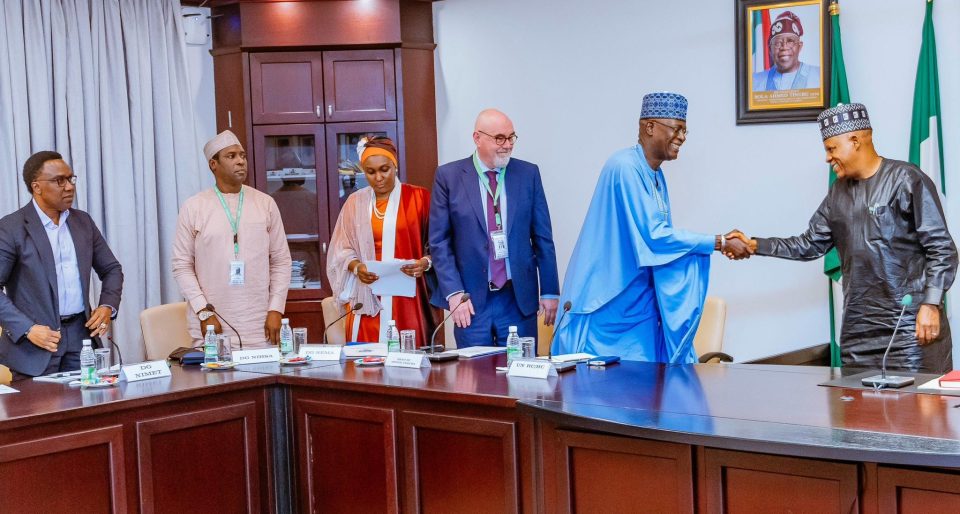
During a meeting of the AATF on Floods at the Presidential Villa in Abuja, he said the traditional response of mobilising relief after floods strike is no longer sustainable.
“We cannot afford to wait for disaster to strike before taking action. The human and economic toll of floods in Nigeria has become unbearable. We must act now to protect lives and livelihoods by leveraging science, technology, and collaboration,” he stated.
Shettima said, “Prevention is always cheaper than response, and investing in early action today will save billions in future losses. We need to strengthen coordination among agencies, engage local communities, and ensure that preparedness efforts are backed by real-time data.”
Other News
Earlier in his remarks, United Nations Resident & Humanitarian Coordinator in Nigeria, Mohamed Fall, explained that the United States’ suspension of humanitarian funding is a wake-up call for us to be more efficient, adding that “transitioning from reactive aid to anticipatory action is critical.
“As we approach the rainy season, we must factor in these developments and ensure that our interventions are timely and effective,” he further noted.
Also, Head of the UN Office for the Coordination of Humanitarian Affairs (OCHA) in Nigeria, Trond Jensen, commended the initiative, explaining that “a critical part of humanitarian response is anticipatory action; not only are we saving lives and reducing vulnerability, we are doing it more efficiently.”
He further commended the government’s leadership, stating that “we are the vanguard of innovation in anticipatory action, and for that, we are grateful to be your partners.”
Director General of NEMA, Mrs Zubaida Umar, outlined ongoing efforts to enhance disaster preparedness, including the development of the Hazard Risk Countrywide Analysis, a document aimed at strengthening Nigeria’s resilience against flooding.
“We have established a national coordination forum, bringing together all relevant agencies to ensure readiness. This effort is based on the seasonal climate predictions from NiMET, ensuring that all stakeholders are on high alert,” Umar said.
Also, Special Assistant to the President on Humanitarian Affairs and Development Partners, Inna Binta Audu, explained the progress made by the task force, saying it has already conducted substantial work, with extensive data collection spanning three decades.
“Presently, we have collated relevant data going back 30 years to be used for the Anticipatory Action Framework for Nigeria,” she said.
Others who spoke at the meeting included the Directors-General of NiMET and NiHSA, as well as the National Coordinator of the National Counter Terrorism Centre, Major General Adamu Laka.