Follow Us on Google
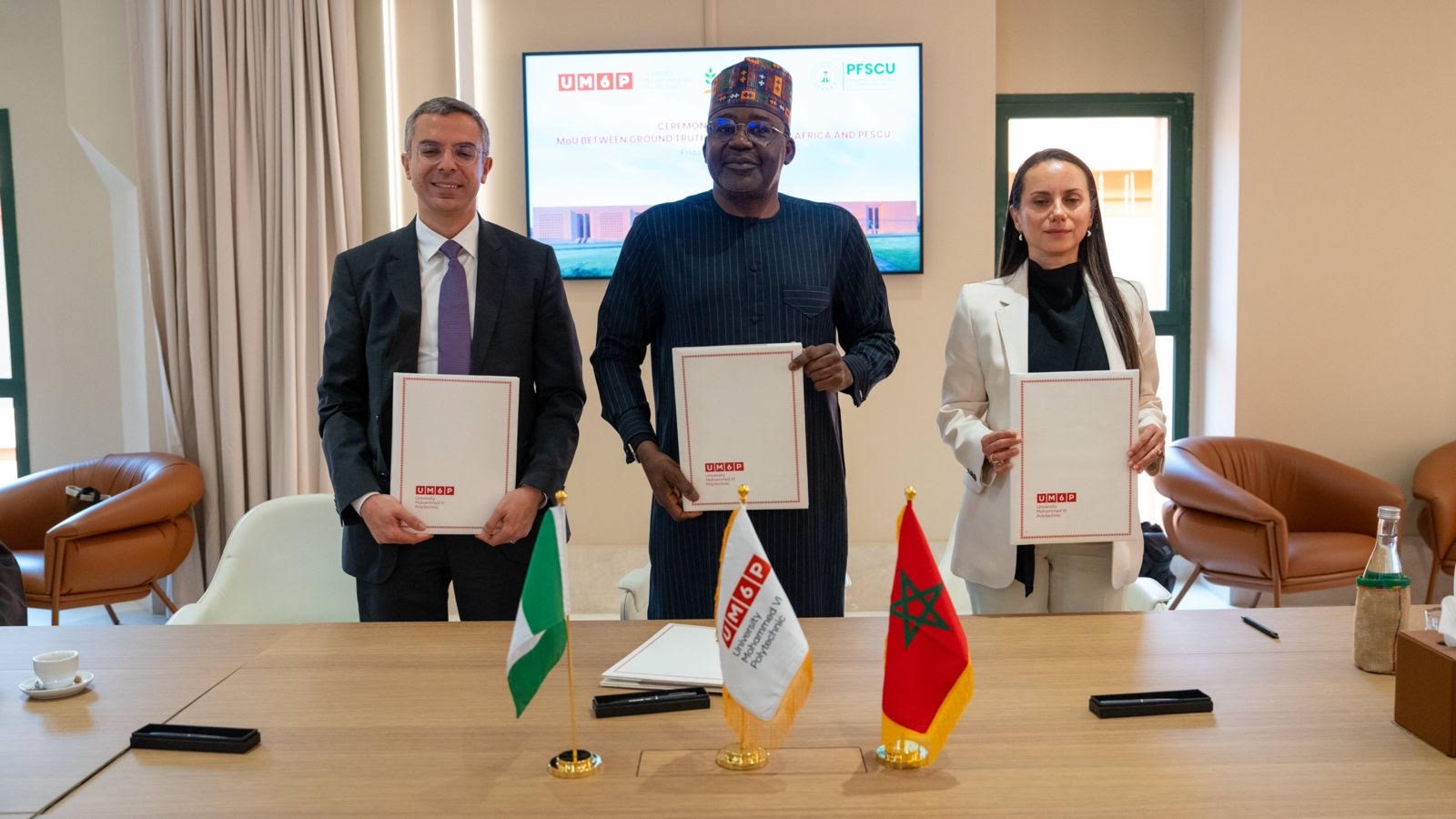
Nigeria has signed a Memorandum of Understanding to roll out a satellite- and artificial intelligence-driven agricultural monitoring system that will supply federal, state and local governments with near real-time data on farmland, crop distribution, yields and potential food security threats.
The agreement was signed on Friday at Mohammed VI Polytechnic University (UM6P) in Ben Guerir, Morocco. Senator Ibrahim Hassan Hadejia, Deputy Chief of Staff to the President (in the Office of the Vice President), signed for the Federal Government alongside representatives of Morocco’s phosphate group OCP Africa and geospatial firm Ground Truth Analytics.
A statement issued on Saturday by Marion Moon, Technical Assistant on Agriculture to the President (Office of the Vice President) and Executive Secretary of the Presidential Food Systems Coordinating Unit (PFSCU), said Hadejia stood in for Vice President Kashim Shettima, who chairs the PFSCU. The statement was titled: “Nigeria Positions Itself for the Next Generation of Agriculture with Launch of National Agro-Productivity System Partnership.”
Moon said the deal launched Nigeria’s first satellite-powered national crop-monitoring system and formally introduced the National Agro-Productivity System (NAPS), a platform built to deliver AI-generated intelligence on crop yields, land availability and food security risks across the country.
Speaking at the ceremony, Hadejia framed the initiative as part of a broader push to build domestic technological capacity.
“The problems we face should not define the limits of our ambition. They should inspire us to develop the technologies, institutions, and capabilities required to overcome them,” he said.
“Agriculture is being transformed by data, precision agriculture, artificial intelligence and geospatial technologies. Nigeria must build the capability not only to adopt these innovations but also to continually improve them, adapt them to our own context, and develop solutions that respond to our national priorities.
“It will strengthen seasonal planning, agricultural investment, productivity monitoring and policy coordination by providing Federal and State Governments with timely, reliable, and actionable agricultural intelligence to support better decision-making.”
Hadejia stressed that the project aims to develop home-grown expertise and institutional ownership, not only to deploy imported tools.
“Our ambition goes beyond the deployment of technology. We seek to build a Nigerian capability that is adapted to our conditions, understood and managed by our institutions, supported by Nigerian expertise, and sustained through knowledge transfer, institutional capacity development, and continuous learning.”
Moon told delegates that NAPS responds to a longstanding information gap between farmers’ production intentions and actual harvest outcomes.
“Monitoring during the season has been our biggest weakness. We reach the end of a season and find we did not hit the targets we saw at the beginning,” she said.
“We need stronger visibility during the season. If a farmer said they were going to plant maize, did they actually plant maize, or did they switch back to rice?
“If we believed everyone was leaving rice and opened our reserves accordingly, only to discover they planted rice after all, we end up with a surplus.”
Moon argued that this mismatch undermines sound national policy because production decisions are taken locally while trade policy is decided at the federal level.
“The Federal Government needs real-time visibility into what is happening on the ground to make trade decisions that complement subnational production.”
She described the National Agribusiness Policy Mechanism (NAPM) — the framework for NAPS — as a four-pillar system balancing domestic production, reserves, imports and exports: “a food balance for Nigeria”.
Approved by the National Council on Agriculture and Food Security in November 2024, the NAPM was piloted across 13 states covering three planting seasons (main wet season, dry season and a minor season exploited by states such as Jigawa).
Other News
According to Moon, the pilot reached 250,000 farmers, surveyed more than 50,000, covered over 2,000 communities, focused on five key commodities and gathered more than one million data points for the food balance.
OCP Africa CEO Alafifi Laadel described the pact as a long-term commitment aimed at building capacity rather than a one-off purchase.
“The partnership reflects a shared commitment to building long-term capability through knowledge transfer, local capacity development and strong institutions ensuring that Nigeria is equipped not only to deploy advanced technologies but to continually strengthen and develop them over time,” she said, adding that the technology essentially “replac[es] boots on the ground with AI and digital tools to read the data.”
Ground Truth Analytics CEO Driss Kitane demonstrated how the platform will close Nigeria’s mid-season visibility gap, showing a Kano State example in which AI processed satellite imagery to delineate agricultural parcels, identify crops and track growth stages without manual mapping.
“Every parcel you see here has been delineated by artificial intelligence; nobody manually drew them. We can do this at massive, country, and even continental scales. The images refresh every five days. We can cover all seasons and also observe the growth stage of each crop.”
Kitane said the platform predicts national wheat output in Morocco three months before harvest with 90 to 95 per cent accuracy, a capability he argued has been vital there as drought cut production from nine million to three million tonnes within a decade.
He added that banks use the technology for farmer credit scoring and cooperatives in Ghana use it to verify planted acreage.
On data sovereignty, Kitane assured that all sensitive information will remain under Nigerian control.
“Everything we develop is sovereign to Nigeria. It will be hosted on Nigerian servers. All sensitive data stays on those servers, and no one can access that data unless Nigeria decides so.”
He outlined a three-phase rollout: a minimum viable product for one state with land-cover analysis for others; expansion to three states with full crop intelligence and land cover for 15 states; and finally, multi-season monitoring across all 15 priority states.
UM6P President and Director General Hicham El Habti, who received the Nigerian delegation, noted Nigeria’s strong student presence at the university.
“Our medical school is now 100 per cent English,” he said, adding that 60 per cent of its students are Nigerian.
The signing comes three years after President Bola Tinubu declared a state of emergency on food security in July 2023, following fuel subsidy removal and exchange-rate unification, which contributed to a sharp rise in food prices.
Food inflation peaked in early 2025 at more than 40 per cent year-on-year, among the highest rates globally.
UNICEF estimates that more than 31.8 million Nigerian children under five are acutely malnourished, the second-largest burden globally after India.
The food crisis has been exacerbated by insecurity in northern farming belts, flooding and climate shocks in the Middle Belt, and weak agricultural data systems that have made it difficult to monitor production or anticipate shortfalls.
The Nigerian delegation in Morocco included officials from the Office of the Vice President, the Federal Ministry of Agriculture and Food Security, the Federal Ministry of Justice, the National Space Research and Development Agency, the Nigeria Governors’ Forum and other agencies charged with implementing NAPS.