Follow Us on Google
By Uche Usim
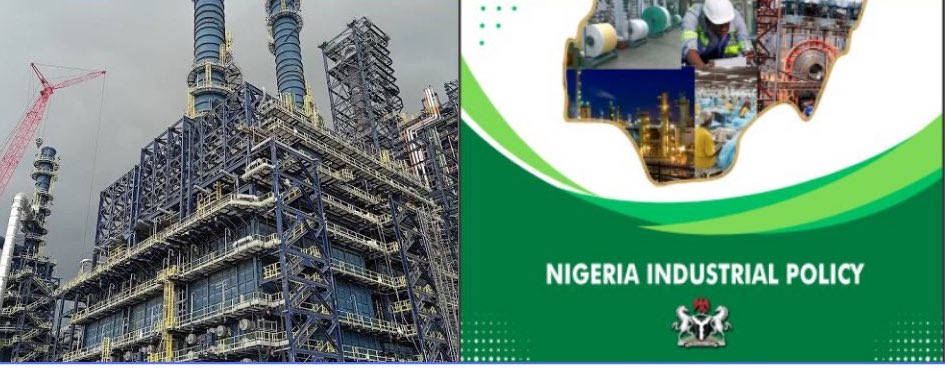
The federal government says the implementation of the Nigeria Industrial Policy (NIP) 2025 has recorded significant progress within its first 90 days and attracted more than $380 million in strategic financing and advancing key initiatives aimed at boosting local manufacturing, exports, skills development and industrial infrastructure.
According to a 90-day progress report released by the Office of the Minister of State for Industry, Senator John Owan Enoh, the policy has moved beyond its launch phase into active implementation, with measurable interventions already underway across its eight strategic objectives.
The report noted that, in addition to mobilising over $380 million in financing commitments, the ministry has also advanced plans for a proposed N350 billion Micro, Small and Medium Enterprises (MSME) Development Fund, while activating five quick-win industrial programmes in collaboration with the Bank of Industry (BOI).
The ministry said the early achievements reflect the Federal Government’s determination to use industrialisation as a vehicle for economic growth, job creation, investment attraction and value retention within the Nigerian economy.
Speaking on the progress made so far, Enoh said the policy was designed as a practical framework for delivering economic transformation rather than remaining a policy document without implementation.
“The Nigeria Industrial Policy is not intended to remain a document on the shelf. It is a delivery instrument for productivity, competitiveness, investment, job creation and national value retention,” he said.
“In the first 90 days, we have focused on building the foundations required for implementation: financing, partnerships, value-chain activation, skills, infrastructure and accountability.”
A major focus of the implementation phase has been the promotion of local content and domestic production through the Federal Government’s Nigeria First Policy.
Other News
The ministry disclosed that it had commenced stakeholder engagements with the Bureau of Public Procurement (BPP), the National Automotive Design and Development Council (NADDC), the Manufacturers Association of Nigeria (MAN), the Association of Local Automotive Manufacturers and stakeholders in the cotton, textile and garment industries to strengthen patronage of locally produced goods and enforce local procurement policies.
On MSME development, the report revealed that the government has made progress in developing a financing framework for the Nigeria MSME Industrial Clusters Programme. The initiative is expected to support industrial infrastructure, increase productivity, create jobs and improve value addition across competitive industrial clusters nationwide.
The policy implementation has also recorded gains in skills acquisition and workforce development. According to the report, 400 young Nigerians have been trained in mechatronics through programmes coordinated by NADDC, while another 220 artisans received training under the Industrial Training Fund’s Skill Up Artisan Programme. The government believes these interventions will help address the skills gap in critical industrial sectors and improve the availability of qualified technical manpower.
The ministry further highlighted ongoing collaboration with the Bank of Industry across five priority areas, including an MSME census and capability mapping exercise, the development of the Idu Industrial Park ecosystem, the Cocoa Value Chain Summit, compliance monitoring mechanisms and industrial roundtable engagements.
In the area of industrial competitiveness and export promotion, progress was reported in several strategic sectors, including cotton, textile and garment revitalisation, sugar production, electric vehicle manufacturing, fertiliser and agricultural inputs, rice processing, cashew processing and export development.
The ministry also cited regional trade achievements, including the launch of a Vehicle Homologation and Certification Programme and the award of African Quality Marks to 131 Nigerian companies covering 220 products. The government said these initiatives are expected to improve product quality, boost export readiness and strengthen Nigeria’s position in regional markets.
Another notable intervention highlighted in the report is the extension of the raw shea nut export ban, which the government said would encourage local processing, support export diversification, drive rural industrialisation and create more opportunities for women in the shea value chain.
On energy infrastructure, the ministry disclosed that work is advancing on the Idu Industrial Park Pilot Power Programme in Abuja. The project is intended to serve as a model for providing dedicated power supply to industrial clusters across the country, helping manufacturers overcome one of their biggest operational challenges.
The ministry said its next phase of implementation will focus on operationalising the MSME Industrial Cluster Programme, providing dedicated gas supply to Idu Industrial Park, launching a revised Cotton, Textile and Garment Sector Policy, implementing the National Shea Value Chain Framework and establishing a monitoring and evaluation framework to track performance across all strategic objectives. The ministry reaffirmed its commitment to regular reporting, stakeholder engagement and strict implementation discipline as the Nigeria Industrial Policy enters its next phase.