Follow Us on Google

By Moses Akaigwe
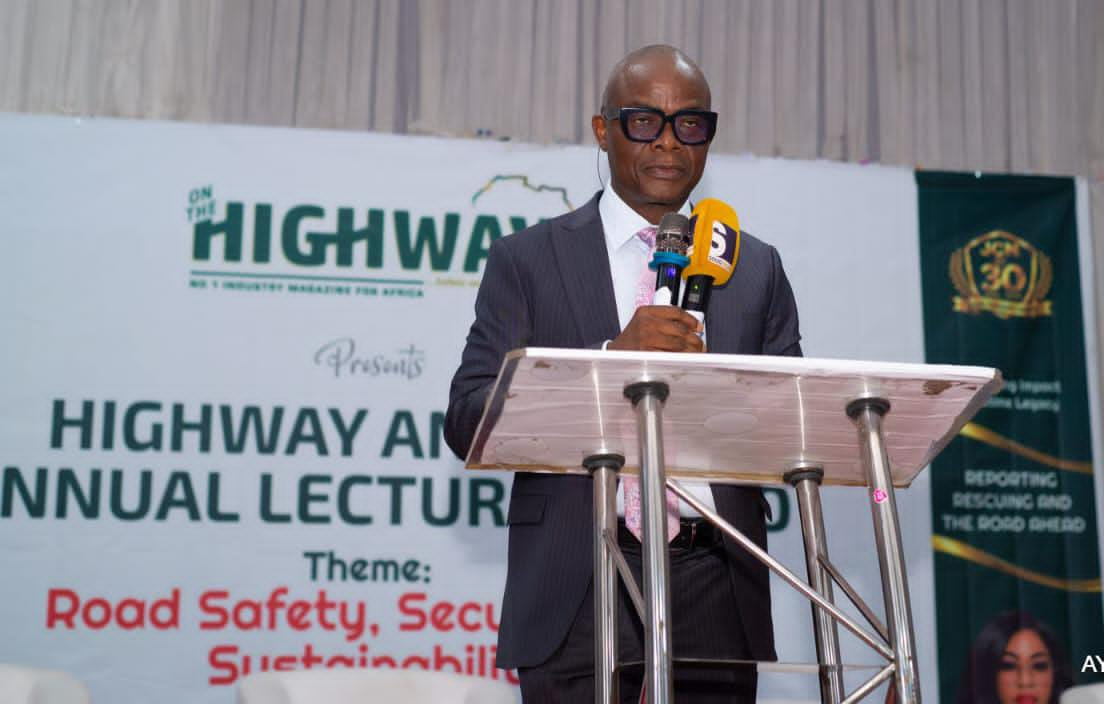
The 30th Anniversary of On The Highway Africa, founded by Julie Chi-Nwoha, took a defining turn recently with a legacy lecture on the theme: “Improving Public Transportation Infrastructure for Road Safety, Security and Sustainability.”
The guest lecturer was Dr. Femi Eguaikhide, Chairman of the Auto and Automotive Components Sectoral Group and Deputy Managing Director of RT Briscoe Nigeria Plc.
Delivering the lecture before chairmen of organisations, captains of industry, executive automotive players, media practitioners, regulators and other stakeholders, Dr. Eguaikhide declared: “Nigeria does not have a road problem. Nigeria has a public transportation infrastructure problem.”
He noted that 30 years ago, when Julie started reporting on the automotive sector, Nigeria was importing fairly used buses and patching potholes. Thirty years later, he said, the country was still doing the same thing, only with more traffic.
“We have celebrated the construction of roads. But we have not celebrated the construction of Transport Systems” he said.
From roads to integrated Transit Infrastructure
Dr. Eguaikhide said Nigeria must stop building roads in silos and start building integrated transport systems, where a Lagos resident can leave Ikorodu, board a CNG-powered BRT bus at the Ikorodu Terminal, connect to the Blue Line at Marina and then connect to last-mile transport, all using one Cowry card, within a terminal that is well-lit, clean and safe.
He noted that dedicated BRT lanes reduce accidents by 30 to 35 per cent globally, a fact he said Lagos had already demonstrated.
He called for a 10-year Dedicated Public Transit Infrastructure Plan involving the development of 1,000 kilometres of dedicated transit lanes and 50 modern interchange hubs across Lagos, Abuja, Kano, Port Harcourt and Enugu, with private-sector participation.
Security is Infrastructure, Not Just Policing
Dr. Eguaikhide said manufacturers, transporters and logistics companies lose over ₦15 trillion annually to insecurity, cargo diversion and unsafe transport corridors.
“You cannot have sustainable transport where a driver is afraid to drive at night, or a woman is afraid to wait at a bus stop at 7pm,” he said.
He argued that security in the next decade would not be about having more checkpoints, which hamper trade, but about providing smart terminals equipped with CCTV cameras and proper lighting, GPS tracking and panic buttons in all commercial buses, cashless fare systems, and a National Secure Corridor Command linking the Federal Road Safety Corps (FRSC), the Police and private fleet owners.
He called for GPS tracking systems and speed limiters to be made mandatory for all public transport vehicles with seating capacities above 18 passengers. He also advocated incentives, including tax rebates for transport operators, to encourage the adoption of cashless ticketing systems.
Sustainability is economics, not environmental Grammar
On sustainability, Dr. Eguaikhide was emphatic that the future of public transportation lay in Compressed Natural Gas (CNG) and electric mobility, not because Paris had said so, but because of the economic benefits.
He explained that while a diesel-powered BRT bus consumes about ₦18 million worth of fuel annually, a comparable CNG-powered bus consumes about ₦6 million, representing an annual saving of ₦12 million per bus.
For a fleet of 10,000 buses, he said, this would translate into ₦120 billion in savings, with additional benefits in foreign exchange conservation and job creation through gas conversion and local vehicle assembly.
While commending the Presidential CNG Initiative, he called for increased investment in supporting infrastructure, including mother stations, daughter stations and conversion centres, and, most importantly, locally assembled buses.
He proposed a five-year National Public Fleet Renewal Programme involving the assembly of 10,000 CNG and electric buses in Nigeria, supported by a five-year import duty waiver on Completely Knocked Down (CKD) kits and single-digit financing for transport operators.
“Let us build the buses here. Let us build the jobs here,” he said.
In his closing remarks, Dr. Eguaikhide congratulated Julie and On The Highway on their 30th anniversary, noting that the publication had demonstrated that journalism could sustain and contribute meaningfully to the growth of an industry.
“For the next 30 years, let us move from reporting accidents to preventing them,” he said. “If we build Systems, we will improve Safety. If we build Secure Corridors, we will improve Security. If we build CNG/electric fleets, we will achieve Sustainability.”
He added: “The Road to Nigeria’s $1 trillion economy will not be built on more cars. It will be built on better public transport.”
Eguaikhide honoured as Automotive Man of the Year
In a fitting climax to the lecture, Dr. Olorunfemi Eguaikhide was also presented with the Automotive Man of the Year Award at the anniversary celebration.
The award was in recognition of his positive contributions and unwavering commitment to the development of Nigeria’s automotive industry, as well as his transformational leadership in growing the automotive value chain.
Nneji honoured with Legacy Leadership Award
The Chairman of the event, Frank Nneji, OON, was also presented with the Legacy Leadership Award at the anniversary celebration in recognition of his outstanding leadership, enduring legacy and immense contributions to the growth of Nigeria’s transport and automotive industries.
He was honoured alongside other award recipients at the event.
The event also featured the presentation of the Road Safety Champion of the Year Award to Cedric Masters, alongside goodwill messages from industry stakeholders.