Follow Us on Google

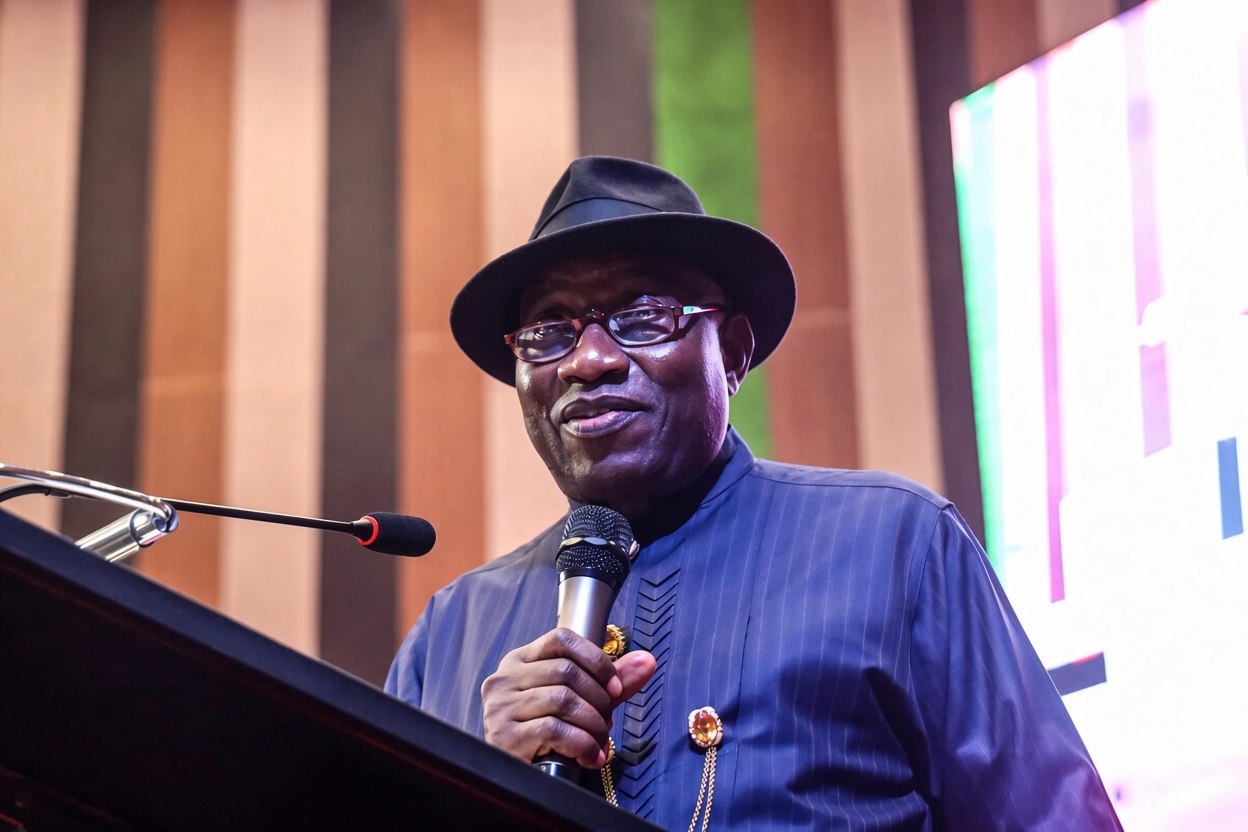
– Says nation’s democracy looks shapeless, needs sanitisation
– Warns youths against quick-money mentality, cybercrime, drug trafficking
_________________________________________________________________________
From Nnamani Adanna
Former President Goodluck Jonathan has expressed optimism about Nigeria’s future despite its leadership and governance challenges, saying the country still has the potential to overcome its difficulties.
Jonathan, however, described Nigeria’s brand of democracy as opaque, shapeless and amorphous, calling for its sanitisation and improvement in the process of recruiting political leaders.
The former president spoke over the weekend in Abuja at the third edition of the Paul Alaje Colloquium, with the theme ‘The Brand: Nigeria’.
He said Nigeria needed leaders with clear development visions, stressing that political office holders must look beyond immediate gains and focus on improving the quality of life of present and future generations.
“Before you decide, first question yourself and ask yourself a real question: What will I do to improve the quality of life of our children and grandchildren, not satisfying the stomachs of those who are waiting to die? What will you do to change the country?” he said.
Jonathan criticised governors who prioritise renovating outdated primary school buildings and commissioning such projects without considering whether they meet modern educational standards.
According to him, development goes beyond road construction and other projects that provide opportunities for immediate financial gains, noting that leaders must identify and invest in sectors capable of transforming society.
He cited the late former Premier of the Western Region, Chief Obafemi Awolowo, as an example of visionary leadership, particularly for his investment in education, which he said contributed significantly to the region’s human capital development.
The former president also referred to India’s establishment of the Indian Institutes of Technology shortly after independence in 1947, saying the country’s early investment in science and technology had helped produce globally competitive professionals.
He equally cited Singapore’s development under its former Prime Minister, Lee Kuan Yew, highlighting merit-based appointments, zero tolerance for corruption and pragmatic policymaking as key factors behind the country’s transformation.
Jonathan said Nigeria must embrace merit and reject tribalism in public appointments, adding that the country could not afford to place square pegs in round holes.
On corruption, he emphasised the need for strict accountability, citing Singapore’s policy of holding public officials accountable for ethical breaches, regardless of their positions.
The former president also urged young Nigerians to protect the country’s image by shunning cybercrime, drug trafficking and cultism.
He expressed concern that the pursuit of quick money had become a growing attraction among young people, while some traditional and religious institutions were increasingly celebrating wealth without questioning its source.
Jonathan said the country’s reputation could not improve if individuals with questionable sources of wealth continued to receive prominent titles and recognition in society.
He further expressed concern over the weakness of Nigeria’s international passport, noting that some Nigerians resorted to spending huge sums to secure foreign citizenship for their children to enjoy greater international mobility.
He cited Singapore as an example of a country whose passport had become one of the strongest globally, despite its relatively small population, saying Nigeria must collectively address the factors affecting its international standing.
Other News
Despite the challenges, Jonathan expressed optimism about Nigeria’s future, particularly its growing technology ecosystem.
He said he was encouraged by information showing that Nigeria had the largest technology ecosystem in Africa, with more than 3,300 start-ups and technology companies operating in sectors including banking, finance and healthcare.
“All hope is not lost. But there are things that must be done well at the leadership level,” he said.
Jonathan called on the President, governors, parliamentarians and local government chairmen to develop clear visions for national development, lamenting that local governments had become largely ineffective.
He also faulted politicians who present manifestos prepared by consultants without understanding or taking ownership of the promises contained in them.
According to him, a manifesto should reflect the genuine vision and development priorities of a candidate rather than serve as a campaign document prepared merely to secure votes.
On Nigeria’s democratic process, Jonathan said the country needed to improve its political recruitment system to ensure that competent and visionary individuals emerged as leaders.
He said: “The brand of politics we are playing in Nigeria could set us backward because our political brand of democracy is not very like what I spoke in Lagos. I said it looks opaque, it looks shapeless, looks amorphous.
“You cannot see clearly what we are doing in the name of politics. Democracy has standards, not business as anything goes.”
Earlier, the convener of the colloquium, Paul Alaje, said Nigeria’s national image was closely tied to the quality of its institutions, economic performance and the experiences of its citizens, rather than government publicity or branding campaigns.
He said the country could not successfully market what it had not built, stressing that institutional weaknesses, insecurity, corruption and policy inconsistency continued to undermine confidence in Nigeria.
According to him, the country’s reputation has significant economic implications, influencing investment, trade, tourism, capital flows, talent retention and the cost of doing business.
Alaje identified healthcare, governance and security, the creative economy, artificial intelligence, and the economy and investment as five critical areas that must be strengthened to build a stronger Nigerian brand.
He called for greater investment in human capital, institutional accountability, Nigerian businesses and a consistent national development vision that would transcend political administrations.
He also urged stakeholders to move beyond conferences and policy recommendations to practical implementation, insisting that the success of the colloquium should be measured by its impact on policy, business decisions and public behaviour.
Alaje said Nigeria must move from perception to performance, potential to productivity, and promises to strong institutions, adding that building a credible national identity was a collective responsibility of government, businesses and citizens.
He said: “The brand Nigeria is not a campaign we launch. It is a nation we build.”