Follow Us on Google
Last Thursday, I embarked on my usual evening walk around my area in Lagos. Along the way, a dispatch rider stopped me. I thought he wanted to ask for direction to where he wanted to deliver some goods. “My big brother,” he started. “Please, I am stranded here. I don’t know what to do. I left my house since morning without any food for my children. The person I am working for promised to give me something today. But he disappointed me. I don’t even have any money on me right now. Please, help me.”
His countenance told me he was not lying. I gave him something from the little I had in my pocket. As I walked back home, I felt seriously disturbed at the plight of this man and many others in his shoes. For how long will this man beg to feed his family? How much is his pay? Is it enough to sustain him in this harsh economic environment? Is there any hope for people like him?
Nigeria overtook India as the poverty capital of the world in 2018. Using data from the World Poverty Clock, the Brookings Institute noted that about 87 million Nigerians lived in extreme poverty. The number has since risen.
Today, Nigeria’s poverty rate is over 60 per cent, as over 133 million Nigerians live in multidimensional poverty. Many of them don’t know where the next meal will come from. Minimum wage is N70,000 a month, but it is obvious that some workers don’t even receive up to this amount of money as salary. Many are walking corpses. Sudden deaths have become rampant.
The National Bureau of Statistics, in 2024, put the rate of unemployment at 4.3 per cent. This looks low because the NBS used a revised calculation method whereby it classified even farmers, artisans, traders, and people who worked for pay for one hour in the survey week as employed.
Between July 7 and 18, 2026, the SBM Intelligence conducted a survey which found out that 45.3 per cent of Nigerian households experienced job losses, business closures, or inability to find work in 2025. This is amid the country’s total public debt which stands at N166.79 trillion as of June 30, 2026. This is a 9.4 per cent or N14.39 trillion increase from the N152.4 trillion recorded in June 2025.
On October 1, 2026, Nigeria will mark 66 years of her independence from Britain. Anyone who has attained the age of 66 is an elder and would have retired from active service. But at 66, Nigeria is not only crawling like a baby of six months, it is still sucking the breast of her colonial masters.
Leadership deficit is the major problem. In the 2026 World Economics Governance Index, Nigeria performed very poorly. Four parameters were used to rank the best-governed countries. They are rule of law, press freedom, political rights and corruption. While Finland ranks first globally among the best-governed countries with governance index of 98.0, Cabo Verde ranks first in Africa and 29th in the world.
Nigeria ranks 112 in the world and is nowhere near the 10-best governed countries in Africa. It is among the countries in poor governance category with a governance score of 33.9. The 10-best governed countries in Africa are Cabo Verde, Mauritius, Nambia, South Africa, Botswana, Ghana, Senegal, Malawi, Sierra Leone and Gambia.
Our leaders boast of building many roads, bridges, flyovers, and airports across the states of the federation. The construction of the N15 trillion Lagos-Calabar Coastal Highway is at advanced stage. We have built and renovated conference centres with billions of naira in Abuja and elsewhere. Many of our leaders live in state of the art houses and acquire exotic vehicles that will make the British Prime Minister green with envy.
Part of our achievements also revolves around sustenance of our democracy despite all odds. It wobbled after independence with highly contentious elections. The military was forced to intervene in 1966. That intervention led to more crises culminating in a counter coup of July 1966 and the civil war of 1967 to 1970. The military continued to rule until 1979 when it handed over to the civilian government of Shehu Shagari.
Other News
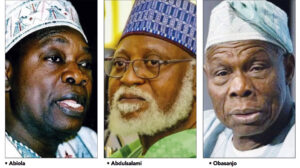
The second republic was as combustible as the first republic. Corrupt politicians were mainly interested in what would be of benefit to them and never bothered about the welfare of the citizens. That republic collapsed in 1983 as the military took over power again with Muhammadu Buhari as Head of State. Buhari was overtaken by Ibrahim Babangida, who later organized the June 12, 1993 presidential election. He annulled that election, presumed to have been won by Chief Moshood Abiola.
The crisis that trailed that annulment led to the stepping aside of Babangida. Chief Ernest Shonekan assumed power as interim President. He did not last long as Sani Abacha upstaged him and became Head of State from November 1993. Abacha died in June 1998, paving way for Abdulsalami Abubakar to take over. He conducted the election that brought in Chief Olusegun Obasanjo as President in 1999.
Since then, there has been transition from one civilian government to the other without any intervention from the military. Obasanjo handed over to Umaru Yar’Adua in 2007 after his second term in office. Yar’Adua died in office in 2010, prompting his deputy, Dr. Goodluck Jonathan, to take over. Buhari defeated Jonathan in a general election in 2015 and governed the country until 2023 when he handed over to the incumbent President Bola Tinubu.
Since Tinubu assumed office, the hardship in the country has tripled. His first major pronouncement was, “Subsidy is gone.” Prices of essential commodities skyrocketed. The price of fuel, for instance, rose from less than N200 a litre to over N1,000 a litre. Currently, the price hovers between N1,350 and N1,500 in many places. The cost of transportation also rose sharply. The worst is that even after spending much on fuel or transport fare, commuters spend hours and, in some cases, days on highly dilapidated roads. In recent times, motorists have had to spend up to four days stranded in heavy gridlocks on Benin-Agbor-Asaba Expressway, Bida-Lapai Road in Niger State, and some other highways.
Sadly, none of the three arms of government is performing optimally. The executive is neck-deep in corruption. Some major contracts are awarded without due process. Some of those entrusted with the country’s treasury often end up looting it.
A former acting Accountant-General of the Federation, Chukwunyere Nwabuoku, was recently convicted and jailed for diverting public funds meant for security and defence while he served as the Director of Finance and Accounts in the Ministry of Defence between 2019 and 2021. Nwabuoku’s predecessor, Ahmed Idris, was suspended in May 2022 for alleged N80 billion fraud. This amount later increased to N109 billion. He is still on trial.
The legislature fails to check the excesses of the executive and rather relish in chorusing President Tinubu’s “On your mandate we shall stand” campaign slogan. The judiciary is also corrupt with some judges taking bribes to upturn the cause of justice. Mostly, they grant frivolous ex-parte orders. Forum shopping is also widespread.
Health sector does not fare better. Over 50,000 Nigerian doctors relocated abroad for greener pastures. Those remaining in Nigeria are frequently on strike. The poor masses have resorted to taking dangerous herbal concoctions, as most of them cannot afford the cost of medical care. At least, 48 people died in Ondo State after taking herbal concoctions recently. Between January and September 2025, over 20,811 maternal and child deaths occurred in Nigeria, one of the highest in the world.
In the area of security, the country has also failed. Boko Haram introduced terrorism in the country in 2009 and since then, it has gone from bad to worse. Tens of thousands of people have been killed. Over two million others have been displaced from their homes.
In April 2014, the Boko Haram terrorists abducted some 276 schoolgirls from their school in Chibok, Borno State. Some of the abductees were released after over one year in captivity. Some died along the way. Over 100 others are yet to regain their freedom. Several abductions have occurred since then. Nobody is free. Nowhere is sacred. Kidnappers have invaded military barracks, schools, churches and mosques. They have killed military officers, worshippers, and schoolchildren.
This is partly why Nigeria scores low in Global Terrorism Index (GTI). In the 2026 GTI, the country was ranked fourth in the world. This is a decline from the eighth and sixth positions attained in 2024 and 2025 respectively.
Tinubu came with the slogan to renew the hope of Nigerians. But rather than being renewed, the hopes of many Nigerians have been dashed. The victims of insecurity often have no shoulders to cry on. The leadership has no time for them. While his countrymen are crying and lamenting over this spate of insecurity and some other ills, Tinubu went on a four-week vacation in Europe. He left Nigeria on August 30 for London and later moved to Paris, France, where he met with French President, Emmanuel Macron. He is due back on Tuesday, September 29, 2026.
Like Tinubu, Nigeria is on vacation. Good governance, health and education sectors are on holiday. The fight against corruption is resting. The promise to have free, transparent and credible elections is in limbo. And the efforts to enhance security of life and property have gone to sleep.
Nigerians should not join in this needless vacation. They should wake up and make their country what it should be. They must overlook ethnic and religious sentiments when they go to the polls in 2027. Yes, power grabbers will try to rig the election, but let’s troop out en masse, do our part, and leave the rest to posterity.