Follow Us on Google
By Chinenye Anuforo
[email protected]
At independence in 1960, owning or even accessing a telephone line in Nigeria was a privilege enjoyed by only a small fraction of the population.
Sixty-six years later, Nigeria’s technology ecosystem has evolved from bourgeoisie ‘ownership’ to one where a mobile phone can serve as a bank, classroom, office, marketplace and increasingly, an artificial intelligence assistant to the average Nigerian.
The transformation, for many stakeholders, has been appreciable.
However, beneath the growth in telecommunications, internet usage, fintech, digital payments, startups, data centres and artificial intelligence lies a more fundamental question, after decades of investment and innovation, what has Nigeria really built, and how much of the value created by its digital economy is being retained in the country?
The nation’s technology story did not begin with smartphones, fintech or artificial intelligence. It stretches back to the era when telecommunications was largely controlled by the state and access to a telephone line was a privilege rather than a common utility.
The genesis
For decades, the Nigerian Telecommunications Limited (NITEL) dominated the sector. NITEL was created in 1985 from the merger of the telecommunications arm of the former Posts and Telecommunications Department and Nigerian External Telecommunications Limited. By 2001, when the country’s telecommunications sector was opened to greater private participation, it had only a fraction of the telephone connectivity it has today.
Then came the revolution. The licensing of GSM operators in 2001 changed the Nigerian economy in ways that went far beyond making telephone calls easier.
MTN Nigeria, Econet, which later became Airtel, and NITEL were among the operators that received the initial digital mobile licences, while Globacom entered the market soon afterwards.
The impact was immediate. For the first time, millions of Nigerians who had never owned a fixed telephone line could communicate through mobile phones.
The mobile phone soon became more than a communication device. It became a business tool, a means of receiving money, a platform for advertising, a source of news and eventually a gateway to the internet.
Looking back at that period, former Executive Vice Chairman of the Nigerian Communications Commission, Dr Ernest Ndukwe, one of the key figures behind Nigeria’s telecommunications revolution, recalled that the demand for telecommunications services was far greater than many had anticipated.
According to him, operators reached levels of network rollout within their first year that had initially been projected for five years.
Ndukwe has also described the 2001 digital spectrum auction and subsequent rollout as the foundation of Nigeria’s telecommunications revolution.
The next stage was the internet. As mobile penetration increased, the country gradually moved from voice to data. The arrival of 3G and later 4G networks changed the nature of the mobile phone. Social media platforms became widespread. E-commerce expanded. Digital media grew. Online education emerged. Businesses began to use social platforms as marketing channels.
Then came fintech. Digital finance arguably became the biggest home-grown expression of Nigeria’s technology revolution.
Companies such as Interswitch, Paystack, Flutterwave, OPay, Moniepoint and others helped change how Nigerians send and receive money, pay for goods and services and run businesses.
Traditional banks also moved aggressively into digital banking, with mobile applications, USSD, internet banking and electronic payments becoming central to customer service.
The figures tell the story. According to the Nigeria Inter-Bank Settlement System, electronic payment transactions have expanded dramatically over the past decade, reflecting the movement of Nigeria’s financial system from predominantly physical banking to a highly digital payments economy.
The fintech revolution also showed that technology could solve uniquely Nigerian problems.
Agency banking brought financial services closer to communities. Mobile wallets reduced dependence on physical branches. Digital payment platforms allowed small businesses to receive money electronically. Fintechs began offering savings, investment, lending and payment products to people who were previously underserved by conventional financial institutions.
As Tunde Kehinde, co-founder of fintech company Lidya, observed in an earlier assessment of Nigeria’s banking transformation, competition between banks and fintechs has helped drive innovation and reduce barriers to financial inclusion.
But the technology story has now moved beyond telecoms and fintech to digital economy
The nation’s digital economy has become a much broader ecosystem involving telecommunications companies, banks, fintechs, software developers, cloud providers, data-centre operators, e-commerce platforms, technology startups, digital media companies, cybersecurity firms and millions of individuals working online.
The smartphone has become the common denominator. It is now the device through which millions of Nigerians communicate, transfer money, learn, work, advertise products, consume entertainment and access government and commercial services. The growth in data consumption demonstrates just how deeply technology has entered everyday life.
The Nigerian Communications Commission reported that Nigerians consumed more than 1.66 million terabytes of data in July 2026, the highest monthly figure recorded in the commission’s series. Between January and July, data consumption was already substantially higher than the corresponding period of 2025.
For telecommunications companies, this explosion in demand has translated into enormous investments. MTN Nigeria, for instance, recorded N1.699 trillion in data revenue in the first half of 2026, compared with N1.229 trillion in the corresponding period of 2025. Total revenue rose to N2.993 trillion. The figures underline an important change in the structure of Nigeria’s technology economy.
Data is no longer an optional service. It is becoming an economic infrastructure.
Industry analyst and Chief Executive Officer of Jidaw Systems Limited, Jide Awe, has argued that the significance of rising data consumption goes beyond telecommunications companies because every additional megabyte consumed can support another economic activity from digital payments and online commerce to remote work and digital advertising. The federal government has also increasingly positioned technology as a central pillar of economic development.
The Ministry of Communications, Innovation and Digital Economy has pursued programmes around broadband, digital skills, artificial intelligence, startups, cloud infrastructure and digital public infrastructure.
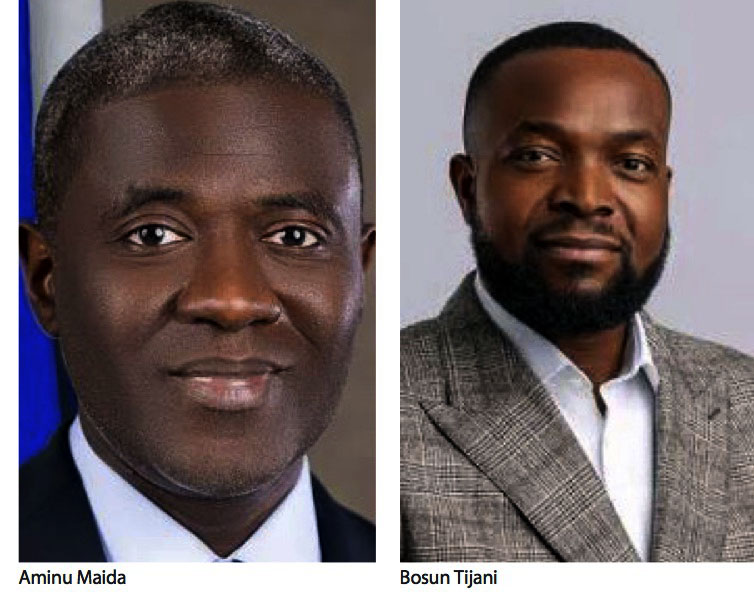
Minister of Communications, Innovation and Digital Economy, Dr Bosun Tijani, recently said the contribution of ICT to Nigeria’s GDP had risen from about 16 per cent to 21 per cent in three years, underscoring the growing role of technology in economic activity. But while the digital economy has grown rapidly, the infrastructure supporting it has not always grown at the same speed.
Challenges persist
The biggest challenge confronting the technology ecosystem is infrastructure. Nigeria can have millions of internet users, but without reliable fibre, electricity, data centres and affordable devices, the economic value of connectivity remains limited.
This is particularly important as the country moves into the artificial intelligence era. Artificial intelligence requires significantly more computing power than traditional digital services. It requires data centres, cloud infrastructure, high-capacity fibre, specialised processors, cooling systems and reliable electricity.
Nigeria’s AI ambitions are, therefore, exposing the weaknesses in its digital infrastructure.
A recent industry assessment found that Nigeria’s broadband infrastructure remains inadequate for the scale of its AI ambitions, while industry stakeholders have raised concerns about the limited availability of AI-ready data centres.
Chief Executive Officer of Digital Realty Nigeria, Ikechukwu Nnamani, was particularly blunt in his assessment, stating that there was no data centre in Nigeria at the time of his comment that was fully AI-ready. That warning is significant because Nigeria is already attempting to position itself as one of Africa’s leading AI ecosystems.
The Federal Government has launched the National Artificial Intelligence Strategy and is developing frameworks around responsible AI adoption, while NITDA is working on digital skills, standards and governance.
Director-General of NITDA, Kashifu Inuwa Abdullahi, has repeatedly stressed that Nigeria’s AI ambition requires more than talent.
“Infrastructure, governance, research and innovation must develop alongside skills”, he had emphasised.
The broadband problem is equally serious. NCC Executive Vice Chairman and Chief Executive Officer, Dr. Aminu Maida, recently said the country’s broadband challenge was evolving from simply deploying fibre to ensuring that existing infrastructure could be accessed fairly and efficiently by operators.
At an earlier NCC forum, Maida noted that although Nigeria had more than 154 million internet subscriptions in April 2026, the country had only about 265,000 fibre-to-the-home subscribers.
“The quality of our work will increasingly shape the competitiveness of our businesses,” Maida said, arguing that broadband infrastructure should be treated as essential national infrastructure.
There is also the problem of fibre cuts. Thousands of fibre cuts were recorded in the first half of 2026, with road construction, excavation and civil works among the major causes.
The implication is that Nigeria is spending billions to build digital infrastructure while simultaneously allowing parts of that infrastructure to be damaged. The government’s proposed Project BRIDGE is expected to address part of the problem by deploying about 90,000 kilometres of fibre, extending the national backbone and reaching all 774 local government areas.
Other News
The Minister of Communications, Innovation and Digital Economy, Tijani, has described the planned $2 billion fibre investment as part of the effort to expand Nigeria’s existing backbone from about 35,000 kilometres to 125,000 kilometres.
But infrastructure is only one part of the challenge. Affordability remains a major issue.
A Nigerian may technically be connected to the internet but unable to afford enough data to use it productively. The same applies to smartphones and computers.
For millions of low-income Nigerians, the cost of an internet-enabled device can represent a significant financial burden. This is why digital inclusion cannot be reduced to internet coverage.
Lanre Idowu, Divisional Head, Financial Industry Partnerships, Remita, captured the dilemma in a recent assessment of Nigeria’s digital divide, describing a country of two realities, one experiencing rapid technological momentum and another still facing barriers around connectivity, affordability, literacy, devices and trust.
“A digital divide is ultimately an opportunity divide,” the presentation noted.
The country’s technology ecosystem is now entering a more difficult but potentially more valuable phase. The first phase was about connecting Nigerians. The second was about getting Nigerians to use digital services.
Next level
The next phase is about building and owning the infrastructure, intellectual property and businesses that will capture the economic value generated by that digital activity. This is where data centres, cloud computing and digital sovereignty become important.
Nigeria is increasingly seeking to keep more of its data within the country. From January 2027, banks, fintech companies, mobile money operators and other payment service providers are expected to store and manage payment transaction data generated in Nigeria on local servers.
The policy is expected to stimulate investment in local data-centre capacity while strengthening Nigeria’s control over critical financial data. But, data localisation could have implications beyond banking.
Local infrastructure could support artificial intelligence, healthcare technology, e-government, education, cloud computing and other data-intensive services.
Nigeria’s data-centre market is already attracting major players, including Rack Centre, OADC, Equinix following its acquisition of MainOne, Africa Data Centres and Airtel’s Nxtra.
The emergence of AI-ready facilities could create a new layer of competition in Nigeria’s digital economy. Another important trajectory is the growth of digital exports.
The country has millions of young people with skills in software development, digital marketing, design, data analysis, cybersecurity and other technology-related fields. The challenge is to turn those skills into exportable services.
A Nigerian software developer working for an American company is effectively exporting a digital service. A Nigerian cybersecurity company protecting a Ghanaian bank is exporting technology and a Nigerian AI company building solutions for African businesses is exporting intellectual property.
This is where the technology sector could become a stronger source of foreign exchange and employment. But, Nigeria will need more than talent to achieve this. It will need reliable electricity, competitive internet, affordable cloud services, access to capital, predictable regulation and stronger intellectual property protection. It will also need a regulatory environment that does not become a barrier to innovation.
The Federal Government recently directed the NCC, NITDA and the Nigeria Data Protection Commission to suspend enforcement of newly issued cross-cutting regulations affecting internet platforms and digital businesses pending the development of a harmonised framework.
The move followed years of complaints from industry groups about overlapping regulation and rising compliance costs.
Former NCC Executive Vice Chairman, Dr Ernest Ndukwe, and Senior Advocate of Nigeria, Paul Usoro, have also argued that Nigeria’s regulatory framework must evolve because the digital ecosystem has moved far beyond the boundaries of the telecommunications environment that existed when earlier policies were created.
Experts’ views
Experts and stakeholders agree that Nigeria has come a long way since the days when NITEL was the dominant telecommunications provider, but they also believe the country is approaching a new stage that will require deeper investment and better coordination.
Ndukwe, who was at the centre of the telecoms revolution, believes the lessons from the early GSM era remain relevant.
The success of that period came from a combination of policy direction, private investment, competition and regulatory oversight.
Today, the same combination is required for broadband, cloud computing, artificial intelligence and digital infrastructure.
Awe has consistently stressed the importance of reliable and affordable connectivity, particularly as more Nigerians depend on data for work, education, commerce and financial services.
Maida, meanwhile, has argued that telecom infrastructure has become too important to be treated merely as commercial infrastructure.
The NCC chief executive has called for stronger protection of telecommunications infrastructure, pointing to fibre cuts, vandalism, theft and other attacks as threats to Nigeria’s digital economy.
ATCON President, Tony Emoekpere, has also called for greater infrastructure sharing and coordination among operators, arguing that duplication and poor planning are slowing broadband deployment.
Nnamani has highlighted another critical weakness, the need to build infrastructure capable of supporting the next generation of computing.
And NITDA Director-General Kashifu Inuwa has emphasised the importance of digital literacy, regulation and human capital as Nigeria prepares for an AI-driven economy.
Inuwa recently warned that Nigeria’s target of achieving 95 per cent digital literacy by 2030 cannot be achieved without stronger commitment from state governments.
The message from the different stakeholders is similar, which is that Nigeria has the market, talent, demand and the entrepreneurs.
What remains is the infrastructure and policy environment capable of allowing those advantages to translate into sustainable economic value.
Nigeria’s technology journey over the past 66 years has been one of the country’s most remarkable stories of transformation.
From a telecommunications system dominated by NITEL and characterised by scarcity, Nigeria moved to GSM, then mobile internet, broadband, smartphones, digital banking, fintech, cloud computing and now artificial intelligence. The transformation has been so rapid that many Nigerians under 30 have never experienced Nigeria in which getting a telephone line could take years.
But the success of the past should not obscure the challenge ahead.
Nigeria has built a large digital market. The next question is whether it can build a large digital economy around that market.
At 66, the country has millions of people online, enormous data consumption, a vibrant fintech ecosystem, a growing startup community, expanding data-centre infrastructure and a young population hungry for technology.
Yet, much of the hardware, software, cloud infrastructure and platforms powering that activity remain dependent on foreign companies. That is the paradox of Nigeria’s digital transformation.
The country has become one of Africa’s biggest consumers of technology, but it is still fighting to become one of its biggest owners and exporters.
The opportunity is enormous. If the country can expand broadband beyond major cities, make connectivity more affordable, protect telecom infrastructure, build reliable power for data centres, develop AI-ready computing capacity, strengthen cybersecurity, deepen digital skills and create a predictable regulatory environment, technology could become much more than another sector of the economy. It could become one of the engines of Nigeria’s next economic chapter.
The GSM revolution connected Nigerians. The fintech revolution changed how they transact. The data revolution changed how they work and communicate while the AI revolution could determine what Nigeria builds and owns.
At 66, therefore, the technology question is no longer whether Nigeria will participate in the digital economy. It already does.
The question is whether Nigeria will remain largely a market for technologies built elsewhere or finally build enough of its own digital infrastructure, intellectual property, platforms and services to capture a greater share of the value created by its enormous digital population. That may ultimately be the real test of the country’s digital journey.