Follow Us on Google
The World Health Organisation (WHO) has declared that the new outbreak of Ebola virus disease caused by Bundibugyo virus in the Democratic Republic of the Congo and Uganda constitutes a public health emergency of international concern (PHEIC), but does not meet the criteria of pandemic emergency, as defined in the International Health Regulations (IHR). Reports say that as at May 16, 2026, eight laboratory-confirmed cases and 80 suspected deaths have been reported in Ituri Province of the Democratic Republic of the Congo across at least three health zones, including Bunia, Rwampara and Mongbwalu.
In the same vein, two laboratory-confirmed cases, including one death, with no apparent link to each other have been reported in Kampala, Uganda, with 24 hours of each other, on May 15 and 16, 2026, among two individuals travelling from the Democratic Republic of the Congo. On May 17, an American who was reportedly exposed as part of their work caring for patients in DRC tested positive for Ebola Bundibugyo disease. However, local officials as at May 19 say at least 131 deaths have been reported in the Ebola outbreak in the Republic Democratic of the Congo, with more than 513 suspected cases.
While Nigeria has no confirmed case of Ebola virus disease presently, the Nigeria Centre for Disease Control and Prevention (NCDC) has stated that it is closely monitoring the situation in the Democratic Republic of the Congo and Uganda because of increased regional movement across countries. However, the agency enjoined Nigerians to remain calm, avoid spreading of misinformation, maintain regular hand hygiene, and avoid contact with bodily fluids of sick persons.
Nigerians are also encouraged to also refrain from contact with dead animals or bush meat from unknown sources. It urged them to promptly report unusual illnesses to the nearest health facility and follow updates only from official public health authorities. According to the Director-General of NCDC, Dr. Jide Idris, the agency is working with relevant stakeholders, including the Port Health Services of the Federal Ministry of Health and Social Welfare, to ensure continued vigilance and preparedness within the public health system.
Medical experts say that Ebola disease is a severe, often fatal illness affecting humans and other primates. According to them, the virus is transmitted to people from wild animals (such as fruit bats, porcupines and non-human primates) and then spreads in the human population through direct contact with the blood, secretions, organs or other bodily fluids of infected people and with surfaces and materials like bedding and clothing contaminated with these fluids.
Other News
The incubation period ranges from two to 21 days, while symptoms may include fever, weakness, headache, muscle pain, sore throat, vomiting, diarrhoea and in severe cases, unexplained bleeding. They also stated that the average Ebola disease case fatality rate is around 50 per cent. Case fatality rates have varied from 25-90% in past outbreaks.
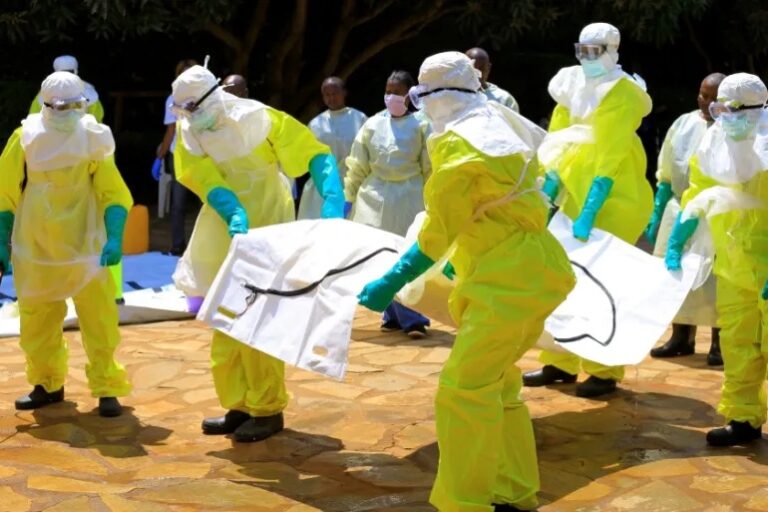
Instructively, response activities are reportedly ongoing in affected areas in the DRC and Uganda. Health authorities in the affected countries, with support from partners, have activated public health emergency measures, including enhanced surveillance, laboratory testing, infection prevention and control (IPC), case management, contact tracing and risk communication activities.
The first Ebola disease outbreaks occurred in the remote villages in Central Africa, near tropical rainforests. The 2014-2016 Ebola virus disease outbreak in West Africa was the largest and most complex since the virus was first discovered in 1976. Nigeria’s first Ebola case was an imported infection confirmed on July 25, 2014, which involved a Liberian-American traveler named Patrick Sawyer, who flew into Murtala Muhammed International Airport in Lagos on July 20, 2014. He later died at a hospital in Lagos after being seriously ill. That led to localized outbreak of the Ebola disease in Nigeria, which resulted in 20 total confirmed cases and eight deaths before Nigeria was declared Ebola-free by the WHO later that year.
It is laudable that the NCDC has timely heightened surveillance systems for Ebola and other epidemic-prone diseases. We urge the NCDC and health authorities across the country to increase surveillance at airport, seaport and land borders. Passengers from the affected countries must be subjected to testing. The public should keep the non-pharmaceutical protocols, such as regular hand hygiene, wearing of face mask, maintaining social distance and avoiding crowds. Apart from giving updates on the outbreak, we call on the government to intensify public enlightenment on the new Ebola outbreak, causative factors, prevention measures and treatment
options.