Follow Us on Google

• In UI, two soldiers bring war, loss, humanity to life on International Day of Peace
By Oluseye Ojo
The Wole Soyinka Theatre, University of Ibadan, was transformed into a battlefield of grief, anger, survival and human conscience some days ago.
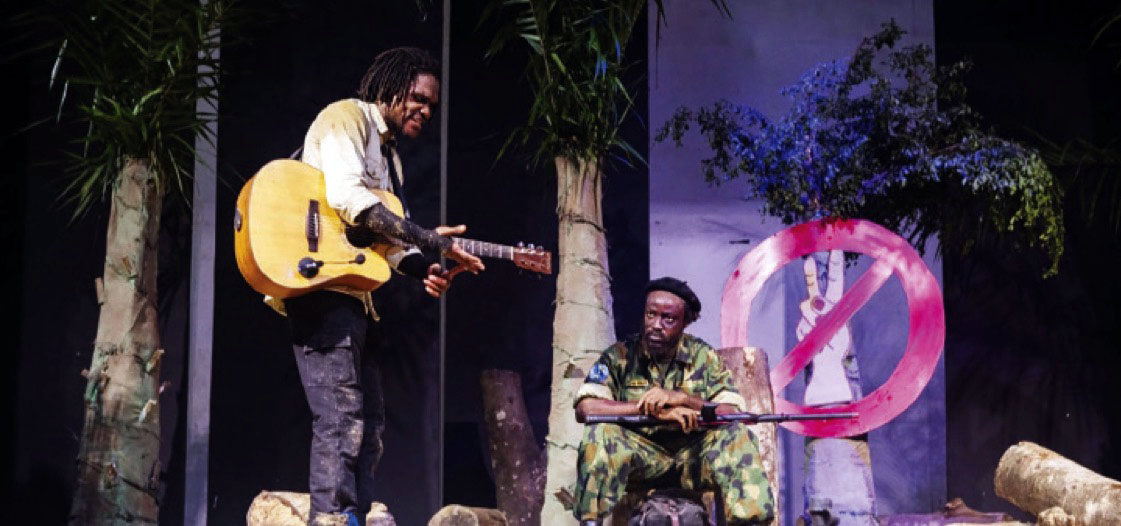
The transformation only required a rifle, a guitar, a bottle of water, a military bag, trees, logs of wood, sawdust, the stage and a red prohibition sign.
With the few props and two actors, a play entitled: ‘Nemesis: A Tale of Two Soldiers”, brought the brutal realities of war to life as the University of Ibadan marked the 2026 International Day of Peace.
The play, written by Chris Ikechi Anyanya, who also played the lead character, Ali Junaid, and directed by King James Dandy (KJD), who portrayed the second character, Leo, was a dramatisation of war and an examination of what violence does to those who survive it.
The story unfolded in a country devastated by war after a bomb blast killed its Prime Minister. The explosion also claimed Ali Junaid’s two wives and children, a soldier whose personal grief became inseparable from the wider national catastrophe.
Anyanya, dressed in military camouflage and carrying a wooden prop rifle, probably embodied a man hardened by loss, anger and years of conflict.
Also, Leo, played by Dandy, dressed in military-style clothing and carrying a guitar, entered the stage as a thirsty survivor. His attempt to take water from the soldier’s military bag triggered a confrontation that gradually grew into something much larger.
The guitar and the rifle were depicted as representatives of two competing responses to a society ravaged by violence, including the language of war, as well as the possibility of music, dialogue and peace.
The drama reached a ceasefire declared by the government. But peace, the play suggested, does not necessarily arrive with a ceasefire. As Leo rushed off the stage on hearing the news from the soldier’s walkie-talkie, a bullet struck him.
He was mortally wounded, and in his dying moments, he asked the soldier to take his guitar and make songs that would bring the country and the world closer to peace. Then, the curtain fell.
Immediately after the performance, the theatre hosted a peace dialogue in the form of a panel discussion.
The play,, which was produced by Dr Olanike Onimisi, a lecturer in the Department of Theatre Arts, University of Ibadan, in partnership with Àfẹ̀mọ́jú Creations and Phoenix Tribe Africa, turned the International Day of Peace into a meeting point between theatre and the realities of conflict.
The play had a matinée performance at the same venue for secondary school students, which was sponsored by American Open University.
Remembering humanity
Before the performance, Onimisi, in her welcome address, noted: “Beyond the play, we are gathered here on the International Day of Peace, to remember our humanity.”
Then, the lights went down. And the audience entered a fictional country, where two strangers turned a bottle of water into a confrontation.
Two men, bottle of water, one war
There were only two characters, Ali Junaid and Leo. Anyanya, the playwright and lead actor, who appeared in military camouflage with a prop rifle. His character, Ali Junaid, was a soldier, who had lost his two wives and children in the bomb blast that killed the Prime Minister and triggered the war.
The second character was Leo, played by Dandy, the director, who entered the stage in military-style clothing, carrying a guitar.
The rifle and guitar immediately established a contrast, with one evoking combat and force, and the other suggesting music, expression and another way of responding to a broken world.
But Leo did not enter as a philosopher, preaching reconciliation. He was thirsty.
The soldier was off stage when Leo entered. He saw the military bag and attempted to take water from it. When the soldier returned and discovered what had happened, he became furious and dealt with him.
But the audience was surprised that the confrontation was more than an argument over water. It depicted that in a country already destroyed by war, trust had disappeared, survival had become personal, every possession mattered, and every stranger could be a threat.
For the soldier, whose wives and children had been killed, anger had become part of his identity. His grief had been transformed into a weapon.
But the encounter forced him to confront another survivor, whose understanding of the war was different from his own.
Leo questioned the value of continuing the cycle of violence. But the soldier insisted that the world was not wired for weaklings and argued that force could sometimes be used to achieve peace.
One of the play’s central tensions is whether violence can ever produce the security people seek, or strength without restraint can create another cycle of destruction.
Other News
Leo continued to challenge the soldier’s position. Gradually, the soldier listened and accept the possibility that continuing to fight could not restore what had already been lost. The two men finally found common grounds. Then came the announcement: that the government had declared a ceasefire.
Ceasefire and another casualty
The ceasefire offered the possibility that the fighting was finally ending. And as at then, the two men had moved from confrontation towards understanding.
But before the moment could settle, tragedy struck. As Leo rushed out of the stage, he was hit by a bullet.
When he discovered that he was mortally wounded, he made one final request. He asked the soldier to carry his guitar and make songs with it. He mentioned songs that could help bring the country and the wider world closer to peace.
The guitar, which was until then, part of his character, became a legacy. The man, who had also lost his elder brother to the war, could not also survive the war.
War not a normal thing
For Anyanya, the playwright and lead actor, the drama was rooted in concerns about the real-world trauma of conflict.
He pointed to kidnapping, war and other forms of violence in Nigeria, Africa and the Middle East, expressing concern that repeated exposure to violence could make society treat it as normal.
“Killing the next person, embracing war is not a normal thing,” he said.
He said the Nigerian Civil War also informed the production’s historical consciousness.
Anyanya recalled that many people died during the conflict, with some eventually forgotten by name.
The lesson, he suggested, is not simply to remember the dead but to prevent future generations from repeating the conditions that produced such destruction.
He described Nemesis as the creators’ ‘own little way’ of calling for an end to war and encouraging people to embrace love.
Humanity first
For Dandy, the director and second actor, the production was also an attempt to confront the human condition.
He said he and Anyanya wanted to tell a topical story at a time when war was increasingly being treated as an ordinary part of contemporary life.
He connected the subject to Nigeria’s own political, religious and ethnic divisions.
“We are humans first, before anything,” he said.
Whether Hausa, Yoruba, Igbo or from another ethnic group, Nigerians, he argued, should first recognise one another as human beings.
He also noted that politics and religion could become so dominant that people place political competition above human relationships.
Theatre becomes dialogue
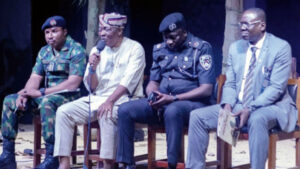
The performance was followed immediately by a peace dialogue, moderated by Dr Olusola Isola, Acting Head of the Department of Peace, Security and Humanitarian Studies, University of Ibadan.
Isola and the panellists were introduced by Dr ‘Tunde Awosanmi, the Acting Head of the Department of Theatre Arts of the institution.
On the panel were the Acting Director, 3 Division Education Services, Colonel Michael Williams, who represented the General Officer Commanding, 2 Division, Nigerian Army; an Assistant Commissioner of Police (ACP), David Apapa, who represented the Commissioner of Police in Oyo State; and Mr. Lasisi Oyekanmi, Chief Security Officer, University of Ibadan.
Isola observed that the play had shown humanity what remains within people even during violent situations.
He also recalled the history of the International Day of Peace, noting that the United Nations decided in 1981 to establish the observance, which took off on September 21,1982.
He then asked the security representatives to reflect on conflict management, de-escalation and the realities of their work.
War is not good – Col Williams
When the microphone was handed over to him, Colonel Williams spoke from the experience of a soldier. He recalled serving in Maiduguri, Borno State in 2017, 2018 and 2019 before leaving in 2020. Lieutenant Colonel Badeh, who was also present at the event, served with him on the battlefield.
For Williams, the fictional war on stage reflected realities known to soldiers.
“War is not good,” he said.
He explained that when crises go beyond dialogue, security personnel are eventually deployed.
Williams also discussed Nigeria’s asymmetric security challenges, particularly situations where non-state actors operate among civilians and sometimes use civilians as shields.
He urged young people to learn from the Nigerian Civil War and warned against hate speech and other conditions capable of pushing young people into violence.
We need each other – ACP
The Assistant Commissioner of Police, Apapa, in his contribution, stressed the need for cooperation among security agencies.
Having served in Sudan’s Darfur region in 2006, Apapa brought international peacekeeping experience to the discussion.
“We need each other,” he said.
He cautioned against deliberately creating conflict in the hope of producing stability, warning that small disputes can degenerate into larger crises.
The family losses depicted in Nemesis, he said, demonstrated the human price of violence.
“War is not the way to go. Peace is always the best,” Apapa said.
I momentarily lost myself – CSO
Oyekanmi, the University of Ibadan Chief Security Officer, acknowledged that the production was so convincing that, at some points, he found himself emotionally absorbed and momentarily forgot that he was watching a stage play.
He also spoke of the sacrifices made by people, who devote their time, energy and, sometimes, their lives to maintaining peace.
Students join conversation
The peace dialogue was not left to security officers and academics alone. Leaders of the University of Ibadan Students’ Union and the Association of Faculty of Arts Students asked questions and made comments on peacekeeping.
Secondary school students had attended the matinée performance in the morning, with their tickets sponsored by American Open University.
The evening performance also attracted students, academics, peace advocates, military and paramilitary officers and other members of the university community.
Beyond the stage
Onimisi, the producer, in her post-performance reflection, said Nemesis addressed the question of Nigerian unity without lecturing the audience or asking anyone to choose a political, religious or regional side.
Instead, she stated that it placed two men from an unnamed war in a room and allowed their hatred, trauma and eventual change to unfold through dialogue and song.
But the performance, she stressed, was only the invitation. The peace dialogue was deliberately held immediately afterwards to move the audience from watching conflict to discussing its consequences.
Onimisi also pointed to the gap between declarations about national unity and realities on the ground, citing crimes, terrorism, banditry, kidnapping, farmer-herder clashes and ethnic conflicts affecting communities.
The consequences, she argued, go beyond security. She cautioned that persistent instability affects investment, institutions and the ability of a country to retain capable young people.