Follow Us on Google
Ndigbo are a proud people with rich cultural heritage. Among the culture and tradition of the people, conferment of chieftaincy titles appears to be one of the most cherished. This is because titled people are revered and respected. They are usually great men and women who have distinguished themselves in the society and have contributed immensely to the development of their various communities.
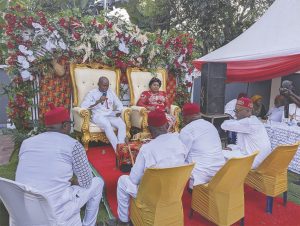
There are different levels or categories of titles in Igbo culture. Eze or Igwe is the traditional ruler of a community. He can confer chieftaincy titles on deserving citizens of his community.
There is a group of people called Ndi Ichie. They are usually appointed to represent their villages in the Igwe’s cabinet. They mediate in disputes and accompany the Igwe on his official visits and functions. The appointment lapses anytime the Igwe goes to visit his ancestors.
The prestigious Nze na Ozo society is as old as the origin of the Igbo. It also confers titles on deserving citizens who are well known in community leadership, wealth or some other achievements. The initiates thereafter become Nze or Ozo. Ths is for men only.
Ozo title-holders are custodians of Igbo tradition. They usually swear to uphold justice, truth and peace in every situation. It is a sacred institution that requires high moral standing among the holders.
The symbols of authority of title-holders are red cap, walking stick, elephant tusk, a fan made from cow skin and a horsetail. They have a traditional way of greeting themselves and non-initiates are not expected to greet that way.
Initiation into this aristocratic society marks the person out as nobility. It is a status symbol taken only by respected people who can afford it. An intending member is usually examined thoroughly to ensure that he does not have questionable character. Once the person is accepted, he goes through various stages of the title-taking. This varies, depending on the community. On the final day, which is for the conferment ceremony, friends, well-wishers and the entire community are invited to come and eat and drink. Cows and cocks are usually butchered for this event.
The conferment of the title takes place after the entertainment. This is when the new initiate is given his regalia and he, in turn, gives out the name he wishes to be called. Some popular names include Akuenwebe (wealth does not have a reserved place), Akubuilo (wealth attracts jealousy), Ochinanwata (the one who gets his title at childhood), Chinyereugo (the one who is crowned or honoured by God), Ezeugo (king of eagles), Nnanyereugo (the one who is crowned or honoured by his father), and so on.
People call them these names until the end of their lives. Immediately after the initiation, the new Ozo man dances with his wife and the other Ozo people. The music is called “ufie’ and only titled men and their wives could dance it. It is sacred and performed only for special occasions like the Ozo ceremony or burial of an Ozo title-holder.
This past Yuletide season, a number of people acquired different titles in different communities in Igbo land. My own town, Isuofia, in Aguata Local Government Area of Anambra State, is not left out. The Head of Nze na Ozo society of every community usually performs the conferment of this title on an intending member.
My younger brother, Dr. Chidi Igbokwe, joined the prestigious Nze na Ozo society of Akulu Isuofia on December 29, 2025. In preparation for this grand occasion, he had earlier done what is called the “Idi” ceremony in April 2025. During this event, an intending member feasts all the members of Nze na Ozo with different types of food and assorted drinks. It is on this occasion that he announces the date for his initiation into the society. Once he picks a date, he cannot change it again. If, for any reason he decides to change the date, he will have to go through the process of “Idi” ceremony again.
A lot of money goes into the preparation of this ceremony. That is why members of the Nze na Ozo society address themselves as wealthy people. When a member says, “Ndi Nze ogbu efi, ogbu efi,” (Nze people, cow killers, cow killers). Others will respond, “akajiaku” (wealthy people.)
Indeed, in most towns, a new initiate must kill cow. And the members must inspect it to be sure that the cow is up to standard. This cow will be killed and shared among members. This is different from the cow the new initiate will kill to prepare food for guests. He will also present big kola nuts that will reach all members of the society as well as some cash. The amount of cash depends on a particular group or town.
In Akulu Isuofia, each Nze na Ozo member goes home with a tuber of yam, a cock, some gallons of palm wine (which is usually very expensive in festive periods) and some amount of money which I will not disclose here. The last festive season, two gallons of good palm wine went for about N100,000. When you consider that the new initiate will have to bring about eight jars (a jar is 20 litres), you will partly understand the amount of money that goes into this ceremony. Some people might consider this a waste. But that is why obtaining such a title is not for the poor.
In the olden days, when a member of the Nze na Ozo society makes a pronouncement on any issue, it is taken as sacrosanct. This is because they used to go through different rituals, including some incision on the tongue, such that when they lie or give biased judgment on any issue, they will die.
These days, Ozo title has undergone some changes due mainly to the influence of Christianity and Western civilization. This has tempered some traditional rites that go with the initiation into this society. That is why good Christians can now join the society without their churches frowning upon it. There are people who still believe that it is pagan practice. Hence, they refuse to join.
Nevertheless, Nze na Ozo people still maintain, to a reasonable extent, the sanctity of their calling. Those who deviate or commit abominable acts are expelled from the society and relinquished of the Ozo title.
Outside the traditional Nze na Ozo society, traditional rulers also confer chieftaincy titles on worthy sons and daughters of their towns. Once conferred with this title, the title holder becomes a palace chief. This is different from Ndi Ichie (cabinet members of a palace).
Again in Isuofia, the traditional ruler, Igwe Col. C.A.O. Muoghalu (retd) used the occasion of his Ofala Festival on January 3, to confer titles on some illustrious sons of the town. The recipients include a Canadian-based medical doctor, Dr. Ikedinachukwu Nwankwor; a Lagos-based businessman, Chief Ifeanyi Ibeabuchi; co-founder of Pemason Pharmaceuticals, Sir Eugene Osele; his brother and fellow of Pharmaceutical Society of Nigeria, Chief Patrick Osele; and an Associate Professor of Data Communication and Information Technology at Nnamdi Azikiwe University, Awka, Professor Ikechukwu Umeh.
The occasion was grand. The governor of Anambra State, a proud son of Isuofia, Professor Charles Soludo, was in attendance. The Onowu Isuofia, Chief Ndubuisi Osele, performed the conferment rites on the recipients. After the palace events, each of the recipients retired to his house to entertain friends and well-wishers.
Particularly worthy of emulation is the philanthropic act of one of the recipients, Dr. Nwankwor. Beyond the merriment, he used the occasion to present cheques to five winners of this year’s scholarship scheme which he and his amiable wife, Dr. Ify Nwankwor, instituted. The scholarship scheme is anchored on the platform of Cyril and Susanna Foundation. It was established to contribute to human capital development in Nigeria, initially focusing on Isuofia community. It has different categories and runs until the awardees finish their academic programmes in the university. There is a category for the best-graduating student from each of the six primary schools in Isuofia to Holychild Secondary School, Isuofia. This is open to all students of these schools irrespective of town of origin.
Other recipients have also made their various contributions to the community. Chief Ibeabuchi is deeply involved in community development and service to his village, Isiaku, and Isuofia as a whole. The two Oseles – Patrick and Eugene – have invested in people’s well-being and have touched many lives. Professor Umeh has received over 60 awards for his academic excellence, leadership, philanthropy, mentorship and community service.
These are the type of people who deserve chieftaincy titles. But like every other aspect of our culture, the essence and prestige of this tradition have been watered down due mainly to the influence of money. Many known criminals have also received these titles simply because they are rich. This notwithstanding, the chieftaincy institution in Igbo land still retains some atom of respect. It behoves on traditional rulers and the Nze na Ozo society to screen recipients well before conferring any title on them.