Follow Us on Google
…Says it will trigger industrial unrest
By Bimbola Oyesola,
The Non-Academic Staff Union of Educational and Associated Institutions (NASU) at the weekend warned the Federal Government that bias in disbursing the promised N50b Earned Allowance could trigger a new wave of industrial unrest in the education sector in the country.
This is even as it condemned selective implementation of agreements and payment delays in the tertiary education sector.
Speaking at a two-day meeting organised by the Universities & Inter-University Centres Trade Group Council of NASU, the General Secretary of the Union, Peters Adeyemi, said the earned allowance has been a problematic issue over time.
“They have tried to divide the ranks of the unions. Particularly in the universities. So, when the earned allowance is released, they will put the non-teaching staff on one side, and put the academics on another side, he said.
He stated further, “And when they want to share the money, they will give 20 percent to the three non-teaching staff unions and give 70 percent to the academics.”
2022 Agitation
Noting that the non academic unions have often protested over this, Adeyemi said this was part of the reasons NASU embarked on a long strike in 2022.
He maintained that as of August 2022, while the strike had lasted for about four months, the union was invited to a meeting, chaired by the former Minister for Education, Adamu Adamu and an agreement was signed.
“In that agreement, government committed itself to releasing N50b for the payment of earned allowance for both the academics and the non-teaching. That was one of the promised incentives that made us to suspend that strike,” he said
Triggers
He however, lamented that government has not fulfilled that commitment. “But suddenly, just about two or three days ago, we saw a circular letter written to one of the unions. That a meeting of stakeholders was held. Stakeholders of the university held with one union (ASUU), leaving three unions out!”
Berating the federal government over the divide and rule action in the nation’s ivory tower, Adeyemi queried, “How will that be a stakeholder meeting? Because if you only meet with one out of four, that cannot be a stakeholder’s meeting.”
He added, “Since we were not part of the stakeholder meeting, we have a strong feeling that they want to pay that N50b to just one union.
“And we like to use this opportunity of this important meeting, to call on Mr. President through the Minister of Education that if the N50b is paid only to the academic union and ignores other unions, it will plunge the universities into an industrial crisis,” he warned adding that government is a continuum— hence the “agreements signed in 2022 remain binding today.”
Tinubu’s intervention
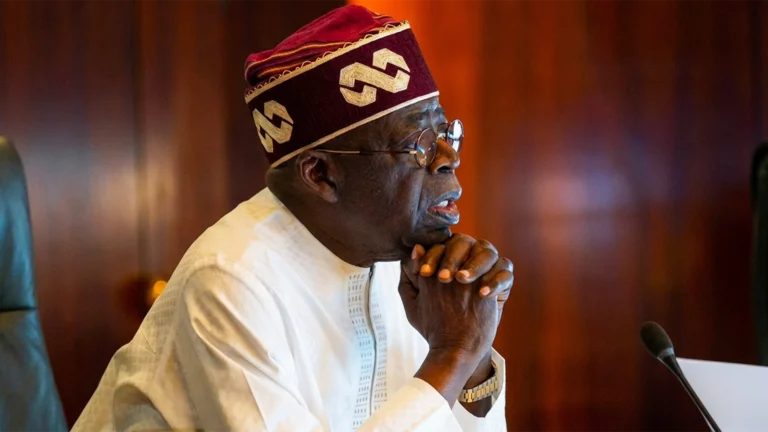
The NASU Scribe said the union presently called for the intervention of President Bola Tinubu as he’s anxious to sustain industrial peace in the university, hence commending him thus far for the peace in the education sector.
“But I think in their desperation not to allow for one union to go on strike, they will not create a situation the way they created the payment of four months salaries to ASUU and refusing to pay two months to us (NASU),” he noted insisting that government by its own action or inaction will set the university on industrial crisis
“This is a great opportunity for us to appeal to the Minister for Education, whom we have a lot of respect for and Mr. President, that any attempt to share that M50 billion to the academics only, will set the university on parallel industrial crisis,” he maintained.
Adeyemi said the union supported the transition from the Integrated Personnel and Payroll Information System (IPPIS) on the condition that all benefits and liabilities would be migrated.
“Unfortunately, IPPIS has failed to take on both the assets and liabilities. This is a major problem for us,” he stated.
The union leader also condemned the alleged illegal stoppage of check-off dues in some institutions, citing the Federal Polytechnic, Ekowe, as a case in point.
“No rector, vice-chancellor, or provost has the power to stop union dues. It is a statutory right under Nigerian labour laws,” Adeyemi declared.
In his contribution, NASU’s President, Hassan Makolo, strongly criticised the federal government over the unpaid arrears, faulty implementation of the IPPIS, and delays in renegotiating of the 2009 agreement.
Makolo slammed the continued non-payment of third-party deductions, promotions, and union dues, calling it a betrayal of trust.
Makolo raised concerns about possible sabotage, warning against punishing unions for opposing IPPIS, and vowed resistance if necessary.
He also decried NASU’s exclusion from recent stakeholder meetings on earned allowances, questioning the legitimacy of those involved.
On the stalled 2009 agreement renegotiation, he expressed frustration at the lack of progress since December 2024.
“Enough is enough,” he warned, urging the government to act with sincerity and urgency.
Others
On his part, the Lagos State Chairman of the Non-Academic Staff Union of Educational and Associated Institutions, Timothy Olawore, lamented the persistent challenges plaguing Nigeria’s education sector.
He cited inadequate funding, poor infrastructure, and brain drain as major setbacks.
“These challenges not only affected the quality of education l, but also the well-being of our members,” he said reiterating NASU’s commitment to advancing members’ interests and the sector’s growth despite the odds,
He called on participants to “share experiences and provide lasting solutions to reposition the sector.
The Trade Group Council Chairman and Deputy President of NASU, Buhari Suleiman, equally raised an alarm over the deteriorating state of Nigeria, highlighting crises in education, security, power, and the economy.
He condemned the government’s 9.2 percent education budget in 2025 as woefully inadequate, calling it a “clear disregard for global standards.”
Suleiman decried Nigeria’s slide to 6th on the Global Terrorism Index, labelling it a “shameful failure of leadership and strategy”.
He slammed government over the deep-rooted corruption and rising youth unemployment, warning that “no nation develops when its future, the youth, is abandoned.”
He also described the power crisis as a national embarrassment, demanding urgent reforms and leadership that works for the people, and not politicians.