Follow Us on Google
From Adesuwa Tsan, Abuja
In Nigeria’s fluid political environment, defections are often the earliest signals of emerging alliances ahead of major elections. The latest wave of defections in the Senate, which culminated in a dramatic debate over the status of Abia South Senator, Enyinnaya Abaribe, has once again drawn attention to the strategic manoeuvring already underway ahead of the 2027 general election.
Beyond the immediate drama on the floor of the Senate, the movement of lawmakers into the African Democratic Congress (ADC) raises deeper questions about the readiness of Nigeria’s opposition parties to challenge the ruling All Progressives Congress (APC), led by President Bola Ahmed Tinubu.
The defections have altered the configuration of the Senate and could signal the early stages of a broader political realignment involving federal and state actors. But Daily Sun gathered that whether these moves translate into a formidable opposition platform capable of confronting the APC in 2027 will remain uncertain.
More importantly, political observers noted that the controversy surrounding Abaribe’s defection has also exposed a deeper political struggle not just over constitutional interpretation but over who controls the opposition space in the National Assembly and how the emerging coalition politics could shape the next election cycle.
Wave of defections in the Senate
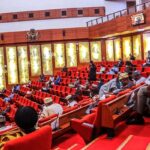
The immediate trigger for the latest debate came during Senate plenary when several lawmakers formally defected to the ADC. Before then, it had recorded a tsunami of movement from various opposition parties to the ruling APC. Among them were prominent figures such as Aminu Tambuwal (Sokoto South), Victor Umeh (Anambra Central), Tony Nwoye (Anambra North), Ireti Kingibe (Federal Capital Territory), Lawal Adamu Usman (Kaduna Central), Mohammed Onawo (Nasarawa South), Austin Akobundu (Abia Central) and Binos Yaroe (Adamawa South).
Most of the lawmakers cited divisions within their former parties, particularly the Peoples Democratic Party (PDP) and the Labour Party (LP), as justification for their move.
But the case of Abaribe triggered intense debate after the Senate leadership questioned whether the constitutional provisions guiding defection should be invoked against him.
Deputy Senate President, Barau Jibrin, argued that Abaribe’s former party, All Progressives Grand Alliance (APGA), had no known national crisis that would justify his defection. Senate Leader Opeyemi Bamidele further suggested that the senator’s claim that he had been expelled from the party could itself trigger constitutional consequences.
Although Senate President Godswill Akpabio eventually gave Abaribe time to clarify his position, the episode highlighted the political tensions surrounding the shifting party landscape.
Yet, the constitutional debate was only part of the story. Behind it lies a wider political calculation involving the leadership of the opposition caucus in the Senate, Daily Sun investigations reveal.
The undertones behind the Abaribe controversy
Within the Senate, leadership positions are traditionally allocated according to party strength. The largest opposition party produces the Minority Leader and controls other strategic minority offices. At the moment, the Minority Leader is Abba Moro of the PDP. However, the recent defections have reshaped the opposition numbers in the chamber.
With more senators now aligning with the ADC than the PDP, the balance of power within the opposition bloc appears to be shifting. In practical terms, that could mean the minority leadership would eventually move from the PDP to the ADC. If that happens, the party would likely nominate one of its most experienced senators for the role and Abaribe, a long-serving legislator and former Senate minority leader, is widely seen as one of the most prominent figures capable of occupying the position.
This context has fuelled speculations among political observers that the threat to invoke constitutional provisions against Abaribe may not be entirely divorced from the politics of Senate leadership. Some insiders believe preventing Abaribe from consolidating influence within the ADC caucus could reshape the emerging opposition hierarchy in the chamber.
Whether or not that interpretation proves correct, the episode illustrates how constitutional arguments and political calculations often intersect in Nigeria’s legislative politics.
A familiar pattern in Nigerian politics
The controversy surrounding Abaribe also highlights a longstanding pattern in Nigeria’s political system. Defections are common in both the national and state legislatures. Yet, the constitutional provisions that require lawmakers to vacate their seats are rarely enforced consistently.
Over the years, many legislators have defected, particularly to the ruling party — without losing their seats. In several political cycles, lawmakers who switched parties justified their actions by citing internal divisions that were often difficult to verify. Some defectors joined the ruling APC without clear evidence that their former parties were truly divided, and their seats were rarely declared vacant.
This history has raised questions among observers about whether the constitutional provisions governing defections are applied selectively depending on the political context.
For many analysts, the controversy surrounding Abaribe, therefore, reflects not only a legal debate but also the broader politics of power within the legislature.
The emergence of ADC as a possible opposition hub
One of the most notable outcomes of the recent defections is the rising profile of the ADC as a potential platform for opposition coordination. With the new entrants, the party now has a stronger presence in the senate and could become a rallying point for politicians seeking an alternative to both the APC and the embattled PDP.
Historically, Nigerian opposition politics has been shaped by shifting alliances rather than ideological coherence. The APC itself emerged in 2013 through a merger involving parties such as the Action Congress of Nigeria (ACN), the Congress for Progressive Change (CPC) and the All Nigeria Peoples Party (ANPP). That coalition eventually defeated the PDP in the 2015 presidential election.
Some analysts believe the ADC could become the nucleus of a similar coalition if opposition figures are able to overcome personal rivalries and regional divisions. However, that prospect remains highly uncertain.
APC’s entrenched advantage
Despite the recent defections, the APC still enjoys overwhelming dominance in national politics. The party controls the presidency under Tinubu and maintains strong majorities in the national assembly. In the senate, for example, the APC commands a large bloc of lawmakers, while the opposition remains fragmented across multiple parties. It also holds a majority of governorships across the federation, giving it control over critical political structures at the state level.
Other News
In Nigeria’s electoral system, state governors often play decisive roles in mobilising resources and influencing legislative elections. This structural advantage means that any opposition coalition hoping to challenge the APC must first build a strong network of governors and state-level political actors. With the persistent crisis within the PDP, once Nigeria’s dominant political party, up to 32 state governors have now moved to the APC, thereby increasing its strength.
Without a credible effort to resolve its internal disputes, analysts warn that the PDP will continue to be weakened until only its shell will remain in the 2027 elections.
Labour Party’s uncertain future
The Labour Party emerged as a major political force during the 2023 general elections, driven largely by the presidential candidacy of Peter Obi. His campaign attracted a strong following among young voters and urban professionals, particularly in southern Nigeria.
However, the party has since been plagued by leadership disputes and factional struggles. Several lawmakers elected on the Labour Party platform have either defected or signalled their intention to leave, citing internal divisions.
The recent defection of senators such as Umeh, Nwoye and Kingibe underscores the challenges facing the party as it seeks to maintain its political relevance.
Looking ahead to 2027, several political figures are already being discussed as possible contenders for the presidency.
Among them is President Tinubu himself, who may seek a second term under the APC. Within the opposition, figures such as Tambuwal and Obi are frequently mentioned as potential candidates.
Tambuwal, a former Speaker of the House of Representatives and former governor of Sokoto State, has long been considered a significant player in national politics.
Obi, on the other hand, retains a strong grassroots following among voters who supported his reformist message in 2023.
The ability of opposition parties to unite behind a single candidate could prove decisive in determining whether they can mount a credible challenge to the APC.
State-level battlegrounds
Beyond the presidential race, the opposition’s prospects in 2027 will depend heavily on state-level dynamics. Governorship elections often shape the broader political landscape by determining which party controls local political structures. States such as Lagos State, Rivers State, Kano State, Katsina State and Anambra State have historically played outsized roles in national politics due to their population size and economic significance.
Opposition parties hoping to challenge the APC must not only win these strategic states but also build a nationwide coalition capable of competing across Nigeria’s diverse regions.
Legislative contests
The struggle for control of legislative seats will also be critical. Defections like those seen in the senate can influence the balance of power in the national assembly and signal broader political shifts.
However, legislative elections are often heavily influenced by local political networks and the popularity of individual candidates. This means that party labels alone may not determine outcomes. Instead, alliances between national leaders, governors and grassroots political operators are likely to shape the electoral landscape.
Challenge of unity
Perhaps the biggest challenge facing the opposition is unity. Nigeria’s political history is filled with examples of opposition coalitions collapsing under the weight of internal rivalries. Personal ambitions, regional considerations and ideological differences often make it difficult for opposition leaders to agree on a common strategy.
If the ADC hopes to emerge as the nucleus of a new opposition coalition, it will need to attract not only defecting lawmakers but also influential governors and political heavyweights from across the country.
Despite the obstacles, the recent defections suggest that political realignment may already be underway. Lawmakers switching parties often signal broader shifts within the political elite.
In some cases, defections are driven by ideological disagreements or policy differences. In others, they reflect strategic calculations about where power is likely to reside in the future.
As the 2027 elections approach, more politicians may reposition themselves in anticipation of emerging alliances.
But for now, the APC remains firmly in control of Nigeria’s political landscape and the growing movement of lawmakers across party lines indicates that the contest for 2027 has already begun.
Whether the opposition can transform these defections into a coherent political movement capable of challenging the ruling party remains one of the defining questions of Nigeria’s evolving democracy.
The drama that unfolded in the senate over Abaribe’s defection may have centred on constitutional technicalities, but it also served as a reminder of the deeper political currents shaping the race for power in 2027.
As alliances shift and political actors reposition themselves, Nigeria’s political landscape could look very different by the time voters return to the polls in a few months.