Follow Us on Google
By Moses Akaigwe
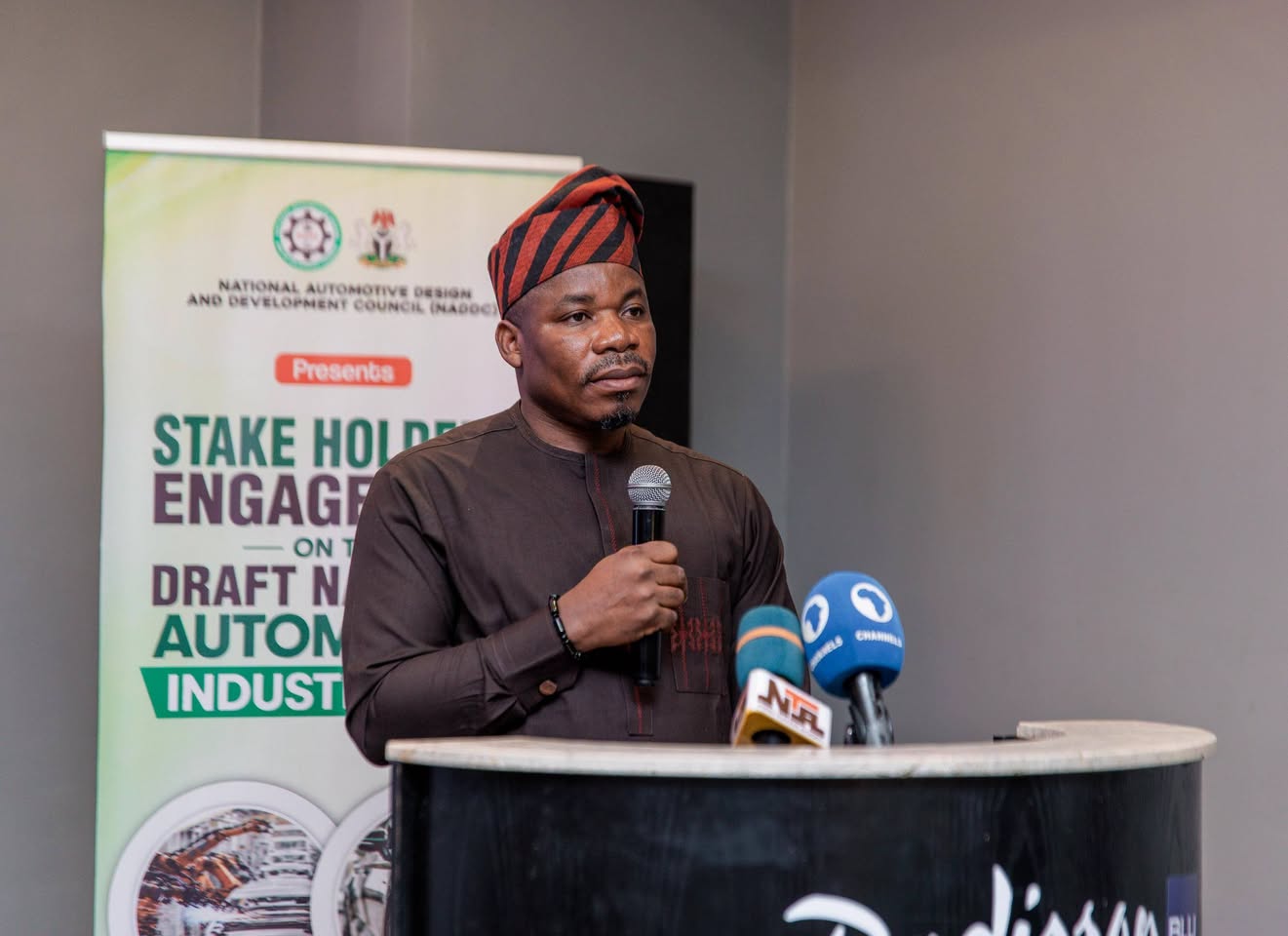
Nigeria’s Automotive Design and Development Council (NADDC) on Thursday took another bold step towards giving the industry a permanent Act of Parliament when it organised an engagement forum for stakeholders to brainstorm on a well-articulated Draft National Automotive Industry Bill 2026.

At the consultative meeting held at the Radisson Blu, Ikeja, Lagos, the stakeholders took turns to applaud the NADDC and its Director-General, Otunba Oluwemimo Joseph Osanipin, for the initiative, which is expected to provide a legal framework for developmental activities in the sector.
The participants included representatives of the Nigerian Automotive Manufacturers Association (NAMA), Motorcycle Manufacturers Association of Nigeria (MOMAN), the Auto Sectoral Group of the Manufacturers Association of Nigeria (MAN), Automotive Local Content Manufacturers Association of Nigeria (ALCMAN), and the representatives of various auto companies,

While some of them stated that they had already submitted their positions, others hinted at turning in formal inputs in the days ahead – all designed to ensure a performance-based policy framework capable of driving investment, local manufacturing and component development.
Osanipin commits to viable auto industry
Addressing the stakeholders, the Director-General/CEO of NADDC, Otunba Oluwemimo Joseph Osanipin, said the Council was committed to developing a legal framework capable of transforming Nigeria’s automotive ecosystem into a self-sustaining and globally competitive industrial value chain.

He said, “When this management team assumed leadership at the NADDC, our vision was clear: to move Nigeria’s automotive ecosystem from mere assembly potentials into a robust industrial value chain anchored on local content, component manufacturing, vehicle electrification, and regional market integration.”
“However, achieving this ambition requires an unyielding foundation. Policy inconsistency, legislative gaps, and outdated legal frameworks have historically created uncertainty for investors. The National Automotive Design and Development Council Act of 2014 laid important groundwork, but the dynamics of global manufacturing, green mobility transitions, and regional trade integration, particularly under the African Continental Free Trade Area (AfCFTA), demand that we upgrade our legal architecture.
“The Draft National Automotive Industry Bill, 2026, represents a bold legislative reform. By transitioning the Council into the National Automotive Design & Development Commission, this Bill aims to: establish a statutory institutional framework with strong regulatory and enforcement mandates; legally safeguard the incentives, protections, and implementation structures of the Nigerian Automotive Industry Development Plan (NAIDP); create a predictable, transparent, and investment-friendly environment that gives original equipment manufacturers (OEMs), component suppliers, and financiers the confidence to commit long-term capital to Nigeria; and fast-track local value addition, supplier development, and sustainable job creation for our youth.”
The DG pointed out that the Council firmly believed that legislation designed for the private sector must be written with the private sector.
“The draft Bill before you today is not a finished product cast in stone; it is a collaborative template. We have deliberately convened this session to listen to you, the plant managers, local assemblers, component manufacturers, and key industry bodies like NAMA and MAN, who navigate the daily operational realities of our market.
“We want to know: Where do these provisions support your growth? Where do they create bottlenecks? How can we refine this framework to position Nigeria as the undisputed automotive manufacturing hub of West Africa?” he added.
This was followed by the presentation of an overview of the Draft National Automotive Industry Bill by Tobiloba Oyewale, who spoke on behalf of Gboyega Oyewake, SAN.
NAMA applauds, seeks amendments
Expectedly, NAMA, represented by its Chairman, Bawo Omagbitse, was the first to laud the concerted efforts initiated by the NADDC and expressed the association’s support for the enactment of a National Automotive Industry Act.
Omagbitse, however, pointed out that substantial amendments were required to ensure that the legislation functions not only as a regulatory framework but also as a catalyst for automotive industrialisation.
The NAMA Chairman said the fundamental issue the Bill must address was whether its provisions would make it commercially attractive for investors to manufacture vehicles and components in Nigeria, rather than rely on imports.
He said the automotive sector was an anchor industry with extensive linkages to steel, aluminium, plastics, rubber, glass, batteries, electronics, chemicals, engineering, logistics, finance, ICT, technical education, and research and development.
According to him, the proposed law should establish a clear and balanced industrial compact between government and investors, with government providing predictable policies, appropriate incentives, market support, and investment protection, while industry commits to measurable targets in investment, production, employment, local content, supplier development, technology transfer, research and development, and exports.
He said, “We recognise the need to replace the existing legal framework with legislation that reflects the changing realities of our industry, including new technologies, electric mobility, consumer protection, standards, vehicle safety, and the growing importance of local manufacturing.
“However, after a careful review of the proposed Bill, the industry believes that substantial amendments are required before the Bill is passed into law. Our principal concern is that the Bill, in its present form, is stronger as a regulatory and institutional law than as an industrialisation law.
“It provides for licensing, standards, inspection, penalties, testing, consumer protection, clean mobility, and administration of industry funds. These are important provisions.”
However, Omagbitse further asked, “What will make it commercially rational for an investor to manufacture vehicles and components in Nigeria rather than simply import them into Nigeria?” That question, he said, must be at the heart of the legislation.
“The automotive industry is not an ordinary trading sector. It is an anchor industry with linkages to steel, aluminium, plastics, rubber, glass, batteries, electronics, chemicals, engineering, logistics, finance, ICT, technical education, and research and development. A successful automotive industry, therefore, does much more than assemble vehicles. It creates an industrial ecosystem.
“Nigeria’s current automotive policy already sets ambitious objectives: the transition from SKD to CKD production, increased local content, increased domestic production, employment generation, and the development of locally produced new-energy vehicles.”
“The proposed legislation should do more than restate these aspirations. The Nigeria Automotive Industry Act, 2026, should create the legally predictable mechanisms that make the aspirations commercially achievable. Our recommendation is that the Bill should establish a clear and balanced industrial compact between Government and investors.
“Under this compact, the Government would provide predictable policies, appropriate incentives, market support, and investment protection. In return, industry would undertake measurable commitments to investment, production, employment, local content, supplier development, technology transfer, research and development and, where commercially feasible, exports.
“This simply implies that there should be no industrial incentive without industrial performance and no industrial performance obligation without predictable Government support. That, in our view, is the balance that is presently missing from the Bill.”
He recommended that the Bill should be strengthened around a number of critical pillars, including investment and policy certainty; establishment of a predictable Automotive Tariff and Industrial Protection Framework that must have a clear and rational relationship between the tariff treatment of Fully Built Vehicles, SKD kits, CKD kits, and locally manufactured components; a strong and practical local-content and component-development programme; establishment of a properly structured Automotive Development Fund.
The fund proposed in the Bill is potentially one of its most important provisions, but it must be properly governed and ring-fenced; and market creation.
According to him, NAMA believes the Bill provides an important opportunity to establish a modern and durable legal framework for the Nigerian automotive industry. But it should not become merely a stronger regulatory law; it must become an equally strong automotive industrialisation law.
“The legislation must help Nigeria move: from SKD assembly to CKD manufacturing; from vehicle assembly to component integration; from import dependence to local value creation; and ultimately from a protected domestic market to a competitive African automotive production base.
“We look forward to working with the National Assembly, the Federal Government, NADDC, other regulatory agencies, and all stakeholders to refine this Bill into legislation that provides not only rules for the automotive industry but a credible pathway for its growth and industrial transformation,” Omagbitse emphasised.
Motorcycle, tricycle makers back bill, set 3-point agenda
Like NAMA, MOMAN (whose membership covers tricycle manufacturers too) was represented at the stakeholders’ engagement by Rev. Lambert Ekewuba, who pledged the association’s support for “the overall objectives of the National Automotive Industry Bill, 2026.”
However, to convert the objectives into sustainable industrial development, MOMAN’s recommendation is that the Bill should clearly reward genuine manufacturing and assembly investment, ensure predictable regulation, establish workable local-content pathways, and protect consumers and responsible investors.
Ekewuba spoke further: “In view of the above, the Motorcycle Manufacturers Association recommends a three-phased deletion programme for motorcycles and tricycles.
“First, maintain a substantial and commercially meaningful tariff gap between locally produced parts and imported ones.
“Two, grant 0 percent import duty on CKD (completely knocked down) kits to the motorcycle/tricycle assembly plants that have invested heavily in the industry with backward integration programmes.”
Honda lauds NADDC, submits 34
recommendations
Honda Speaking on behalf of Honda Manufacturing Nigeria Ltd., Ota, Ogun State, the Divisional Manager for Sales & Customer Service, Olabade Badejo, told the forum: “Honda completely welcomes and supports this Bill” as what the industry needs for development and growth.
Badejo disclosed that the company had articulated and submitted 34 recommendations and some amendments to sections of the draft Bill to the NADDC, and hoped that they would reflect in the final draft that would go to the Legislature later.
He also harped on a very key area that recurred at the forum – the need for critical volume and economies of scale that can drive real investment into the auto industry and protect that investment.
Other participants who underscored the importance of high volumes and economies of scale were the representative of Elizalde Nigeria Ltd and the Motoring Editor of The Sun newspapers, Moses Akaigwe.
The Honda Manufacturing representative tied his argument to new car sales volume of not up to 30,000 units in Nigeria per year, while imported used, scrapped, and unroadworthy vehicles run into several hundreds of thousands of vehicles imported into Nigeria per year.
“No major investment will be attracted if the Nigerian Government or this Bill does not prohibit used, scrapped, unroadworthy vehicle importations by individuals or entities who are profiteering big and are also well connected with and lobbying the political elites,” he stated.
To buttress his point, Badejo gave the example of Honda’s huge investments in the late 1970s in Ota to set up a comprehensive factory with welding, painting, machining and assembly lines, etc., along with other major investments by Leventis and several other major stakeholders in the past, who did not recover the majority of their investments because of policy somersault and inconsistencies from the 1980s till date.
Such policy flip-flop, according to him, should be avoided as a new era beckons because several of the companies that were victims of the previous policy inconsistencies have either gone moribund or completely moved out of Nigeria.
Badejo informed the stakeholders that Honda Manufacturing Nigeria Ltd. (the motorcycle maker) and Honda Automobile West Africa Ltd. (the car plant) “have formally merged into one entity as Honda Manufacturing Nigeria Ltd. from September 1.” This was part of efforts to consolidate its operations in Nigeria for future expansion.
Other participants who made contributions at the NADDC stakeholders’ engagement on the Draft National Automotive Industry Bill were Oluchi Odimuko, the Assistant Director in the Auto Sectoral Group of the Manufacturers Association of Nigeria (MAN); and Engr. Femi Olafunmiloye, Managing Director of the Akure-based Lafbart Innovations & Consulting Limited (manufacturers of tricycles and other mobility solutions).
Promise fulfilled
Thursday’s (September 3, 2026) Stakeholders’ Engagement on the Draft National Automotive Industry Bill was in fulfilment of the Director-General’s assurance two months ago that the NADDC was working in tandem with the relevant stakeholders to give the industry a legal framework that won’t be vulnerable to policy somersaults.
According to Otunba Osanipin, one way to ensure the new policy was not reversed later would be to make it the product of legislation.
He had told The Sun in an exclusive interview: “Where we are now on our National Automotive Industry Bill is that we already have a draft. In the next few weeks, the stakeholders would be meeting to critique it and then make inputs before we move forward and send it to the Ministry of Justice.
The interactive session organised by the NADDC attracted a wide spectrum of industry players, including automotive manufacturers, assemblers, and other stakeholders who reviewed the proposed legislation.
Both the NADDC team – including the Director, Policy, Planning & Statistics, Umar Nura Sidi; and Obi Anthony Obiakor of the Legal Unit – and other participants were confident that a final National Automotive Industry Bill would be ready before long.
The clean copy is expected to be ready for submission to the Federal Ministry of Justice before the end of the year.