Follow Us on Google
By Moses Akaigw
The National Automotive Design and Development Council (NADDC) has commenced the technical critique and validation of draft instructional manuals designed to guide the training and certification of personnel in compressed natural gas (CNG) and electric vehicle (EV) technologies.
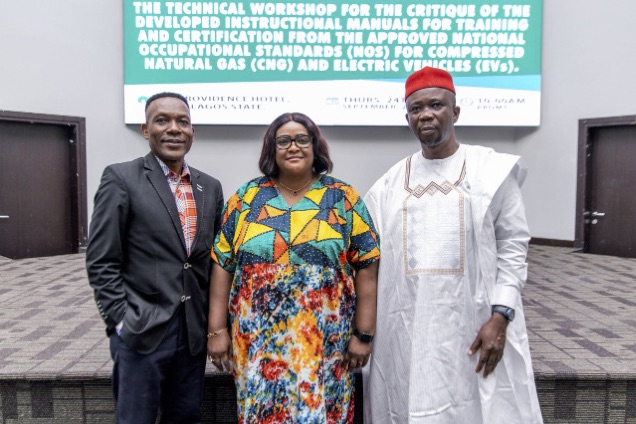
The exercise, which is aimed at ensuring that the manuals meet industry requirements and provide effective pathways for competency-based training, was held on September 24, 2026, at Providence Hotel, Ikeja, Lagos.
Director-general/Chief Executive Officer of NADDC, Otunba Oluwemimo Joseph Osanipin, who was represented at the workshop by the director, Industrial Infrastructure Department, Mrs. Joke Onireti, said the exercise marked an important stage in the development of competent manpower for Nigeria’s rapidly changing automotive industry.
Osanipin commended the past and present leadership of the Automotive Sector Skills Council (SSC) for their commitment to advancing competency-based skills development in the sector.

He recalled that NADDC was granted approval by the National Board for Technical Education (NBTE) in 2016 to establish the Sector Skills Council for the Automotive Industry.
According to him, the recognition underscored the importance of industry-led skills development in addressing the changing manpower requirements of Nigeria’s automotive sector.
He explained that Sector Skills Councils bring together employers, industry practitioners, professional bodies, academia, technical institutions and other relevant stakeholders to formulate and review National Occupational Standards (NOS), identify skills gaps, promote workforce development, influence training and certification and create opportunities for individuals to acquire industry-relevant competencies.
“Over the years, NADDC, in collaboration with the Sector Skills Council and other stakeholders, consistently supported the development of NOS covering various areas of the automotive industry, including emerging technologies such as Electric Vehicles and Auto Gas/CNG technologies,” Osanipin said.
He noted that the instructional manuals being reviewed at the workshop were developed from the approved NOS during an earlier exercise held in Keffi.
He said the current engagement was therefore intended to critically examine, technically review and validate the manuals before their wider application for training and certification.
Osanipin stressed that the quality of any training programme was significantly influenced by the quality and relevance of its instructional materials.
He explained that while the NOS defined the competencies required for specific occupations, the instructional manuals provided the practical pathway through which those competencies could be taught, acquired, assessed and demonstrated.
He therefore urged the experts and stakeholders participating in the workshop to ensure that the manuals were technically accurate, clear, practical, current, competency-based, industry-relevant and suitable for the Nigerian operating environment.
According to him, the global automotive industry is undergoing a profound technological transformation, with the increasing adoption of alternative propulsion systems, particularly CNG and electric vehicles, changing the skills requirements of automotive technicians, mechanics, engineers, trainers and other professionals across the value chain.
He said the transformation presented Nigeria with opportunities for industrial development, employment creation, youth empowerment, technology transfer, local content development and investment.
However, he stressed that the opportunities could only be fully realised if the country developed a workforce equipped with the appropriate knowledge and practical competencies to safely install, operate, maintain, diagnose, repair and service the emerging technologies.
“This is why the validation of these manuals is particularly significant,” he said, urging the technical experts and other stakeholders to subject every aspect of the manuals to rigorous scrutiny.
He listed the technical content, sequencing, learning outcomes, practical exercises, safety requirements, assessment components, terminology, illustrations and overall usability among the areas that should be carefully examined.
The NADDC boss also called for the manuals to reflect current industry practices and technological developments while taking into consideration the realities of Nigerian training institutions, workshops and automotive businesses.
He said particular attention should be given to occupational health and safety, especially in areas involving high-pressure CNG systems, high-voltage EV systems, battery technology, charging infrastructure, diagnostics and maintenance procedures.
“Safety must remain a fundamental component of competency in these emerging technologies,” he stressed.
Osanipin further encouraged the participants to ensure that the manuals were sufficiently practical to support different categories of learners and trainers.
He said the documents should serve not merely as reference materials but as effective tools for teaching, practical demonstration, skills acquisition and competency assessment.
He urged the participants to approach the validation process with openness and professionalism, identifying and addressing any gaps, ambiguities, inconsistencies or areas requiring improvement.
He also called for additional industry input to be incorporated where necessary, so that the final documents would meet the expectations of both the training system and the automotive industry.
“As a Council, we will continue to support the development of Nigeria’s automotive sector in all facets,” Osanipin said.
Other News
He expressed the hope that, when finalised, the manuals would be globally acceptable and serve as credible national reference materials for trainers, learners, assessors and industry practitioners, while remaining adaptable to future technological developments.
SSC commends NADDC
In his goodwill message, the President of the Automotive Sector Skills Council, Engr. Best Nnodim, commended NADDC for its leadership, commitment and continued investment in developing the skills required to move Nigeria’s automotive industry forward.
Nnodim said the development of the instructional manuals had come at an appropriate time, given the rapid changes taking place in the automotive industry.
He noted that Nigeria was witnessing increasing adoption of alternative-energy vehicles, electric mobility, CNG-powered vehicles, electronic vehicle systems and other emerging automotive technologies.
“These developments require a workforce that is not only knowledgeable, but also properly trained, practically competent and able to work safely with modern vehicle technologies,” he said.
According to him, the Automotive Sector Skills Council recognises that the quality of Nigeria’s automotive workforce will determine the success and sustainability of emerging automotive technologies in the country.
He therefore stressed that the manuals must go beyond being documents on paper and become practical learning tools that instructors, trainers, assessors and technicians could confidently use to develop competent automotive professionals.
Nnodim said the workshop provided an opportunity for stakeholders to examine the manuals critically and constructively.
He pointed out that CNG and EV technologies required different but complementary competencies.
“For CNG, we must pay particular attention to gas systems, installation, inspection, leak detection, maintenance, diagnostics and safety,” he said.
“For EVs, areas such as high-voltage systems, battery technology, charging systems, diagnostics, isolation procedures and electrical safety require particular attention.”
He emphasised that safety must remain non-negotiable, adding that anyone trained with the manuals should understand not only how to carry out a task, but also how to carry it out correctly and safely.
The SSC president also underscored the importance of industry participation in the development of effective automotive training materials.
He said the manuals must reflect what was happening in workshops and on the roads and respond to the realities faced by technicians, vehicle owners, training institutions, manufacturers, conversion centres and other stakeholders.
“The strength of these manuals will be determined not merely by their authors, but by the quality of the contributions we make during this validation process,” Nnodim said.
He assured NADDC and other stakeholders of the Council’s continued support towards building an industry-led, competent and globally competitive automotive workforce for Nigeria.
He commended NADDC for initiating the process and appreciated the experts and stakeholders who participated in the workshop.
According to him, the future of Nigeria’s automotive industry would depend not only on the vehicles deployed on the country’s roads but also on the competence of the people who design, train, convert, maintain, diagnose and service them.
How draft was developed
Providing insight into the event, the immediate past President of the SSC, Engr. Francis Udeh, explained that the NADDC in collaboration with the Skills Council had developed the National Occupational Standards for the training of technical experts for the maintenance of both CNG and EVs in Nigeria.
Udeh further explained that the developed NOS which has since been approved by the Government through the National Board for Technical Education (NBTE) is now a requirement for institutions offering training in these areas to be used.
“However, in order to ensure standards and maintain the quality of training regardless of where such training is taking place, the NADDC took another step forward by further developing comprehensive instructional manuals as a guide to all stakeholders in the auto sector.
“In line with its mandate, the NADDC and the Auto SSC have been contributing immensely to the development of standards, knowledge and skills in the Auto industry in line with international best practice.
“The Council has equally assisted in the setting up of various CNG conversion centres in the country, training and retraining of technical personnel including Assessors, Verifiers etc,” Engr. Udeh remarked.
The Draft Technical Training Manuals for CNG and Electric Vehicles were presented in two sessions covering the two broad technology segments for detailed input from participants.
The CNG segment was anchored by Tunde Onakoya while EV was handled by John Quincy
Stakeholders brainstorm
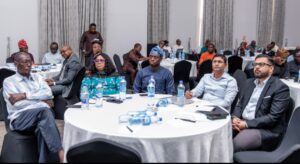
The technical sessions provided participants with an opportunity to scrutinise the proposed training content and make recommendations towards ensuring that the final manuals meet the required occupational, safety, training and certification standards.
The validation exercise is expected to contribute to the development of a structured pool of skilled Nigerian technicians and other automotive professionals capable of safely supporting the country’s transition towards CNG and electric mobility.