Follow Us on Google
Says Nigeria ready for industrialisation
___________________________________________________________________
From Okwe Obi, Abuja
The National Automotive Design and Development Council (NADDC) has reiterated its resolve to ensure that Nigeria scales up locally produced automotives to boost the nation’s economy, as against importation.
NADDC boasted that Nigeria possessed the human capital, entrepreneurial potential, market, environmental conditions, energy infrastructure and transportation needs to be self-sufficient in automotive industrialisation.
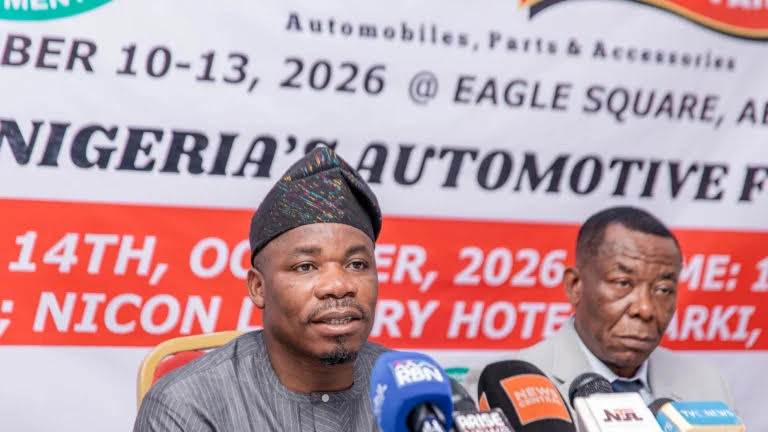
Its Director General, Joseph Osanipin, stated this yesterday at a press briefing ahead of the 26th Abuja International Motor Fair, themed ‘Driving Nigeria’s Automotive Future’, slated for 10 to 13 November 2026.
Osanipin stressed that the country’s automotive future must be built locally and not defined by imported and sometimes rickety vehicles not fit for Nigeria’s roads.
He noted that the automotive industry offers Nigeria opportunities to diversify the economy, conserve foreign exchange, create jobs and strengthen indigenous manufacturing.
He said: “The future of our automotive industry must not be defined solely by the vehicles we import, but increasingly by what we design, manufacture, assemble and develop.”
“A strong automotive industry cannot depend on vehicle assembly alone, hence the need for local suppliers of components, spare parts and accessories.”
The director general also explained that the NADDC’s priorities included local content development, support for assembly and component manufacturing, research, technical capacity building and investment in emerging automotive technologies.
According to him, the council had prepared Nigeria for electric mobility, alternative fuels and battery technology, adding that Compressed Natural Gas (CNG) remained an important opportunity for affordable and efficient mobility.
He pointed out that CNG solutions must be backed by safety standards, technical training, quality assurance and public education.
“Our young people must not remain spectators in the transformation of the global automotive industry.
“They should be equipped as technicians, engineers, innovators, manufacturers and business leaders. Thus, industry players should ensure to explore partnerships, internships and knowledge transfer at the fair.”
He urged manufacturers, assemblers and financial institutions to explore investment in vehicle assembly, component manufacturing, after-sales services and automotive technology.
On his part, Chairman of BKG Exhibitions Limited, Ifeanyichukwu Agwu, said the country’s automotive industry was on the verge of massive industrialisation leading to job creation and national pride.
Agwu said the sector spanned components, skills and services, from steel, rubber and batteries to finance, insurance, logistics and repairs.
He maintained that the fair was positioned as a national automotive marketplace and a platform for policy engagement.
Agwu said: “When a nation builds a strong automobile industry, it does not build only vehicles. It builds industries around industries.”
In his projection, he said the exhibition would assemble manufacturers, assemblers, distributors and other industry players.
“We are gathered because the automobile industry is not simply about vehicles. It is about industrialisation. It is about technology. It is about mobility. It is about jobs.
“It is about national pride. It is about whether Nigeria will remain merely a marketplace for what other nations manufacture or rise to become a major manufacturing and mobility powerhouse in Africa. The automobile is one of the most powerful products in the modern economy.
“Behind every vehicle are thousands of components. Hundreds of specialised skills, an entire chain of enterprise, steel, aluminium, glass, rubber, plastics, leather, batteries, electronics, lubricants, tyres, paints, finance, insurance, logistics, servicing, repairs and technology. Therefore, when a nation builds a strong automobile industry, it does not build only vehicles.
“It builds industries around industries. It creates jobs around jobs. It develops skills and gives birth to more skills.
“This is the future we are calling Nigerians to embrace. The 26th Abuja International Motor Fair, holding from Tuesday, 10 November to Friday, 13 November at the prestigious Eagle Square, Abuja, is being positioned as far more than an exhibition. It is a national automotive marketplace.
“It is a platform for policy engagement. It is a meeting point for manufacturers, assemblers, distributors, component producers, financial institutions, fleet owners, transport operators, government agencies, state governments, investors and millions of present and future vehicle owners,” he added.