Follow Us on Google
By Moses Akaigwe
The National Automotive Design and Development Council (NADDC), last week, in Abuja, organised a national workshop to enlighten and sensitise Nigerians on the safety and benefits of embracing auto gas as an alternative to fossil fuel.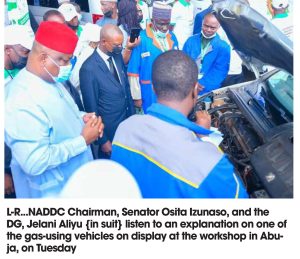
This was n line with the Federal Government’s gas expansion programme.
The gas-powered vehicle awareness campaign with the theme “Safety and Benefits of Using Gas Powered Vehicles,” was part of the auto sector regulatory agency’s current efforts at promoting the transition to cheaper and cleaner means of fuelling vehicles with auto gas.
NADDC is also concurrently driving the process of introducing electric vehicles in recognition of the fact that Nigeria should not be left behind as the automotive industry across the world rapidly gains momentum on strategic transitioning from the use of petroleum or diesel to EVs and gas-powered vehicles.
At the event held on Tuesday, September 28 at the International Conference, Abuja, the agency earned a loud applause when it unveiled the NADDC Auto Gas App to enhance the revolutionary paradigm shift towards a purer energy that would power today’s generation of vehicles.
Speaking at the workshop, the Director General of the NADDC, Mr. Jelani Aliyu,
observed the continuous use of conventional fuels {petroleum and diesel} in vehicles, contributes a global warming and climate change which is detrimental to human health as it pollutes the environment.
He explained that NADDC’s alternative fuel promotion dovetails into the National Gas Expansion Programme (NGEP) launched in December, 2020, by President Muhammadu Buhari. The programme, among other objectives, aims at auto gas utilisation (compressed natural gas CNG; and liquefied natural gas, LPG), taking advantage of the country’s abundant natural gas deposit.
Aliyu further remarked, “Therefore, it is imperative that Nigeria must leverage on these natural gas resources, and transform it to an energy that will drive the automotive wheels of Nigeria.
The global automotive industry is like a horse race that is technically advanced that only countries with adequate utilisation of natural and human resources can fully participate and have a head start in the race.
“Certainly, Nigeria is blessed with great talents and resources, so we cannot afford to be left out, but rather be at the fore-front of the race. Nowadays, with emergence of new automotive technologies, the automotive industry is rapidly gaining momentum on the strategic transition from use of petrol and diesel to electric vehicles (EV) and natural gas-powered vehicles (NGV)…
“Natural Gas Vehicle (NGV) uses auto gas fuel also known as Liquefied Petroleum Gas (LPG) or Compressed Natural Gas (CNG) to power vehicles. CNG and LPG powered vehicles are safe, cost-effective and environmentally friendly which produce about 20 percent less CO2 exhaust emission than petrol and diesel vehicles.
“Studies have shown that gas-powered vehicles are relatively safe to drive, and are equipped with features that automatically shut-off gas supply in the event of an accident. The CNG/LPG cylinder has high impact resistance that prevents accidental exposure. Although there are numerous safety features and benefits of gas powered vehicles, the public is still sceptical about safety of gas-powered vehicles.
“This awareness workshop is, therefore, aimed at allaying such fears and educating the public on the benefits inherent in the use of auto gas in Nigeria.
“NADDC will continue to support the development of gas-powered vehicles in Nigeria through the formulation and implementation of automotive gas policy, skills development through mechatronic trainings, standardisation and monitoring of auto gas conversion centres, research, design and development of Nigerian made gas-powered vehicles.”
Aliyu disclosed that the council has trained over 20,000 technicians in the industry through its
Automechatronics Skills Development Programme in collaboration with accredited training providers nationwide, hinting that some of the providers’ facilities would be certified as conversion/installation centres for auto gas.
The NADDC, he stated, has also concluded plans to develop National Occupational Standards (NOS) for the conversion of fuel-powered cars from petrol to gas in order to ensure that the skills to competently and safely convert vehicles are available in Nigeria.
“The NOS when developed, validated by industry practitioners and approved by the regulatory authority would be used to train auto technicians on the conversion, repair and maintenance of gas powered vehicles. This is the global best practice and Nigeria cannot afford to do otherwise.”
The Automotive Council DG also described the auto gas development project as a means of diversification of the Nigerian economy, saying it would lead to more job opportunities and wealth creation.
In his keynote remarks, the Minister, Federal Ministry of Industry, Trade and Investment (FMITI), Otunba Niyi Adebayo, who was represented by Dr. Adewale, acknowledged that the forum was a great step in a major programme which among other things tackles environmental challenges and provides cheaper fuel for Nigerians.
Bakare, who is the Director, Industrial Development Department, FMITI, stated that the conversion of petrol and diesel powered cars and generators to gas is a vital component of Federal Government’s National Gas Expansion Programme.
“This aligns with the Federal Government’s plan to make gas the first choice for cheaper and cleaner energy. The plan is expected to deliver at least 1 million vehicle conversion by the end of 2021,” Bakare stated.
In his goodwill address, NADDC Board Chairman, Senator Osita Izunaso, who is a solid pillar of strength to the council’s alternative fuel drive, recommended the use of auto gas to the motoring public, assuring that it is one of the obvious ways of reducing the harmful pollutants petrol and diesel vehicles emit into the atmosphere.
Senator Izunaso emphasised that vehicles that are produced or converted to run on auto gas do not pollute the atmosphere with harmful emissions associated with the traditional fuels, and therefore, offer the best alternative.
One of the highpoints of the well attended workshop was the display of vehicles converted from petrol use to gas consumption by an auto gas conversion company, THLD, in conformity with the NADDC’s approved standards.
A wholly Nigerian-owned alternative energy solution’s company with a worldwide connection, THLD Group also specialises in all aspect of logistics solution for bulk liquids and gas transportation.
Other stakeholders that showcased their factory-made gas powered vehicles at the venue included PAN Nigeria, Stallion/Bajaj and Simba/TVS.