Follow Us on Google
By Lukman Olabiyi
As Lagos State continues to position itself as Africa’s foremost economic hub and intensify efforts to unlock the vast tourism potential of Badagry, one critical piece of infrastructure tells a troubling story of neglect: the Mowo-Ikoga Zebbe-Ado Odo road.
For thousands of commuters, traders, farmers and residents who rely on the corridor daily, the road has become less a gateway and more of an obstacle, undermining economic activities and diminishing the appeal of one of Lagos’ most historically significant regions.

Once a vibrant inter-state route linking communities in Badagry, Lagos State, with neighbouring Ado-Odo/Ota, in Ogun State, the road has deteriorated into a hazardous stretch of broken asphalt, deep potholes and flood-prone sections that leave motorists stranded and businesses struggling.
Its worsening condition stands in sharp contrast to the ambitious vision of transforming Badagry into a major tourism destination.
Badagry, home to iconic historical attractions, including Trans-Atlantic Slave Trade relics, heritage museums, beaches and cultural landmarks, remains one of Nigeria’s most important tourism assets. Yet access to many communities and commercial centres around the area is increasingly hampered by a road network residents describe as abandoned.
Every morning, commercial drivers and private motorists embark on journeys marked by uncertainty. Rather than focusing on travel time, many are forced to calculate the potential damage to their vehicles as they navigate the road’s numerous craters and broken sections.
What should ordinarily be a brief journey often turns into a prolonged ordeal as motorists weave through potholes, avoid flooded sections and contend with traffic bottlenecks caused by damaged vehicles.
The situation becomes even more dangerous during the rainy season. Floodwaters routinely cover large portions of the road, concealing deep potholes capable of causing serious accidents and extensive vehicle damage.
For unfamiliar motorists, the route has become a trap of hidden hazards. Residents say the consequences extend far beyond transportation challenges.
According to community members, transportation costs have risen sharply as commercial operators pass repair expenses on to passengers. Farmers struggle to move produce to markets, traders face delays in deliveries, while businesses along the corridor report declining patronage.
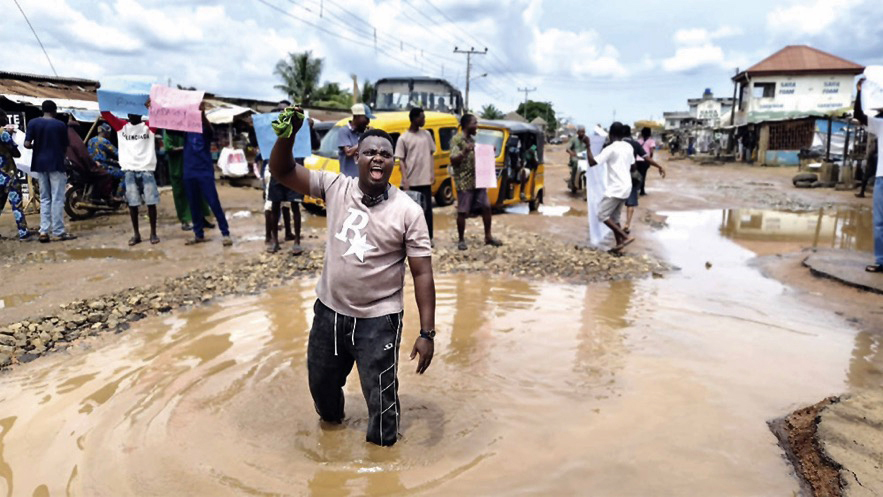
The growing frustration reached a boiling point on June 13, 2026, when scores of youths and residents staged a peaceful protest to draw government’s attention to the deteriorating state of the road.
Led by legal practitioner and social activist, Medemaku Abayomi Noah, the demonstrators described the road as a critical economic artery that has remained in deplorable condition for more than a decade despite repeated appeals to government authorities.
Carrying placards and chanting solidarity songs, the protesters accused successive administrations and elected representatives of failing to provide lasting solutions to a problem that affects thousands of residents daily.
Other News
According to them, repeated appeals to relevant government agencies have yielded little more than promises, while flooding, vehicle breakdowns and road accidents continue to define life along the corridor.
Addressing protesters, Medemaku insisted that the community would continue to demand accountability until reconstruction work begins.
He announced plans for sustained weekly demonstrations and warned that residents may escalate their actions if visible intervention does not commence soon.
Commercial drivers, who bear much of the burden created by the road’s condition, echoed similar frustrations.
Many recalled previous palliative repairs that provided temporary relief but failed to address the underlying structural defects. They noted that residents had hoped for comprehensive reconstruction projects following various election cycles, yet the road remains largely unchanged.
“We have suffered for too long. Every day our vehicles break down, transport fares increase and the hardship continues,” one driver kamenred
Observers say the deteriorating road raises broader questions about infrastructure priorities in a region often promoted as a strategic economic and tourism corridor.
For a state seeking to attract investors, tourists and businesses, infrastructure remains fundamental.
Good roads not only facilitate movement but also enhance commerce, improve safety and stimulate local development.
Badagry’s strategic location as a border town connecting Nigeria to neighbouring West African countries further underscores the importance of efficient transportation networks.
The Mowo–Ikoga corridor serves as a key link between communities, markets and economic activities across Lagos and Ogun states.
Residents argue that rehabilitating the road would do more than improve mobility; it would boost commerce, support agriculture, encourage investment and strengthen Badagry’s attractiveness as a tourism destination.
As the rainy season intensifies and conditions continue to deteriorate, many believe the road has become a symbol of the wider infrastructure challenges confronting communities on the outskirts of Lagos.
For now, motorists continue to navigate its dangerous stretches, traders count mounting losses and residents endure daily frustration.
But beyond the potholes and flooding lies a larger concern: whether a state with aspirations of global competitiveness can afford to leave one of its critical gateways and one of its most promising tourism corridors in such a state of disrepair.
For the people of Mowo, Ikoga, Zebbe and adjoining communities, the demand is no longer for promises or temporary fixes. It is for urgent reconstruction of a road they believe is essential to the economic future of the area and the realization of Badagry’s long-envisioned potential.