Follow Us on Google
From Taiwo Oluwadare, Ibadan
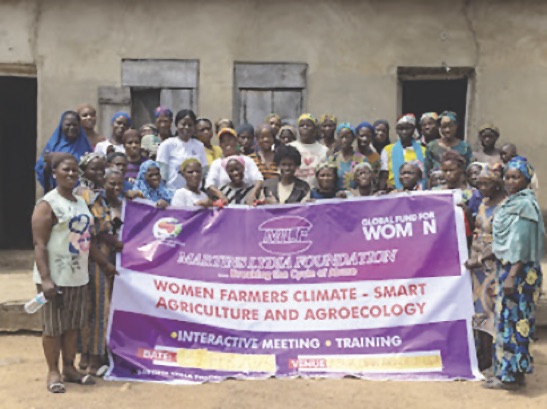
Concerns over the health of rural women farmers and the hidden impact of declining soil fertility on human wellbeing took centre stage in Apapa Odan community, Akinyele Local Government Area of Ibadan, Oyo State over the weekend as the Martins Lydia Foundation (MLF) organised a climate-resilient agriculture and agroecology training for over 100 women.
The training moved beyond conventional farming techniques to highlight a critical but often overlooked connection: the relationship between soil nutrients, food quality and the health of farming families.
Speaking during the session, Professor Olufumilayo Ande of the Nigerian Institute of Soil Science explained that the health of humans is directly tied to the health of the soil. According to her, micronutrient deficiencies in soil can silently translate into nutrient-poor crops, which in turn weaken human immunity and trigger diseases.
She cited a case study of a community where as much as 60 to 70 per cent of residents reportedly suffered from goitre, a condition later traced to iodine deficiency in food crops grown on micronutrient-deficient soils. The discovery, she noted, showed how soil health determines the nutritional value of what people eat.
“When crops lack micronutrients, they may appear healthy and big, but nutritionally they are deficient. When people consume such food over time, their immune systems weaken, creating room for diseases,” she said.
Professor Ande further explained that continuous cultivation without replenishing nutrients leads to chemical infertility of the soil, resulting in poor yields and reduced crop quality. She stressed the importance of biological fertility, maintaining soil microorganisms that break down organic matter into humus as well as proper land management practices such as crop rotation and residue recycling to restore soil nutrients naturally.
For the women farmers, many of whom rely solely on their farms for family sustenance, the message was clear: protecting soil fertility is not only about increasing harvests but about safeguarding their families’ long-term health.
The programme also placed strong emphasis on the physical wellbeing of the women themselves. MLF volunteer, Dr. Omobolanle Adegoke, noted that women contribute between 70 and 75 per cent of Nigeria’s agricultural labour force, making their health central to national food security.
“It is important that women farmers take very good care of themselves because they are the backbone of agricultural production, from the farm to the table,” she said.
Other News
Dr. Adegoke urged the women to monitor their blood pressure regularly, attend antenatal services during pregnancy, and seek medical attention when necessary. She warned that poor health among women farmers could directly affect farm productivity and household food availability.
She also cautioned against unsafe handling of agrochemicals, stressing the need for personal protective equipment such as gloves, boots, nose masks, hats and goggles when applying fertilisers, herbicides and insecticides.
“Long-term exposure to chemicals without protection can predispose farmers to chronic illnesses. They must protect every part of their body while working,” she advised.
Beyond physical safety, the training addressed nutrition and diet. The women were encouraged not to sell all their best farm produce but to reserve part for family consumption to ensure balanced nutrition.
“We are what we eat. A farmer who does not eat well cannot remain productive. If women farmers fall sick due to poor nutrition, food production itself is at risk,” Dr. Adegoke added.
An MLF expert, Oloruntosin Taiwo encouraged participants to join the National Women Agricultural Progressive programme to gain better access to farm inputs and support services that could ease financial pressures and reduce stress.
Participants described the training as eye-opening, particularly the revelation that soil degradation does not only reduce yields but can quietly erode community health through nutrient-deficient food.
To support practical implementation, MLF donated fertilisers and farm gloves to the women, enabling them to adopt safer and more sustainable practices immediately.
Oloruntosin on behalf of the foundation reaffirmed their commitment to promoting sustainable agriculture and improving the wellbeing of rural women farmers, with support from the Global Fund for Women through the Africa Climate Justice Movement.