Follow Us on Google
• Takes toll on residents along Mile 2-Badagry corridor
By Bianca Iboma-Emefu
On a bright Lagos morning, when the city’s rhythms rise with the grind of Danfo buses, echoing conductors’ chants, and the ceaseless hustle of roadside traders, another, far less visible rhythm flows through the metropolis—one of neglect. It announces itself not with sound but with smell.
Along the Mile 2-Badagry expressway, stretching through the buzzing transport hubs of Okokomaiko, Iyana-Iba, and down toward the rail construction zones, the air is thick with a stench that now feels like part of the environment: urine, faeces, and refuse baking under the sun.
For thousands of commuters entering and leaving their envelope daily through these corridors, the welcome is almost always the same—offensive odour, swarm of flies, and the sight of human waste dotting the highway median and nearby motor parks. What should be a symbol of infrastructural renewal, marked by new railway bridges and upgraded routes, has become a canvas for one of Nigeria’s lingering public health crises: open defecation. This is happening in the metropolis, which Governor Babajide Sanwo-Olu is investing billions to turn into a megacity.
The ongoing Lagos–Badagry rail and road expansion was expected to transform the transport landscape, improving mobility for millions and boosting trade across the West African corridor. But along portions of the construction sites, medians, and abandoned spaces, the lack of public sanitation facilities has created opportunities for open defecation to thrive.
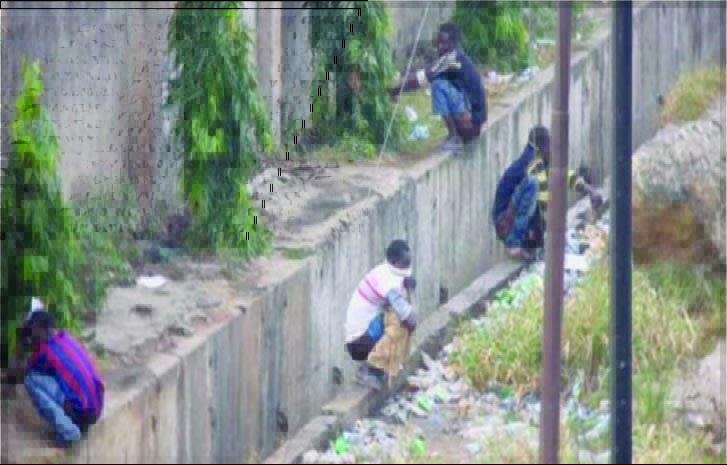
From Mile 2 down to Okokomaiko, the median, meant to serve as a safety barrier and green separation, has literally become a toilet.
“It is very pathetic,” says Taiwo A., a roadside trader at Volks bus stop. “Every morning, you will see fresh faeces on the median. People go there before daybreak. Some even do it in broad daylight because nobody cares.”
The combination of blocked drainage, heaps of refuse dumped beside pedestrian paths, and public urination has turned the area into a foul-smelling corridor where passengers often use handkerchiefs, nose masks, or clothing to shield themselves from the stench.
“You cannot stay at the bus stop for five minutes without perceiving something terrible,” complains commuter Ebuka Nwankwo, who travels from Okokomaiko to Mile 2 daily. “Sometimes, the smell is so strong that your eyes will tear up.” Under the Mile 2 Oke bridge, if you alight from a vehicle, you need to walk faster than your legs can carry you.
While inside the bus plying the route, at various points, you will see persons openly defecating. In the course of writing this report, a lady who boarded the same bus heading to Mile 2, identified herself as Mama Rachael, expressed to the reporter how irritating this act is to her. She said that her neighbour, a young man in his early twenties who indulges in open defecation, often uses the rail construction site as his personal toilet. When she confronted him, his response irritated her even more, as the young lad told her that the experience is “something out of this world,” that he feels free openly defecating on the road, and that enough breeze penetrates his body. He said he enjoys doing it every day. When asked about the health implications, cholera, diarrhoea, the smell, and other risks, he replied in local parlance, “We go dey alright.”
In many Lagos motor parks, poor sanitation is not new. But the situation in the Mile 2–Badagry corridor has taken a troubling turn.
At Mile 2, one of the busiest interchange terminals in the metropolis, commuters jostle for buses amid stalls built with plywood and tarpaulin. Behind these makeshift structures, piles of trash conceal something more alarming—human waste.
“You will see faeces behind the buses,” says Daniel, a bus conductor at Mile 2. “Most of the parks don’t have toilets. Even when they have, the toilets are locked or too dirty. People just go anywhere.”
The scenario repeats itself at Iyana-Iba, a junction serving thousands of students from Lagos State University, market women, truck drivers, and traders. Here, the back of the market fence and areas close to the under-bridge have become informal defecation zones.
These “toilet corners” are known to regulars. They are known too by the flies that dominate food stalls, the same flies that perched on faeces minutes earlier.
“It is dangerous for us selling food here,” says Mama Rilwan, who operates a roadside buka near Iyana-Iba. “Flies will not let your food rest. Sometimes customers complain, but what can we do? Everywhere smells.”
A significant portion of those engaging in open defecation along the corridor are homeless youths, displaced persons, and casual labourers working at the construction sites. With no shelters, toilets, or designated facilities, many sleep under the bridges, inside parked buses, or on bare pavements at night.
For them, defecating behind trucks, near rail tracks, or in bushy corners is a matter of survival, not choice. A young man, S.O., who sleeps around the Mile 2 under-bridge, explains: “Where do you expect us to use? We cannot enter someone’s shop. No public toilet. Police will chase you if you go inside the park at night. We do it anywhere we find.” Private operators sometimes run makeshift toilets but the amount charged (₦50 to ₦100 per use) is a barrier for those with little or no income.
In the words of hygiene advocate Mrs. Yetunde Osho: “Sanitation is a basic human right, not luxury. But for the urban poor, especially in transit corridors like Mile 2 to Okokomaiko, access to clean toilets remains a privilege.”
This problem is not isolated. Across Lagos, especially in large motor parks, open defecation has created a silent crisis. From Oshodi to Mile 2 and down to Iyana-Iba, faeces hide in corners, behind fences, and under bridges. Some spots are so notorious that traders warn newcomers not to step there.
At Oshodi’s notorious “under-bridge,” early morning commuters often step over puddles of urine while hustling for buses. At Mile 2, the stench is most intense at dawn, when the night’s waste reveals itself. At Iyana-Iba, public transport operators have carved out makeshift latrines behind rusting containers.
“Lagos is Nigeria’s commercial centre,” says Amanda Agahowa. “But how can a mega city that prides itself on economic growth still function without basic WASH facilities (Water, Sanitation, and Hygiene) in its transport hubs?” The result is more than inconvenience—it is a public health time bomb.”
Open defecation is not just an eyesore. It spreads diseases—cholera, diarrhoea, typhoid, hepatitis, parasitic infections. During the rainy season, the risks multiply as faeces wash into open drains and water bodies.
Already, Lagos has recorded sporadic outbreaks of cholera and waterborne diseases in recent years. Areas like Ojo, Amuwo-Odofin, and Ajeromi, many of which flank the Badagry expressway, are among the most vulnerable.
“When you mix faeces with poor drainage, stagnant water, and food vendors, you get an epidemic waiting to happen,” warns Agahowa. “Motor parks are hotspots for disease transmission.”
Children, pregnant women, the elderly, and those with compromised immunity are particularly at risk. Commuters, exposed daily to contaminated surfaces and the aerosolized particles of faecal matter, face constant danger. Flies, which feed on both faeces and food, become major carriers of pathogens in these environments.
Nigeria pledged to end open defecation by 2025 under the “Clean Nigeria: Use the Toilet” campaign, launched with much fanfare. But the target has long slipped out of reach, especially in urban centres where population growth overwhelms infrastructure.
Lagos, despite its megacity status, has not implemented a coordinated sanitation strategy for its major transport hubs.
Many motor parks are run by unions or private operators whose priority is revenue, not hygiene. Toilets, where they exist, are often poorly maintained, insufficient, or locked at night. Government-built facilities are few and far between.
Environmental laws exist, but enforcement is weak. The Lagos State Waste Management Authority (LAWMA) and Kick Against Indiscipline (KAI) occasionally conduct raids, but these efforts rarely lead to sustained change.
“Sanitation is not achieved by arresting poor people,” says Agahowa. “It requires infrastructure, maintenance, community involvement, and political will.”
On the question of political will, Joseph Ibezim, a marketing and perception management consultant wants “Governor Sanwo-Olu to display the kind of goal-driven iron will that moved Asiwaju Bola Ahmed Tinubu, who as governor of Lagos State created the Highway Managers, a specialised, well funded agency charged with responsibility for sweeping the major highways in Lagos every morning. Executing the task involved engaging thousands of men and women who assigned to the roads. This move created employment for people who renedered an essential service to the society. I remember that some years there was one entrepreneur, who specialised in producing, providing and managing mobile toilets in several locations. He even extended the service to people who held open parties and such events. This issue of open defecation requires the Lagos State government think out a practical solution that will also create employment for the people who will manage the facilities that will be built cheaply and spread across the target areas. In doing this, the government should borrow leaf from the strategy book of late Lateef Jakande on how his administration was able to build mass low cost housing, which are still subsisting till today.”
Interviews with commuters, traders, and Lagos residents revealed multiple factors driving open defecation in the corridor. They include: lack of public toilets—there are too few functional toilets along the entire Mile 2–Okokomaiko route; affordability—many people cannot afford ₦50–₦100 several times a day; poor maintenance—where toilets exist, they are often filthy, non-operational, or lack water; night-time vulnerability—thousands of people sleep in or around motor parks with no access to sanitation at night; construction displacement—the ongoing rail and road works have removed old facilities and exposed new open spaces used for defecation, and weak enforcement—there are no real deterrents for those who defecate openly.
The Mile 2–Badagry expressway is not just any road. It is the main entry point into Lagos from the West African corridor, a gateway linking Nigeria to Benin, Togo, and Ghana. Yet today, it greets visitors with scenes of filth.
For a city aspiring for have global status, the state of this corridor is an embarrassment. “The smell alone tells visitors that something is wrong,” says a foreign stylist from the Cotonou axis. “It doesn’t represent the Lagos we hear about in our country.”
The median-turned-toilet is perhaps the most visual symbol of this neglect—a metaphor for development that is skin-deep, infrastructure without social planning.
Nigerians say the solution is neither complex nor impossible. The government needs to build accessible public toilets at every major bus stop—Mile 2, Volks, Trade Fair, Alaba, Iyana-Iba, and Okokomaiko. The toilets need to be modern, affordable sanitation centre, which have to be open 24/7.
Furthermore, there is need to enforce sanitation regulations in motor parks. Union leaders must be compelled to maintain hygiene as a condition for operating rights. There is strong need to integrate WASH facilities into ongoing rail and road construction—sanitation should be a mandatory component of all transport infrastructure designs.
In addition, mobile toilets and night-use facilities must be introduced. These will serve commuters, homeless residents, and construction workers. There should be community-led monitoring by local volunteers, youth groups, and market associations, to enforce cleanliness.
Public health campaigns and education must accompany infrastructure. Lagos, a city of over 20 million people, sits at a crossroads. Its ambition to be a world-class megacity clashes daily with the reality on its streets and motor parks.
Open defecation is more than a sanitation failure—it is a public health hazard, a dignity crisis, a reflection of the inequality that defines urban life in Nigeria’s economic powerhouse.
As buses speed along the Mile 2–Badagry corridor and workers lay new tracks for the future railway, one question lingers in the air as strongly as the stench itself: when will Lagos finally confront the crisis that is happening in plain sight, every single day?
Until then, flies, filth, and faeces will continue to welcome passengers into a city too busy to manage its environment.