Follow Us on Google
By Chekwube Nzomiwu
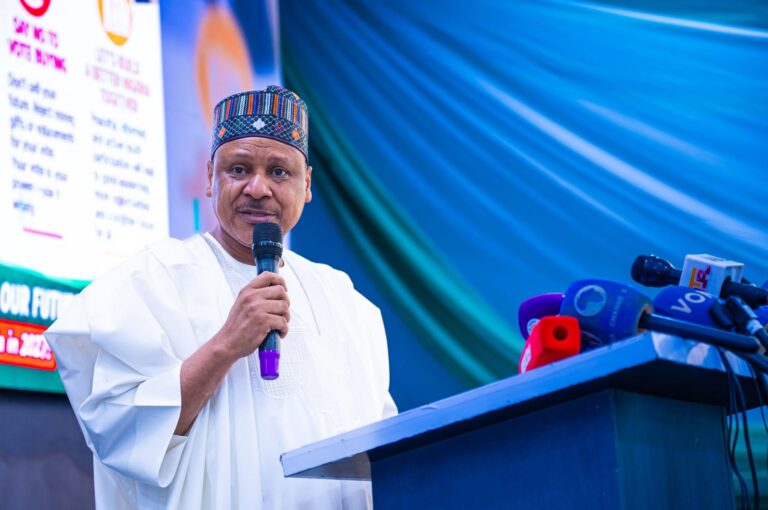
On Thursday, June 18, 2026, Premium Times published a news item under the headline “Stop giving publicity to terrorists, Information Minister urges Nigerian media.” In the report, the Minister of Information and National Orientation, Mohammed Idris, appealed to Nigerian media organisations to stop giving publicity to terrorists and other criminals.
The minister expressed concern that media reports often give prominence to the activities of terrorists, bandits and kidnappers, while paying less attention to the efforts and sacrifices of security personnel working to protect lives and properties. According to him, the excessive coverage of terrorist activities serves the interests of those seeking to spread fear and instability. He appealed to journalists to balance press freedom with national responsibility, in the interest of nation-building.
Quoting him: “Please, take these terrorists and criminals off your front pages. This is what they crave for free of charge.” He spoke at a summit organised by the Nigerian Union of Journalists, in collaboration with the State Security Service, operationally known today as the Department of State Services. Since Idris speaks for the Federal Government, I took it that he spoke the mind of the Tinubu administration.
However, I think that anyone who recognizes the role of the media in national security must be perturbed by certain utterances of the minister. Much as his fears about the media providing oxygen for terrorism are not unfounded, asking media organizations not to report the activities of terrorists or treat such as “unimportant” would obviously cause more harm than good.
The media have the constitutional duty to uphold the fundamental objectives and directive principles of state policy and accountability of the government to the people, as explicitly enshrined in Chapter II of the 1999 Constitution of Nigeria (as amended). Part of these objectives is the security and welfare of the people.
Hence, in the interest of national security, it is expected of the media to report the activities of terrorists in the country, as long as the reports do not glamourise or celebrate them. Telling media organisations not to give prominence to the activities of terrorists is akin to telling them to downplay the outbreak of a killer pandemic or epidemic. I thought that Malam Idris, being a player in the media industry, ought to know as much.
Nigeria is not the only country in the world facing security challenges. Even the highly advanced countries of the world are facing one form of security challenge or the other. The United States of America has witnessed high incidence of mass shootings. I have seen the CNN many times run live coverage of incidents of mass shooting. At times, the coverage of a mass shooting takes a whole day or more.
Newspapers in the United States routinely report mass shootings, although it must be reported in a way to prevent copycat attacks. I have not seen the spokesman of the American government tell newspapers how and where to report a mass shooting. Nigeria’s case should not be different.
I do not understand what the information minister meant by excessive coverage of terrorists’ activities. It is well known globally that terror attacks have assumed epidemic proportions in Nigeria. The excessive reportage of terrorists’ attacks in the country by our media reflects the very high incidence of occurrence across the country.
The media do not give these terrorists attacks prominence because they occur anywhere. These attacks occur frequently in places that ordinarily are regarded as safe or sacred, such as schools, churches and mosques. Their victims include women and children.
The terrorists attack government institutions. The media cannot ignore or downplay the bloody attack by these merchants of death on the Nigerian Institute of Policy and Strategic Studies (NIPSS), the main national policy think tank, located in Kuru, Plateau State. Three policemen on duty were killed during the attack.
The death of former spokesman of the Nigerian Army, Major General Rabe Abubakar, in the captivity of the terrorists cannot be denied prominence in the Nigerian media. Many officers and men of the Nigerian military have lost their lives while fighting terrorists in different operational theatres across the country. All these people died trying to defend the country from enemies within. The media cannot treat their death as inconsequential.
Other News
Much as I agree with the information minister that journalists should be socially responsible in the interest of nation-building, the government should also be responsible enough to perform their constitutionally duty of ensuring the security and welfare of the people. The media should not be made a scapegoat for the failure of the government in this regard.
If the government is sincerely concerned about the excessive coverage of terrorism activities by the media, it should muster the political will to tackle the scourge. The wherewithal to tackle terrorism in Nigeria is there, both human and material. What is lacking is the political will.
Nigerians deserve adequate information on events happening around them. There should not be an information blockade simply because coverage of terrorism activities serves the interests of those seeking to spread fear and instability.
This could be counterproductive.
Only the Information Minister can explain how he came to the conclusion that terrorists are craving for their stories to be on the front pages of newspapers. I know that these terrorist find the social media “easily accessible” for the celebration of their “monstrous” activities. I have seen viral videos recorded by these criminal elements while attacking military formations. I have equally seen viral videos of terrorists, displaying the millions of Naira ransom money they collected for the release of their hostages.
The job of the media is not only to inform, educate and entertain. In line with its surveillance role, the media function as the “eyes and ears” of the society, constantly monitoring the environment to gather, process and disseminate information. The media keep the public abreast of daily events.
The appeal by the Information Minister to the media to stop giving publicity to terrorists is therefore misplaced. With the prevalence of terrorists’ activities in Nigeria, the concern should not be the prominence that the media gave the attacks or the frequency of reportage. What should bother the government perhaps is how the reports are framed. The media should report terrorism as long as they do not celebrate or sensationalise it.
I disagree with Malam Idris that the media paid less attention to the efforts and sacrifices of security personnel working to protect lives and property. The government providing N3000 ration daily for a soldier fighting in the theatre should be held culpable in this regard, and not the media.
The media reported recently that the Federal Government has raised N500 billion emergency security fund from the Federation Account Allocation Committee revenue for May 2026 to fund a national emergency intervention. I expect that with the half a trillion Naira set aside for funding of security, the daily ration of our frontline soldiers will increase from N3000 to at least N20,000 daily.
In conclusion, let me remind the Honourable Minister of Information of two key promises he made to Nigerians on assumption of office, which I highlighted in an article in This Day newspapers three years ago, titled “Agenda for the Information Minister.” One, he promised to give Nigerians true information about various government programmes and projects of the administration in all sectors, and a Ministry of Information and National Orientation, open, transparent and accountable to Nigerians . So far, I think he has largely fulfilled that promise.
In addition to information dissemination, he announced that national orientation would form the core of his ministry’s mandate. Sincerely, this is where I find his Ministry wanting. Even the few flashes seen in the National Orientation Agency (NOA) under his supervision have since fizzled out. National orientation is a crucial non-kinetic approach to ending insecurity, although it cannot succeed alone. It must be paired with kinetic actions like equipped security operations, economic development and robust laws.
• Dr. Nzomiwu MNIPR, a commentator on national and international issues, writes via [email protected]