Follow Us on Google
By Juliana Taiwo‑Obalonye
They told us children are the leaders of tomorrow. This May, Nigeria let them lead.
At a high‑level dialogue in Abuja, a 14‑year‑old girl described how her classmate was taken from school early in the morning, forced into marriage, and never returned to the classroom.
“She was 13,” she said, voice trembling. “She used to sit in front of me. Now she is a mother, and her dream is gone.”
The room fell silent. Then Minister Imaan Sulaiman‑Ibrahim leaned forward and said: “When a girl is subjected to child marriage or violence, the nation loses productivity, potential, and long‑term economic value. In this new Nigeria, the voices of both our girls and our boys must not only be heard, they must influence outcomes.”
That was the opening note of a month declared by the Ministry of Women Affairs and Social Development as devoted to families, children, women and the care sector. Across five anchor events, the theme, “Future Now: Promoting Inclusion for Every Nigerian Child” became a practical agenda — from policy blueprints to laptops in children’s hands, from a boy‑child policy to a caregiving sector that will finally be recognised as work.
Child marriage: interrupted destinies, national cost
The week kicked off on May 16 with the High‑Level Inter‑Generational Dialogue themed: “Her Voice, Her Power,” where the Federal Government unveiled policies to end child marriage, gender‑based violence (GBV) and female genital mutilation (FGM). Sulaiman‑Ibrahim cited distressing figures: about 30 percent of Nigerian women aged 15 to 49 have experienced physical or sexual violence, and one in three girls is married before 18 – a rate that approaches 48 percent in some rural areas.
“These statistics are not merely numbers; they represent interrupted destinies, diminished opportunities, and a collective call to action,” she said. The government announced the National Costed Action Plan on Ending Violence Against Children, the National Costed Action Plan on Ending Child Marriage, the Strategy for Ending FGM, and an upcoming Menstrual Health and Hygiene Policy. It is accelerating the domestication of the Child Rights Act across all 36 states and intensifying enforcement of the Violence Against Persons (Prohibition) Act.
UNICEF’s Wafaa Saeed urged communities to back children’s ambitions: “When you give girls education, you set them up for progress. Their voices are not small. It is our collective responsibility to ensure ‘Her Voice, Her Power’.”
The ministry also launched: “FutureNow,” a national podcast to give girls and boys a public platform to shape policy debates, and announced an expansion of the World Bank’s AGILE project to reach more than 8.6 million girls across 18 states.
The boy child: no longer left behind
On May 17, at the Ministry’s Family Picnic commemorating the International Day of Families 2026 and the International Day of the Boy Child at Harrow Park, Abuja, the minister announced a new policy focus on boys. “All you hear about is women and girls. We’ve left our boys behind – not anymore,” she said, unveiling a boy‑child policy. “Our boys are very dear to our heart… Continue to be good boys, protecting girls, good ambassadors of Nigeria. Continue to dream big, because there’s a lot of opportunities on the land.”
Andre Murphy Daniels, prefect of Kadokuchi Junior Secondary School, spoke on behalf of the children: “I really appreciate all you have been doing for the families in Nigeria. You are the only Minister of Women Affairs whose name has been banging everywhere.”
The minister described 2026 as the “Year of Families and Social Development” and proposed an annual family day to strengthen parental bonding. “If we secure the home, we secure the future of Nigeria,” she said.
Insecurity: when children are kidnapped, dreams are stolen
Insecurity is the shadow that falls across classrooms. At the National Children’s Day celebration at Eagle Square, Jessica Nufi, a student of Government Secondary School, Garki, put it plainly: “Insecurity is making children feel unsafe at school and at home… Make education free, accessible and quality for every child, regardless of background or location. Protect us from insecurity and violence so we can learn and grow in peace.”
She spoke of children kidnapped on their way to school, of communities where parents now walk their children to class with fear in their eyes. Jessica said: “Pressure, cultism, and drugs are also impacting children negatively, making them feel unsafe at school and at home. We are calling on the government to act.”
She pledged on behalf of Nigerian children: “We will obey our parents and teachers. We will study hard and pursue excellence. We will obey the law of our country, shun drugs and all vices. We promise to be responsible leaders tomorrow.”
Major General Adamu Laka (retd), delivering a goodwill message on behalf of the National Counter‑Terrorism Centre (NCTC), at the National Children’s Day at the State House Conference linked inclusion to peacebuilding. “Promoting inclusion is not only a moral responsibility but also a strategic investment in peacebuilding, national cohesion, and the prevention of violent extremism, terrorism, and other forms of insecurity,” he said. “Children affected by conflict, displacement, poverty, and social exclusion are particularly vulnerable.”
He pledged policies and programmes that promote rehabilitation, reintegration, psychosocial care and inclusive development for affected children.
Science innovations: children solving Nigeria’s problems
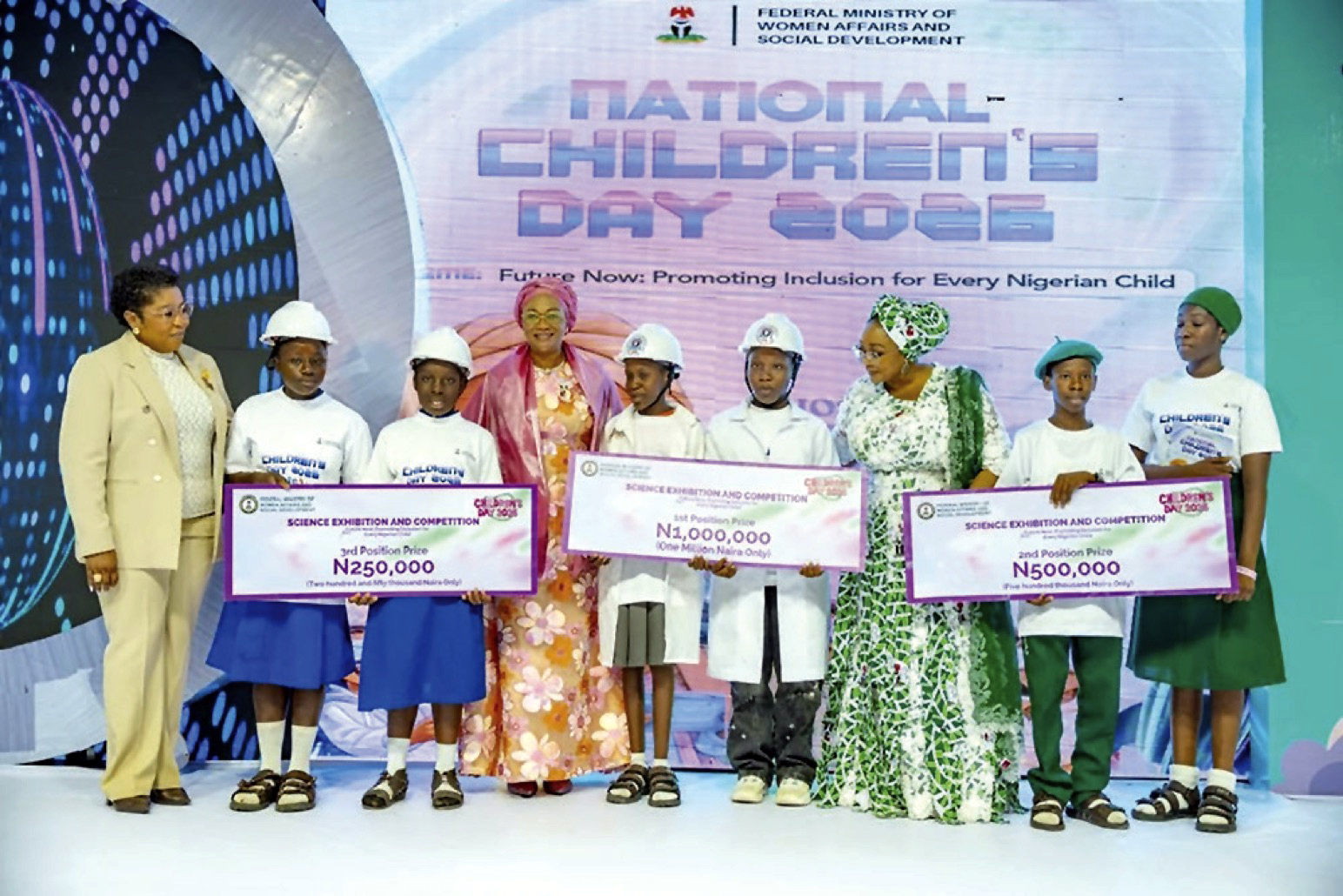
On May 19, at “The Future is Now” event — the Annual Children’s Day party hosted by First Lady Oluremi Tinubu and the National Science Exhibition/Competition among Secondary Schools in the FCT at the State House Conference Hall, Abuja — children turned innovation into solutions. First Lady Tinubu and Minister Sulaiman‑Ibrahim presented cash prizes and laptops: top winners received N1 million, second place N500,000, third place N250,000. Laptops and tablets were distributed to children to support learning and digital skills.
First prize went to Junior Secondary School Phase 3, Gwagwalada — Hassan Peace and Uyammadu Anita — for the “Ultra‑modern seed planting and chemical spraying machine.”
Other News
Anita said: “We invented the ultramodern seed planting and chemical spraying machine. The machine helps to dig, select seed, plant seed, cover the soil and also spray chemicals all at the same time.”
Peace Hassan explained the mechanics: “So, the machine can be operated both manually and automatically. Now for the automatic process, it’s actually powered by a solar panel. The solar panel collects light energy from the sun and stores it in the battery. For the manual operation, while the farmer pushes, the wheels rotate, causing the jars and chains to rotate, which has an effect on the seed selector.”
He added that the rotating mechanism also drives the pumping unit to spray fertiliser and crop chemicals.
When asked what inspired the invention, Anita said: “The problems faced by farmers include heat stroke, back pain and even direct contact with hazardous chemicals. We decided to come up with an innovation that not only solves this problem but also generates income for young people like us.”
On commercialisation: “Yes we already do. So we have farmers lease it and they pay per hectare. We generate income from sales, service, and data analysis.” The inventors are thirteen.
Second prize winners from Government Science Secondary School Maitama — Ikechukwu Chidambaram and Isioma Divine — presented a Manual Flood Detector and Warning Alarm and a Solar‑Powered Pump. Ikechukwu explained: “For the one I made, which is the flood detection and warning system, it works with two scientific principles, which is electrical conductivity and the floating sensor system… immediately the water level rises and passes that water saturation area, it sends and completes the circuit sending an alarm. Applicable because it can help communities in flood‑prone areas.”
Isioma Divine Chukwuyem described her pump: “My project has been converted from Solar energy to electrical energy, chemical energy and finally mechanical energy. My project helps in places like aquaculture, agriculture, household and if the governor can actually hear me and make reservoirs in places like Borno, Nasarawa and Niger, places that have poor energy and clean water supply.” She said the prototype could be improved with more funding to increase accuracy and reliability.
Third place went to LEA Phase III Primary School, Gwagwalada — Favour Thomas and Victory Ogbonnaya — for a Solar Panel Chemical Spraying Machine.
At the same ceremony, a young beneficiary from GSS Gwarimpa Estate expressed heartfelt gratitude after receiving his very first laptop from the First Lady. He said: “This laptop is hope, it is learning, it is growth, it is endless possibilities. My dream is to learn AI and technology skills. When children are supported, inspired, and equipped, they can become anything they aspire to be. Through initiatives like this, lives are being impacted and futures are being shaped.”
Caregiving: the quiet pillar made visible
At the National Caregivers Summit, themed: “Inclusive, Value‑Based Parenting and Education,” held at the Dr. Maryam Babangida National Centre for Women Development, Minister Sulaiman‑Ibrahim argued that caregiving must be treated as essential social infrastructure.
She said: “Today, we gather not merely for dialogue, but to address one of the most fundamental pillars of nation‑building: the Care Economy and the social infrastructure that sustains human dignity.
“Today, we are formally recognising caregiving not as an invisible domestic obligation, but as a vital professional sector deserving of structure, standards, investment, and dignity.”
She linked the agenda to President Tinubu’s Renewed Hope Agenda and the declaration of 2026 as the “Year of Families and Social Development.” She said: “No nation can attain sustainable prosperity when a significant segment of its productive population is constrained by invisible and unsupported care responsibilities.”
Blessing Adesiyan, founder of Caring Africa, supplied the economic case: “Care is not welfare policy. We’re not here to discuss charity. What we are looking for is an investment in care.” She warned that women globally perform five times more unpaid care work than men and that formalising the care workforce could create up to 17 million jobs in Nigeria.
Beatrice Eyong, UN Women Country Representative to Nigeria and ECOWAS, commended the initiative: “It is a wonderful thing that women and children are under one ministry. What the minister is doing by bringing the conversation around the care economy to the table is highly commendable.”
Inclusion in motion: from Eagle Square to the carnival
On May 25, the rally and march past in collaboration with the FCT Administration brought thousands of children to Eagle Square. At the National Children’s Day celebration, President Tinubu’s message, delivered by Minister Sulaiman‑Ibrahim, set the moral tone. He said: “A nation that listens to its children is one that is wisely preparing for the future. We are committed to building a governance culture where children are not merely seen, but genuinely heard and meaningfully included.“Your opinion matters, your ideas matter, your well‑being matters.”
The President anchored the message on the 2026 theme, “Future Now: Promoting Inclusion for Every Nigerian Child,” and linked it to social investment under the Renewed Hope Agenda — Nutrition 774, RH‑SII 774, ANRiN 2.0 and NELFUND. He said: “Inclusion, therefore, must become the moral foundation of our national development. No Nigerian child should ever feel invisible, unheard, excluded, or forgotten.”
Oluremi Tinubu urged inclusion as the centrepiece of development. “Today is not only a celebration of our children, but also a reminder of our shared responsibility to build a nation where every child is valued, protected, educated, and given the opportunity to thrive.”
She said: “Every Nigerian child deserves access to quality education, healthcare, protection, digital skills, and a safe environment where they can reach their full potential.”
“Wherever you see the Nigerian flag, know that it says, Nigeria believes in you, and Nigeria expects you to make her proud,” she told the children.
Sulaiman‑Ibrahim pledged a policy overhaul at the ceremony. “This reality places a profound obligation on the State to deliberately invest in their survival, protection, education, participation, and development,” she said, unveiling RH‑SII 774 as “a unified National delivery framework for women and child wellbeing.” She committed to reviewing the Child Rights Act, the National Child Policy and the Child Adoption Policy to align with global standards and digital realities. “We are moving from reactive protection to proactive empowerment,” she said.
Wafaa Abdulatef of UNICEF said: “Let us listen to children. Not only during this Children’s Day, but also every day.” Mathew Verghis, Country Director of the World Bank, said: “The story of Nigeria’s future … will be determined and that happens in the earliest years of life.”
The Annual Children’s Carnival at Monoliza Amusement Park, Area 11, Garki, Abuja, wrapped with joy, culture and civic messaging. Throughout the events, the minister urged children to reject negative influences. “To our dear children, this is your moment. Stay focused, embrace learning, uphold strong values, and reject violence, drugs, abuse, and every negative influence. Nigeria believes in you,” Sulaiman‑Ibrahim said.
From promise to proof
The week’s calendar of events turned the Ministry’s declaration into a sequence of actions — from the High‑Level Inter‑Generational Dialogue unveiling policies to end child marriage and GBV, to the Boy Child Policy announcement, the First Lady’s “Future is Now” prizegiving and science exhibition, the Rally and March Past, and the National Children’s Day celebration and Carnival. The promise was clear: inclusion must be measurable, funded and enforced.
As Jessica Nufi puts it: “Create an environment free from drugs, cultism and environmental hazards so you can hand over to us a Nigeria we can be proud of.” The country has pledged a May of Promise; now it must deliver a lifetime of proof.