Follow Us on Google
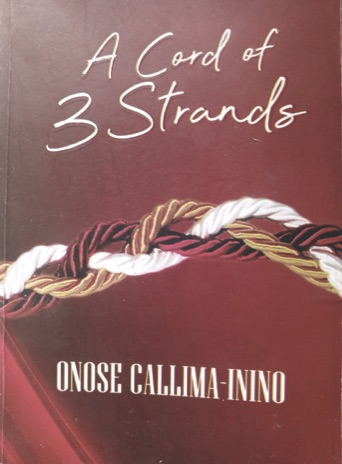
Onose Callima-Inino, A Cord of Three Strands, Starlight Print Media, 2025
Onose Callima Inino’s A Cord of Three Strands is a tender, emotionally layered exploration of marriage under pressure, told through the intimate story of Pere and Ibufuro, a couple whose once-promising love is tested by infertility, cultural expectations and the unrelenting weight of family influence.
Drawing its title from the Biblical proverb that suggests strength in unity, the novel interrogates what happens when one strand begins to fray and whether love, faith, and patience can still hold a marriage together.
At its heart, the novel examines barrenness not merely as a medical condition, but as a social and emotional burden that seeps into every corner of a woman’s life. Pere and Ibufuro begin well, deeply in love, hopeful, and united by shared dreams forged during their university days at the University of Port Harcourt.
Their early relationship, recalled through deft shifts between past and present, is filled with warmth and promise. These flashbacks serve an important narrative function: they remind both the reader and the characters of what once was, making the present conflict even more poignant.As the years pass without a child, however, love is gradually eclipsed by suspicion, fear, and resentment. Ibufuro becomes convinced that her mother-in-law is actively instigating Pere to take another wife. This belief, whether fully justified or not, becomes the seed of constant conflict in the marriage.
Inino handles this tension with restraint and realism; the novel does not rely on dramatic villainy but instead exposes how subtle indifference, silence, and cultural entitlement can be just as destructive as outright cruelty. Pere’s mother is portrayed as emotionally distant and largely unconcerned with Ibufuro’s pain.
Her fixation on lineage and grandchildren reflects a wider societal attitude in which a woman’s value in marriage is tied almost exclusively to her ability to bear children.
As Pere’s only son, the pressure on him is amplified, placing him at the center of a generational tug-of-war between loyalty to his wife and obedience to his mother. Inino does not demonize Pere outright; rather, she presents him as a man struggling to assert his love in a system that constantly undermines it.
Pere repeatedly reassures Ibufuro of his commitment, but his words fail to penetrate the wall of fear she has built around herself.
This emotional disconnect is one of the novel’s most compelling elements.It highlights how communication can falter when trust is eroded and how love, when not actively protected, can begin to feel inadequate.
Ibufuro interprets Pere’s actions through the lens of her insecurity, convinced that his loyalty is wavering, even when he insists otherwise.
One of the novel’s strengths lies in its portrayal of Ibufuro’s support system. In contrast to her cold relationship with her mother-in-law, she is surrounded by warmth, empathy, and fierce loyalty from her own mother and siblings. They share her pain, grieve with her, and provide a safe emotional refuge. Yet, interestingly, they also challenge her. While they acknowledge her suffering, they encourage her to fight for her marriage rather than abandon it.
This tension, between validating pain and advocating perseverance, adds depth to the family dynamic and prevents the support system from becoming one-dimensional. Ibufuro’s determination to pursue divorce, despite counsel from both families and professionals, reveals the psychological toll of prolonged emotional distress. Her desire to leave is not born out of spite, but exhaustion. Inino captures this with sensitivity, illustrating how unresolved pain can harden into hopelessness.
Marriage counselling is introduced as a potential bridge between Pere and Ibufuro, signaling the author’s belief in dialogue and professional intervention. However, the counselling process also exposes how deeply entrenched beliefs and unspoken resentments can resist easy solutions.
Faith emerges as a quiet but persistent theme throughout the novel.The title itself gestures toward a spiritual framework in which marriage is sustained not just by two people, but by a divine presence. Yet Inino avoids preachiness. Faith is presented as something fragile, sometimes sustaining, sometimes questioned, especially in the face of unanswered prayers and deferred hopes.
The struggle with barrenness forces characters to confront the limits of belief and the painful silence that can follow fervent devotion.
Sex, or more precisely the absence and strain of it, is handled with honesty and maturity. The novel acknowledges how infertility can transform intimacy from a source of pleasure and connection into a reminder of failure and frustration. This shift further alienates Pere and Ibufuro from each other, underscoring how physical closeness is deeply intertwined with emotional security in marriage.
Inino also engages contemporary realities through discussions of IVF and assisted reproductive options. These moments ground the novel in modern Nigerian society, where traditional expectations increasingly intersect with medical possibilities. The emotional, financial, and moral implications of such choices are subtly woven into the narrative, adding another layer to the couple’s dilemma.
Structurally, the movement between past and present is effective, though at times emotionally heavy. The contrast reinforces the sense of loss that permeates the story: loss of innocence, ease, and uncomplicated love. Inino’s prose is accessible and heartfelt, prioritizing emotional truth over stylistic excess. The characters feel real, flawed, and familiar, particularly to readers who understand the cultural context in which marriage is rarely just between two people.
A Cord of Three Strands is ultimately a reflective and courageous novel about love under siege. It does not offer easy answers or idealized resolutions. Instead, it asks difficult questions about endurance, self-worth, and the true meaning of commitment.
Onose Callima Inino has written a story that resonates beyond its central couple, speaking to countless women and men navigating the silent grief of unmet expectations. It is a novel that lingers, urging readers to reconsider how empathy, faith, and community can either fracture or fortify the most intimate of bonds.