Follow Us on Google
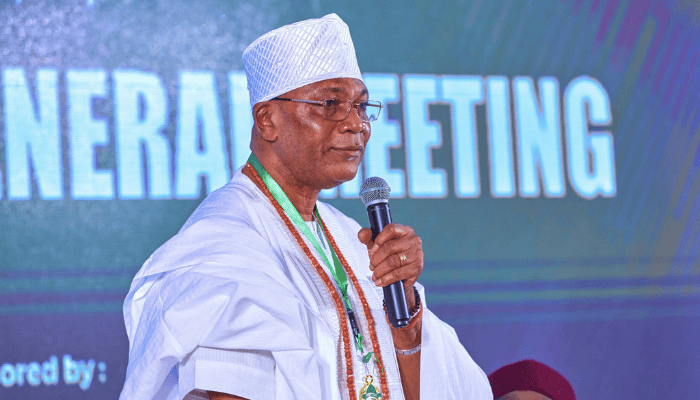
The Manufacturers Association of Nigeria (MAN) has identified implementation gaps, policy inconsistency and weak coordination as major factors limiting the impact of Nigeria’s industrial policy frameworks.
President of MAN, Francis Meshioye, stated this yesterday at a press briefing ahead of the association’s 54th Annual General Meeting (AGM), scheduled for October 5 to 7, 2026, at the Lagos Oriental Hotel, Victoria Island, Lagos.
The AGM, themed “Leveraging National Industrial Policy to Position Nigeria as Africa’s Industrial Hub,” will bring together manufacturers, government officials, policymakers, development partners and other stakeholders to examine how the National Industrial Policy can translate into measurable industrial outcomes.
According to Meshioye, the Nigeria Industrial Policy 2025, formally launched by the Federal Government in February 2026, provides a roadmap for strengthening the country’s industrial base, deepening domestic value chains and placing production, competitiveness and job creation at the centre of economic development.
He said the policy also seeks stronger coordination across critical enablers of industrialisation, including energy, infrastructure, finance, skills, trade and innovation.
Meshioye, however, stressed that the success of the policy would ultimately depend on effective implementation.
“This is particularly significant because Nigeria has had industrial development frameworks in the past, but implementation gaps, policy inconsistency and weak coordination have often limited their impact.
“The challenge before us, therefore, is how to ensure that the new framework translates into measurable improvements in industrial performance,” he said.
He noted that MAN actively participated in the stakeholder consultations leading to the policy, providing perspectives and practical experiences from the manufacturing sector.
While welcoming the policy’s renewed emphasis on industrialisation and indigenous entrepreneurship, he said implementation must remain the defining priority.
He said its focus on value-chain development, strategic industrial sectors, infrastructure and energy alignment, skills, technology and MSME integration provides an important framework for strengthening domestic production.
“For manufacturers, implementation must be reflected in factories operating more competitively, stronger local supply chains, increased investment, improved productivity, sustainable jobs and greater access to domestic and export markets,” he said.
Meshioye said Nigeria possesses a large market, abundant resources, entrepreneurial capacity and significant human capital, but must harness these advantages through coherent industrial policies and disciplined implementation.
He added that sustainable industrial growth could not depend on the resilience of manufacturers alone, but also on the quality of institutions, consistency of public policy, availability of critical infrastructure and effective collaboration between government and the private sector.
The MAN president said manufacturers continued to contend with high production and energy costs, limited access to affordable finance, infrastructure deficits, inflationary pressures and exchange-rate challenges.
Other News
He added that global economic developments and geopolitical tensions had further underscored the need for Nigeria to strengthen domestic productive capacity and reduce vulnerabilities associated with excessive dependence on external supply chains.
“Against this background, our advocacy has continued to emphasise macroeconomic stability, improved infrastructure, affordable long-term financing, a stable foreign exchange environment and a predictable regulatory framework,” he said.
On taxation, Meshioye noted that MAN had continued to work with its partners in the Organised Private Sector of Nigeria to engage government on the implementation of the country’s evolving tax framework.
“We support measures that improve tax administration and strengthen fiscal sustainability, but such reforms must also promote investment, productive enterprise and the competitiveness of Nigerian businesses,” he said.
He disclosed that the AGM would also feature the sixth Adeola Odutola Lecture, with Dr. Kandeh Kolleh Yumkella, former director general of the United Nations Industrial Development Organization (UNIDO), as distinguished guest speaker.
Meshioye said Yumkella’s experience in industrial and international development would bring valuable perspectives to discussions on how Nigeria could translate industrial policy into productive capacity, competitiveness and sustainable economic development.
He said the three-day programme had been structured around the promotion of Made-in-Nigeria products, high-level policy engagement, accountability to members and practical discussions on the future of manufacturing.
The first day will feature the opening of the Made in Nigeria Exhibition (MiNE 2026), which will run throughout the three-day event and showcase the quality, innovation and capabilities of Nigerian manufacturers.
The second day will feature the Public Session, Adeola Odutola Lecture and Presidential Luncheon, while the third day will be devoted to the 54th AGM Private Session for MAN members.
Members will also participate in a value-added session titled “Bridging Industrial Skill Gaps with Smart and Additive Manufacturing: A Manufacturing Imperative,” which will examine emerging technologies and the skills required to improve productivity, efficiency and competitiveness.
Meshioye said the programme was designed as a platform for advancing conversations critical to the future of Nigerian manufacturing.
“As manufacturers, we remain convinced that Nigeria cannot sustainably consume its way to prosperity. We must produce, add value, innovate and compete,” he said.
He reaffirmed MAN’s commitment to advocating an enabling environment for manufacturers while working with government and other stakeholders to ensure that industrial policy delivers tangible outcomes for businesses and the Nigerian economy.
Also speaking, MAN Director-General, Segun Ajayi-Kadir, said the outlook for Nigerian manufacturing remained promising, stressing that effective implementation of the National Industrial Policy should translate into more competitive factories, stronger local supply chains, increased investment, improved productivity, sustainable jobs and greater access to domestic and export markets.