Follow Us on Google
With Okorie Uguru
Ancient Arochukwu in Abia State, Nigeria is a kingdom slowly relinquishing the past. It is a town caught between relics of the past and the steady creeping of the present. Arochukwu is a kingdom with an illustrious, but equally legendary past. It is the kingdom of ancient traders who embraced and conquered their fear in search of wealth; it is equally the kingdom of the fearsome deity, the mere mention of whose name in the olden days left many numb with fear. It is the kingdom of the ‘Arochukwu Long Juju’ called Ibini Ukpabi. The shrine is still in existence up till the present.
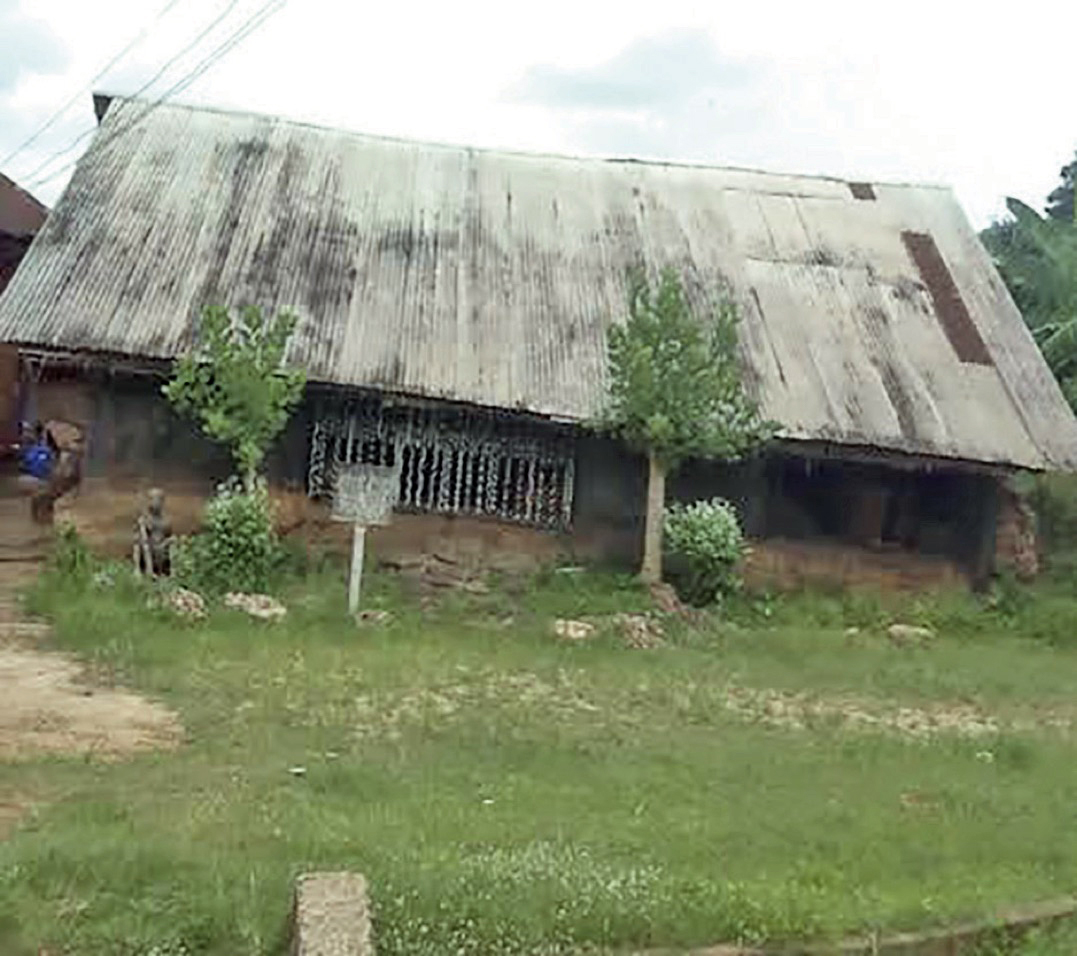
However, the tour was not about the ancient Long Juju, rather about the ancient valiant slave traders of Arochukwu. No relics tell a better story about the wealth of these traders than the relics at the Maazi Okoroji Oti House in the Ujari area, called Okoroji House. The house is currently under the protection of the National Commission for Museums and Monuments (NCMM).
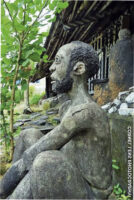
Okoroji House is one of the richest heritage sites in the country. It has valuable artefacts from the Trans-Atlantic slave trade era. The house was probably built in the 17th century by Maazi Okoroji Oti, a local slave merchant, who was active during the Trans-Atlantic slave trade. Built with mud, and covered with an aluminum zinc roof, entering the house, the interior has different sacred shrine objects. There were other historical artefacts like slave chains, brass manillas, swords and guns.
It was like a throwback to Okonkwo’s era in Chinua Achebe’s Things Fall Apart. There are processes for visitors. A chalk-like ball is presented to the tourists to touch and rub as a sign of welcome by the curator of the house.
For tourist visitors, a kolanut was brought. After the initial passing around, the kolanut was broken into pieces. Carefully, the keeper of the house looked at the pieces of kola and nodded his head. “The pieces are okay,” he said.
He took one, threw it into his mouth and passed the rest to the other family members around. He then took the bottle of local gin in front of him, brought out a small glass cup, took a tot and started praying that the visit to the place would be for good and not for bad.
After that, he took the glass cup outside and poured it at the threshold of the ancient house. He came, helped himself to another tot which he gulped. He grimaced as he drank.
He cleared his throat and passed the drink to other family members who had come to join him. The others took turn to measure the local gin in the glass cup and gulped. It was after this that the discussion on the Okoroji heritage site began.
The Maazi Okoroji House in Ujara, Arochukwu is one of the preserved heritage sites in Abia State. The place is of great importance and a treasure throve that could yield volumes of information on the history of Ndigbo and the Trans-Atlantic slave trade.
The Okoroji House is located at the heart of Arochukwu where most of the activities at the height of the town’s prowess in the 17th, 18th and early 19th centuries took place.
A few metres from the house is the place where the house of the Scottish missionary, Mary Slessor, used to be. It is equally not far from the river through which she entered Arochukwu at the beginning of the 20th century when the British punitive expedition had been completed and it was the time for the Christian missionaries to move in.
The first fruit of the Christian missionaries’ activities is the Presbyterian Church, Obinkita. The site was said to be an evil forest where corpses of twins and others whose deaths were considered a taboo were dumped.
To many, the import of this monument site is not the story of the exploit of Okoroji, a very successful and powerful merchant in those days, but it is the ancient artefacts at the site that give vivid information about life about 300 years ago. It encapsulates history of over 300 years, most especially in the early days of contacts and trade between local merchants and the white slave traders from Europe.
The legendary Okoroji of Arochukwu was said to be stubborn as a youth. At a stage, he decided to run away from his father’s house to his maternal family. After much pleading, he later returned to become one of the wealthiest and most powerful merchants in Arochukwu.
He sent out his agents and apprentices on trading missions to different parts of Igboland and even further. He engaged in slave trading with merchants from Europe. He became so wealthy and famous that people were bringing their children to him. Some used their children as collateral to borrow money.
The children would remain and work for him as apprentices or slaves. Such individuals, after carrying out his own findings, would decide whether to use them as his domestic slaves or sell them.
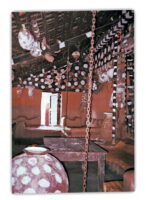
The Okoroji House proper is one heritage site that has rich artefacts. At the outer section of the house, there are some old pots, bundles of wooden sticks, chains, handcuffs and so on.
The seats were built from clay. They were built in such a way that they face each other. On the left of the door, leading to the inner chambers, is also a clay seat with a metal chain that hangs from the roof to the floor.
According to the curator, that was where Okoroji used to sit to hold court. He sent out different signals: by the way he would draw the chain; his acolytes would know what to do once he did that.
On the right hand side of the house door is another chain with cuffs obviously used to hold prisoners. Farther on the left, by the wall, is what looks like a shrine.
There is also an old human skull, with a crack on one side of the skull. This shows how the person died. Up on the ceiling, there is a carved wooden image of a leopard. There are also old calabashes and skulls of wild animals held together in a bunch and hung on the wall. There are about three wooden drums, a broom and many other items.
On the left of the house, there are a bunch of sticks of the same length tied together. According to the curator, this was used by Okoroji to keep track of his debtors and who and when they were supposed to pay. There is a huge metal pot said to have been used for cooking for the slaves.
There is a huge wooden door painted black and white. According to the curator, the wooden door was taken as war loot from the King of Orumba in the current Anambra State.
The curator said: “Okoroji had two other brothers, Otti Orji and another person. Okoroji was the last born child of his mother. Otti was a trader and migrated to Orumba to trade. He settled at the place. The people waged a war against him and he sent a message to his younger brother, Okoroji.
“Okoroji sent his men to Orumba to fight for his brother. As a sign that they actually conquered the people, Okoroji’s soldiers came back with the door of the king’s palace. Our people settled there and became indigenes of the place. But up till now, they still have their roots here.
He also explained other items. “Those animals’ horns and jugs were used for drinking palm wine. These are plates used for eating. If you go inside, you will see so many things. If you go inside the chamber, you will see so many other things.
“The skulls of animals you see there were those of games killed by Okoroji’s slaves and brought to him. Usually, when they killed big games, as a sign of respect and homage, they would bring the head to their master, Okoroji.”
The artefacts at the outer chamber are a child’s play compared to the ones inside, but one would have to look beyond the shrine that is very close to the door.
On the shrine are very old swords with an elaborately designed handle, a gun and so many other items. Behind the shrine are ancient bush lamps and many other items. These were likely some of the items Okoroji gathered in the course of his trading with the merchant ships.
The inner chamber is like a store where ancient artefacts, both local and European, are kept.
The Okoroji House has both tourist and scholarly value. Fortunately, the road to Arochukwu has become better, making it easier for many tourists to visit the site.
Arochukwu is blessed to have a cluster of rich tourism sites: the Okoroji House, the Ibini Ukpabi shrine, old Presbyterian churches that are more than 100 years old and the Mary Slessor route that leads across the water. For tourists, the kingdom is packed full of touristic options.