Follow Us on Google
• We’ll go after those making things difficult at Lekki Port, authorities vow
By Simeon Mpamugoh
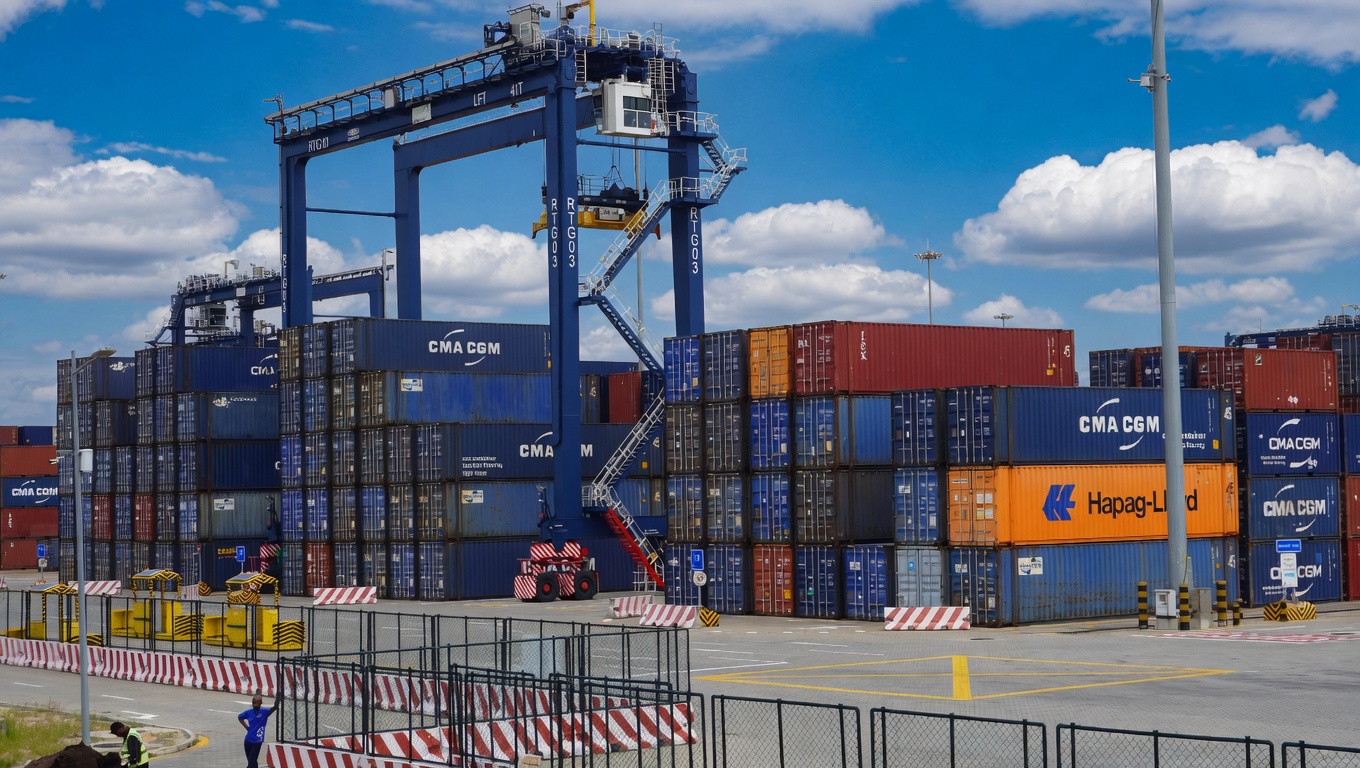
Designed to handle over 1.2 million 20-foot equivalent units (TEUs) annually, the Lekki Deep Seaport stands as Nigeria’s first fully deep-sea port and one of the largest in West Africa.
Conceived as a strategic maritime hub, the port was expected to decongest older facilities, enhance trade efficiency, and strengthen Nigeria’s competitiveness in global logistics.
The Minister of Marine and Blue Economy, Adegboyega Oyetola, had projected that the port could generate about $200 billion (N276 trillion) in government revenue over its 45-year concession period. Beyond revenue, it was also envisioned as a trans-shipment centre serving West Africa and facilitating global trade.

Tucked within the Lekki Free Zone in Lagos, the port initially won the admiration of freight forwarders for its modern infrastructure, transparency, and relative speed in cargo clearance. But recent developments suggest that the port’s early promise is being undermined by administrative bottlenecks and alleged sharp practices within certain departments—particularly the quarantine unit.
At the centre of complaints is one man popularly referred to as ‘Alagba,’ who claimed to be a principal staff Officer ((PSO) of the quarantine department at the port.
Freight forwarders alleged that he has institutionalised the collection of unofficial fees before granting clearance for containers to exit the port.
However, during a visit, the reporter observed interactions between the official and freight agents. During one exchange, an agent pleading for a reduction in charges was threatened that failure to comply would attract higher fees at the Ikeja, South West office of the Nigeria Agricultural Quarantine Service (NAQS) —up to N70,000 per container—compared to N15,000 per wedge at Lekki Port. The PSO allegedly insisted payment must be made before documents could be processed
A concern group of agents noted that: “These charges are imposed on wooden wedges (also called chocks) used to stabilise cargo inside containers. The wedges prevent goods—especially drums containing fluids—from shifting during transit,” they stated. “Globally, such materials are regarded as accessories or protective packaging, not taxable cargo items.”
They argued that attaching quarantine fees to these wedges—initially N5,000 and later increased to N15,000 per wedge in 2025—contravenes international shipping practices. The increase, they claim, was unilateral and enforced with threats of delayed clearance.
They claimed that officials sometimes withheld documentation to trigger demurrage or overtime vehicle charges, compelling compliance with unofficial payments. This, they say, undermines Nigeria’s ease-of-doing-business policy and discourages investment.
One of the freight forwarders who gave his name as Etikwe disclosed that his company, which handles over 60 containers at a time, could incur charges rising from N6 million to N18 million due to the revised wedge fees. He claimed he paid over N3 million in December 2025 to prevent delays affecting more than 20 containers.
Importers however argued that such arbitrary levies ultimately inflate the cost of goods in local markets. “The additional clearance expenses are passed on to clients, who in turn adjust retail prices. For raw materials, this means higher production costs and increased prices for finished goods,” they stated.
Reacting to the controversial issue of quarantine fees on wedges, the National President of the Council of Maritime Transport Unions and Associations (COMTUA), Prince Adeyinka Aroyewun said: “Our association has shown concern on this kind of development at the port. Our members had complained about similar unofficial payment. It’s not only on wedges but there are also other illegitimate payments. This is unacceptable. The collection is not stated anywhere, and there is no legislation about it. It’s not official. It’s extortion. We feel strongly that the government agency in charge should look into it.
“This is only happening in Lekki Deep Seaport. We don’t see that happening in Tincan Port. And if this is allowed to continue unchecked, other commands will like to follow suit on the collection of those illegal charges. So, COMTUA strongly condemns in clear terms any forms of extortion ranging from illegal union dues to call up, queuing system charges or quarantine and customs. It affects our operations. The moment a truck is delayed because of one thing or another, it affects the entire maritime, and a loss of revenue to our members,” Areyowun said.
Other News
Also reacting, Chairman, Steering Committee of the Logistics Practitioners Association of Nigeria (LPAN), Comrade Godwin Ikeji, attributed the persistent bottlenecks in Nigeria’s port sector to entrenched corruption across various segments of the economy.
He described the arbitrary charges within the port industry as “corruption on a catwalk,” questioning the effectiveness of reforms such as the ETO truck call-up system. “After years of ETO implementation, how do we still explain congestion and extortion at the ports,” he queried.
A stalwart of the Road Transport Employers Association of Nigeria (RTEAN), Ikeji also questioned the legality of multiple access charges imposed on port users. “Can anyone cite a single law authorising or demanding payment for access into the port outside of the Access to Lagos Traffic (ATL) or official port pass,” he asked.
He expressed concern that despite the concessioning of Nigerian ports, inefficiencies and bottlenecks persist, allegedly sustained by agencies seeking to remain relevant. “The bottlenecks and sharp practices within the port corridor are rooted in corruption that has not been addressed. Everything revolves around extortion and maladministration,” he said.
Ikeji also cast doubts on the effectiveness of government interventions, particularly the ETO/Truck Transit Park (TTP) system, noting that port entry and exit processes remain cumbersome. “Even with the ETO/TTP system, accessing and exiting the port is still a major challenge. Corruption tendencies remain deeply embedded in the system,” he added.
He further alleged that unregulated tariffs and non-gazetted charges are imposed on operators, worsening the situation for transporters.
According to him, “even containers that have been duly cleared and documented are sometimes intercepted by the Federal Operations Unit (FOU), leading to severe losses for transporters.”
In such cases, he stated, vehicles were impounded and drivers detained. And the transporters were not as financially strong as freight forwarders.
He added: “The situation highlights a recurring challenge in Nigeria’s port operations: the disconnect between policy intentions and operational realities. While the Lekki Deep Seaport was designed as a symbol of efficiency and reform, alleged internal practices threaten to erode confidence in its management, and if left unchecked, such bottlenecks risk discouraging importers, diverting cargo to neighbouring countries, and weakening Nigeria’s ambition to become a regional logistics hub.
“For a port projected to generate substantial long-term revenue and enhance national competitiveness, ensuring transparency, accountability and strict oversight of officials is not optional—it is imperative,” he added.
When contacted on phone, the Officer In Charge (O/C) of Media, Nigeria Agricultural Quarantine Service, (NAQS), Federal Capital Territory, and Deputy Superintendent of Quarantine (DSQ), Rahmatu Usman in a response sent through an official WhatsApp number said: “With reference to the initial complaint raised to our agency, we wish to inform you that the matter has now been escalated for further review.”
The NAQS’ Communication Officer, who later spoke to this reporter on phone, disclosed that the agency “does not have any Principal Staff Officer (PSO) by name “Alagba” in its books.
“Even the so-called senior officer, who gave his name as Adebayo is not known to the agency..”
She added that though there was no government agency where there were no good and bad people, “for us at the NAQS, we don’t entertain such behaviour. The good thing is that the bad people know that there is always someone watching. So, we are not going to sit back and allow our integrity as an agency to be lost to a polluted officer. This is the more reason we don’t shield or condone officers who cannot be decent in their operation.”
Usman promised to follow up on the officers alleged to be behind the unethical practices ‘because we do not shield crime especially, my principal and the Director General who don’t condone officers who embarrass the agency. This is an assurance I’m giving the public and stakeholders in the industry.”
When told that the officer at the centre of the allegation was not in uniform and has no nametag, she replied: “This is already an offence to the officer concerned. We also preach against someone in uniform but no nametag.
“There are people we don’t allow entry and exit at certain points, especially those polluted officers working in such places. Most of the time, we check them out of the place. We put our best officers forward, especially in delicate places. Not somebody who will embarrass the agency and present it negatively. Anyone who is mindful of his job will behave decently.
“If we shield bad people in our midst, it means we are encouraging such kind of people. We do not shield them. On this particular claim, I’ll escalate it to other zonal commands. We are not going to take it lightly, and we are not going to sleep on it until we take the persons involved down,” she assured.