Follow Us on Google
•In Waru community, 800 students, principal share 4 classrooms
From Okwe Obi, Abuja

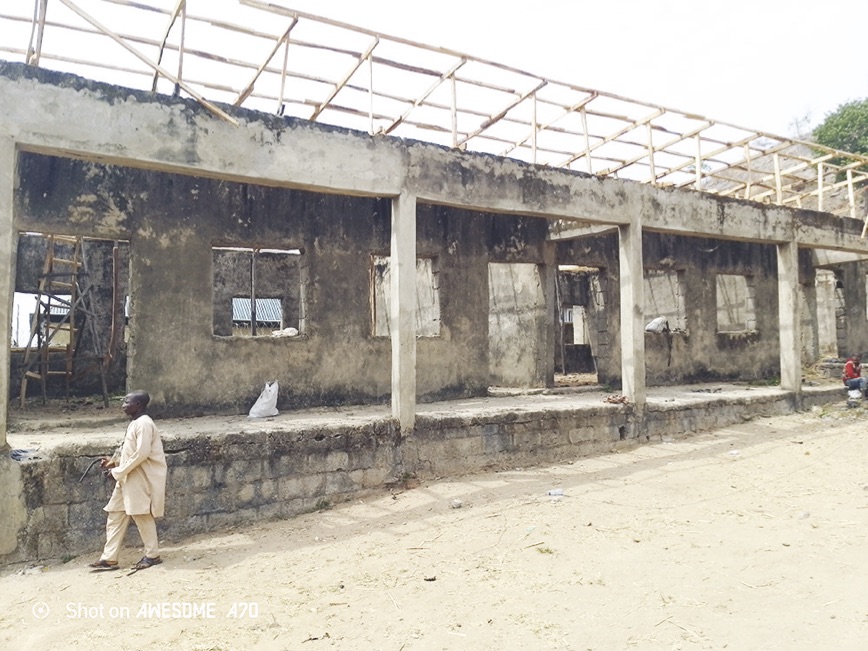
• Abandoned block of classrooms
Waru is a densely populated community in Apo District of the Federal Capital Territory FCT (Abuja). Dirt, dust, bad roads, poverty, epileptic power supply and stinking drainage are permanent fixtures of the area.
Most of the inhabitants are believed to be Internally Displaced Persons (IDPs) from the North East states of Borno, Adamawa and Yobe.
The people are prone to banditry and kidnapping because the suburb is surrounded by mountains and thick forest, with skeletal services of the police, Nigerian Security and Civil Defence Corps (NSCDC) and the armed forces.

•Ramat
Early child marriage and childbearing are on the increase without recourse to the economy and the health implications. To say the least, most of them are at the mercy of philanthropists.
For these people, quality education remains a pipe dream. The only primary and secondary schools serve eight villages —Zhida, Shafe, Yimitu, Gugugu, Wasa, Borum, Takushara and Waru itself.
If not for the signpost signalling an institution, one would likely take the place for a camp meant for IDPs, or a village square or an abandoned facility that is in need of repair.
The roofs and ceilings are blown off. There is no library or laboratory for science practicals. No light. No water. The only source of water, a borehole that was built by a nongovernmental organisation, has been pillaged. The toilet is a mess because of the scarcity of water. The students defecate in the open.

•Students sitting on desks
Some who cannot bear it, excrete and urinate behind the one block of 4 classrooms, unhindered as it has become a norm.
The classrooms are choked with desks. Walking on top of the desks or scaling the windows are the means students can get in or get in.
In fact, the principal shares a classroom with over 50 students. The rest of the teachers sit on the corridor.
A building that should have served as an alternative classroom, has not been completed since 2019.
While lamenting the psycological and emotional torture they go through, the Vice Principal, Administration, Etamesor Ramat, said: “This environment is dominated by Gbagyi but most of the settlers are Internally Displaced Persons (IDPs) from Borno. They give birth to plenty children. Most of them have 11 children in the family
“When I was registering them, I will be hearing Goma. When I asked, they said Goma means the third child. They are so many.
“We have four classes and the children are over 800. Last session, we ran shifts. JSS 2 come in the afternoon. JSS 1 and 3 are coming in the morning. We have been complaining and government said the minister has released money to renovate schools and to build more classrooms.
“Luckily for us, our school was captured. So, they said they are coming to build eight classrooms upstairs. Where we are sitting is supposed to be the principal’s office. The three of us are sitting in a small office.
“The principal and the are in one place. My teachers are sitting on the corridor.
“The building you are seeing was abandoned since 2019. The PTA is trying to cover it so that they will separate the students.”
A teacher, who opted to be anonymous, said: “We are understaffed. Because of the lack of space, most teachers do not come to school. We are only managing the situation. If it rains, we get drenched. If it is windy, the dusts stink into our eyes.”
Despite the infrastructural challenges in the community, a nongovernmental Organisation, the Sexual Offences, Awareness and Response Initiative (SOAR Initiative), took a campaign against early forced early marriage to the school and neighbouring communities like Chafuyi and Pigba-Kasa.
SOAR project officer, Levi Yakubu, said initiative was to stamp out the social vices, counsel victims of sexual harassment and train them on how to produce reusable sanitary pads sequel to the current economic hardship.
Yakubu, said the project, which is targeted at empowering about 240 vulnerable girls aged 10 to 16 years, was funded by Mundo Cooparenti, for 9 months.
According to him, SOAR Initiative also set up a community child protection committee, to fish out victims, and report them to the relevant authorities, adding that the aforementioned social vices, if allowed to fester, would steal the joy, careers and fulfillment of young girls.
He said: “This project is funded by Mundo Cooperanti to build the capacity of adolescent girls about child sexual abuse, early forced child marriage in schools and communities.
“Basically, we are implementing this project in two communities; Chafuyi and Pigba-Kasa.
“The school that are serving these communities are JSS Kabusa, L.E.A Pigba Kasa and JSS, Waru because the girls from the communities are attending those schools.
“So, we said for those who are not opportune to hear it in the community, they will hear it in school.
“We have built their capacity in a project called girls empower to arise. It is a mentoring session to help them understand their rights and resist sexual abuse, early forced child marriage in their schools and communities.
“A lot of things have been happening in schools and communities. In fact, they do not even see it as violence.
“But with this sensitisation and capacity we have built in 12 sections with different topics on self assertiveness, self confidence, child marriage, sexual and gender-based violence and child sexual abuse, there will be significant changes.
“So, today is their graduation. We are here to distribute t-shirts, cooked food and so on.
“In all of these, the girls were able to speak up against sexual violence. We were able to identify those that have been violated and provided counseling for them.
“In Sexual Offences, Awareness and Response Initiative, we build the capacity of children in communities and schools.
“We respond, we prevent and link them to service providers like hospitals and NAPTIP, so that they can get justice.
“In communities, we established what is called community child protection committee.
“You know that a project has a lifespan, so we established the committee to address child sexual abuse because if we are not there, the violence will continue.
“The members of the committee will report such cases to the relevant authorities for action.
“So far, the community child protection committee has been working. They go to churches, mosques and schools in their communities to sensitise people about sexual and gender-based violence.
“Also, we are in Waru to celebrate those that participated in the training and have graduated.
“Another thing we are doing is to train them on how to make reusable sanitary pads because we understand that it is now an issue because of the hardship.
“It is very difficult for most parents to buy sanitary pads for them. We hired a consultant to teach them on how they can make it locally with materials within their reach.”
A student, Faith Waziri, said the training energised her to be proud of her being and to protect herself against sexual abuse.
“I am proud of myself. Before now, I was dull and scared. But with the knowledge gained from the training, I am now bold and confident. Nobody can intimidate me again. My yes is my yes. And my no is my no,” she said