Follow Us on Google
By Christopher Oji
Traders at the Lagos International Trade Fair Complex have called on the Federal Government to look into the issue of multiple roadblocks and taxation on containers and goods coming into the market, by conventional security agencies and other bodies. The traders equally called for stronger collaboration with the Federal Government.
The appeals were made during a visit by the Minister of Industry, Trade and Investment to the market.
The visit brought together traders, business leaders and government officials in a meeting that highlighted the economic importance of the complex and the challenges faced by operators within the facility.
A founding leader of the market and Chairman, Board of Trustees, Mr. Okey Ezibe, said local investors had been among the biggest contributors to the country’s economy since 1998, stressing that they had demonstrated strong confidence in Nigeria by investing heavily in the trade fair complex.
He noted that although the traders largely operate within the informal sector, they were gradually transitioning towards formalisation after studying global best practices in international trade markets.
According to him, the traders transformed the once dilapidated complex into a thriving commercial hub serving not only Nigeria but also the entire West African sub region. He said the area was previously run down with little or no infrastructure until traders invested massively to rebuild and develop it into what he described as ‘an enviable masterpiece’ that now attracts thousands of traders and customers daily.
“I can remember when we first came here many years ago. It was swampy, but with the help of God and other inventors who invested massively, it became a great transition,” Ezeibe said
He explained that despite the investments, the traders are with various operational challenges and insufficient government support.
According to him, traders frequently face multiple regulatory checkpoints and excessive taxation while moving goods from the ports and border posts.
“From the port to this place, there are several checkpoints targeting our goods. From the borders, we face more than 20 checkpoints,” he said.
He explained that the situation increases the cost of doing business and ultimately affects consumers through higher prices. Stakeholders also called for the harmonization of taxes and levies imposed by different government agencies.
“Can’t we streamline the taxes and payments so that we pay once and operate without harassment?” he asked.
Infrastructure deficits also featured prominently during the meeting, ranging from poor road networks to limited electricity supply and inadequate public utilities within the complex.
Ezeibe said traders pay substantial ground rent and other charges to the government’s agencies but have not seen corresponding improvements in infrastructure.
“We pay billions of Naira in ground rent and other charges to the Federal Government, yet we have not seen basic infrastructure like street lights or transformers, and we get disturbances from both the state and local government,” he stated.
He urged the government to partner with traders to rehabilitate key access roads leading to the complex, noting that hundreds of trucks and trailers move through the corridor daily.
“If the roads are improved, more businesses will come here and trade will grow even more,” he added.
He raised concerns about the demolition of some structures within the complex, which he said caused heavy financial losses to the affected traders.
“Some people have still not recovered from that demolition,” the representative said, calling for compensation or support measures.
Also, speaking at the meeting, the executive chairman of Trade Fair Management Board, Erelu Vera Safiya Ndanusa, urged traders to support the government’s policies aimed at strengthening the economy. She expressed optimism that the FG would deliver on its promises, noting that improved infrastructure and policy support would further position the complex as a major commercial and export hub for Nigeria and the wider West African region.
Other News
“I have been in charge as the executive director. The market space has been amazing; with maximum corporation with support of the Federal government this market remains at the top in West Africa,” Ndanusa explained.
However, Mrs. Oduwole acknowledged the concerns raised and commended the traders for their role in driving economic activity within the complex.
She noted that although many operators belong to the informal sector, the scale of the businesses reflects their importance to Nigeria’s economy.”
The minister, who was visibly overwhelmed with the developments recorded by the traders in the market after taking a tour of the entire area, said: “Your informality does not mean you are small. You are moving billions of Naira internationally and we recognise that. That is why I have come here to personally tour the whole complex, see the area of concern and what the complex lacked so that I can explain what I have seen to Mr. President,” she said.
She stressed that the government was committed to supporting domestic investors as part of its broader economic strategy.
“Before attracting foreign investment, we must treat our domestic investors well and support them. Also, the level of investment and trade observed in the complex clearly contributes to Nigeria’s Gross Domestic Product (GDP)
I assure traders that the government recognises their role in driving economic growth.”
The minister assured stakeholders that the FG would work with them to address regulatory challenges, tax harmonisation and infrastructure development.
She announced that Nigeria was preparing to host a major intra-African trade fair in 2027 as part of efforts to strengthen its position as a regional trade hub.
She also welcomed proposals for regular consultations between the government officials and business leaders, suggesting quarterly meetings to track progress.
“We will meet regularly and agree on what we will achieve every quarter. We will hold ourselves accountable and deliver tangible results, if not immediately,” she said.
According to market leaders, Lagos International Trade Fair Complex has long served as a major platform for exhibitions, trade fairs and commercial exchanges involving businesses from across Nigeria and the wider West African sub-region.
They said that revitalising the facility would be key to expanding Nigeria’s trade capacity as the country positions itself to benefit from the African Continental Free Trade Area.
For many traders present at the meeting, the minister’s visit signalled what the minister tagged, ‘renewed hope agenda,’ and it would be a new phase of cooperation between the government and the private sector operators at the complex.
“This is the beginning of building trust,” the minister said. “We may not always agree, but we will work together step by step to improve this corridor.”
The meeting ended with calls from stakeholders for sustained dialogue and practical reforms aimed at unlocking the full potential of one of West Africa’s busiest trading centres.
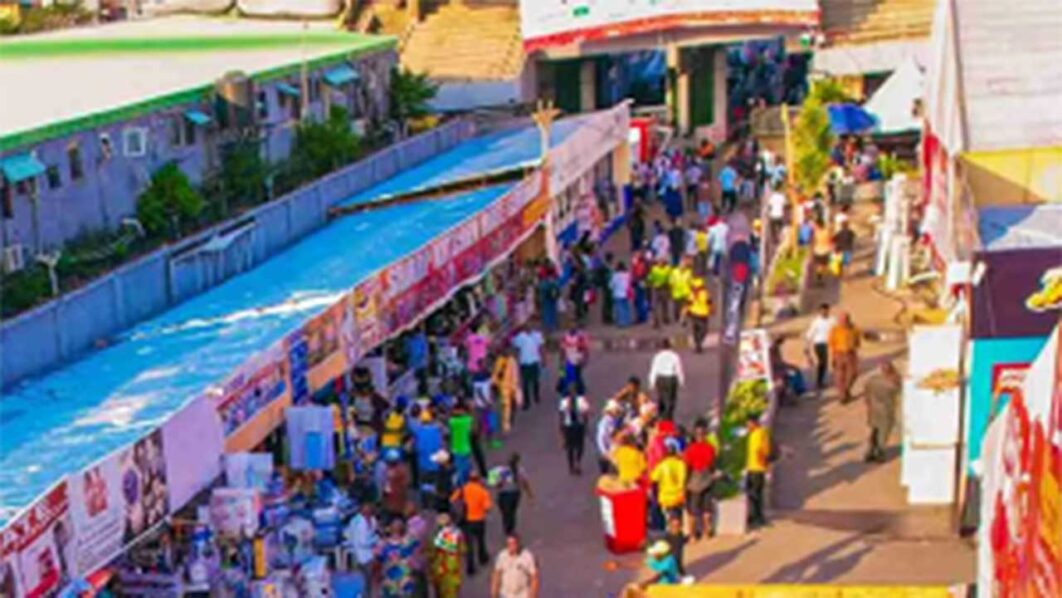
The market leaders explained that, “the Lagos International Trade Fair Complex is one of Nigeria’s most important commercial hubs and a key centre for wholesale trade in West Africa. Located along the Lagos–Badagry Expressway in Lagos, the complex gradually evolved into a major permanent marketplace.
“The project is managed by the Nigerian International Trade Fair Complex Management Board and designed as a purpose-built exhibition ground with pavilions, halls and open spaces for trade fairs.
“The complex occupies roughly 32 hectares of land and includes exhibition halls, warehouses, administrative buildings and large open trading spaces.
Traders from across Nigeria began acquiring plazas and warehouses in the facility over time and it attracted merchants from neighbouring countries such as Republic of Benin, Ghana, Togo and Niger Republic.